
24/7 Customer Support

Free returns

Same-day & Next-day Delivery

Quality Guaranteed

Unlock Your Welcome Offers: FREE Delivery | Up to 80% OFF | Free 30-day JoyPlus trial
Download the APP
Choosing between stainless steel cookware sets, ceramic-coated pans and non-stick frying pans can be harder than it appears. Product listings often emphasise coating technology or impressive-sounding material descriptions while leaving out details that affect daily use: hob compatibility, pan dimensions, handle design, cleaning requirements and oven temperature limits.
Three common buying traps deserve particular attention:
304 stainless steel pans are commonly selected for their resistance to rust and corrosion. The material alone, however, does not determine how evenly a pan cooks. Look for a bonded or encapsulated aluminium core, multi-layer base or tri-ply construction.
An aluminium core can help transfer heat through the base and, in some designs, the sidewalls. This is useful for frying, sautéing and reducing sauces, where hot spots may otherwise cause uneven browning.
Uncoated stainless steel is also different from a ceramic-coated cookware set. Ceramic coatings may offer easier release when new, but they need careful use: metal utensils, abrasive cleaners and sudden temperature changes can damage the surface.
A family cookware set should include sizes that match your usual portions rather than simply offering the highest number of pieces. A 20cm frying pan can suit one or two portions, while a 26cm to 30cm stainless steel frying pan set gives more room for vegetables, meat or larger family meals.
For sauce, pasta and soups, check pot capacity as well as diameter. A 5-litre stock or soup pot may be more useful to a family than several small saucepans. Glass lids, steamer inserts and internal measurement marks can also improve everyday convenience.
For an induction cookware set, the base must respond to magnetic induction. If you have changed from gas or electric to induction, confirm that every included item—not only the largest pan—is suitable.
“All-hob compatible pans” should specify suitability for induction, gas, electric and ceramic hobs. For oven cooking, check the maximum stated temperature and whether the handles and lids can remain attached. A stainless steel pan with a metal handle may be more suitable for oven finishing than one with heat-sensitive components.
Dishwasher-safe cookware can reduce cleaning time, but hand washing is often recommended for ceramic coatings and polished stainless steel if you want to limit staining or preserve the finish.
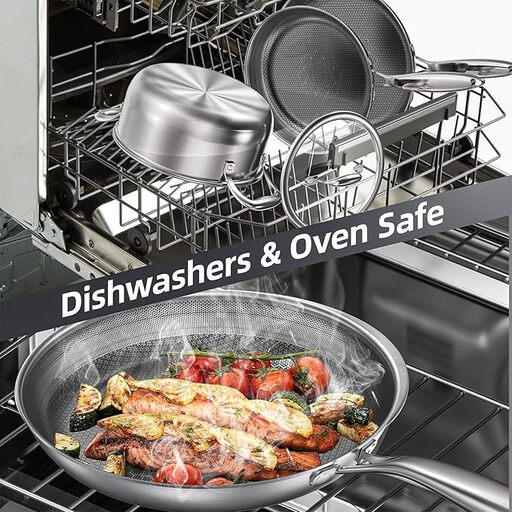
Why This Fits Their Persona: Three frying pan sizes—8, 10 and 12 inches—give new cooks practical flexibility for breakfasts, individual portions and family meals.
The set lists induction, oven and dishwasher compatibility, helping shoppers compare practical features rather than relying only on coating claims.
Three stated pan sizes; stay-cool handles; compatible with all hobs according to the product listing.
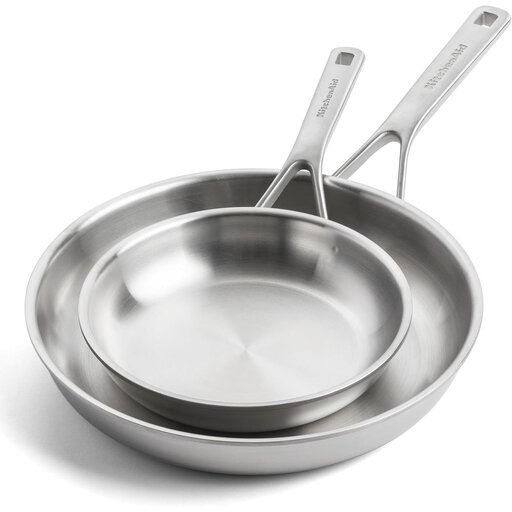
Why This Fits Their Persona: The 20cm and 28cm sizes suit cooks who want uncoated stainless steel for precise frying, searing and sauce reduction.
Its uncoated interior avoids the need to monitor a non-stick layer, while the specification clearly identifies the pan sizes and construction.
MultiPly stainless steel with an encapsulated aluminium core; curved pouring rims; internal measurement marks; induction and oven suitability.

Why This Fits Their Persona: This combination of pots covers boiling, soups, steaming and larger family meals, including a 5-litre soup pot.
The set specifies capacities, included steamer insert and hob compatibility, making it easier to assess whether the pieces match real cooking routines.
Includes 1.5-litre, 2-litre, 2.5-litre and 5-litre vessels; ceramic-coated exterior; suitable for gas, electric and induction hobs.
We have compiled a complete, real-time list of products that fully satisfy these strict selection criteria and UK safety regulations.
Many are, but not all. Look for an explicit induction-compatible base or an all-hob compatibility statement. If you are buying a mixed set, confirm that every pot and pan is suitable rather than assuming the largest item represents the whole range.
An uncoated stainless steel pan does not have a surface coating that can wear away, so it can be a practical long-term choice when cared for correctly. Non-stick and ceramic-coated pans may be easier for low-fat cooking initially, but their surfaces require more careful handling and may need replacing if scratched or degraded.
The cookware itself does not require a separate running cost beyond normal hob energy use. Heat distribution, pan size and using a correctly sized hob ring can affect cooking efficiency. A well-sized pan with a flat, compatible base may reduce unnecessary heating compared with an oversized or poorly matched pan.