
24/7 Customer Support

Free returns

Same-day & Next-day Delivery

Quality Guaranteed

Unlock Your Welcome Offers: FREE Delivery | Up to 80% OFF | Free 30-day JoyPlus trial
Download the APP
A stainless steel divided plate can simplify family meals, packed lunches, nursery catering and outdoor dining. Separate sections help keep sauces away from dry foods, while metal construction is generally less vulnerable to cracking than ceramic or ordinary plastic.
However, product listings can make similar plates appear interchangeable. The wrong design may be awkward to store, difficult to clean or unsuitable for hot food. Before buying a 304 stainless steel plate, check the construction, section layout and care instructions rather than relying on phrases such as “premium”, “unbreakable” or “restaurant quality”.
“Stainless steel” is a broad description. A listing that clearly identifies 304 stainless steel gives you more useful information than one that only says “metal”. Grade 304 is commonly used for food-contact items and is valued for its corrosion resistance, but the grade alone does not tell you the plate’s thickness, weight, edge finish or long-term appearance.
Also check whether the product is genuinely a single-piece metal plate. Thin inserts, painted coatings or separate sections may affect durability and cleaning.
A 3-compartment plate is not automatically suitable for every meal. Large sections may work for a main course, vegetables and fruit, while small sections may be more useful for dips, snacks or children’s portions.
A 5-compartment dinner tray offers more organisation, but the individual spaces can be too small for larger portions. Look for the overall diameter or length and width, section depth and raised divider height. These details determine whether it works as a divided dinner plate, lunch tray or portion control plate.
A dishwasher-safe plate is convenient, but it still needs sensible handling. Abrasive scouring pads can dull polished or brushed surfaces, and sharp utensils may leave marks. If a listing includes oven, hob, steaming or freezing use, read the safety instructions carefully: a plate suitable for food service is not necessarily cookware.
For children, check the edge shape, weight and depth. For camping, consider whether the plate stacks efficiently and whether its surface will tolerate frequent transport.
For everyday use, look for a clearly stated material such as 304 stainless steel and a transparent care section. Product descriptions may also refer to food-grade construction or compliance with particular standards. These statements should be treated as product information supplied by the seller; check the listing and packaging for the documentation relevant to your intended use in the UK.
A smooth, rounded rim is practical for children and shared catering environments. A brushed finish may help disguise light marks, while a polished finish can look brighter but may show scratches more readily.
Choose the layout according to the meal rather than the headline number of sections:
A portion control plate can support visual meal organisation, but it does not replace personalised dietary advice. For nurseries, schools and cafeterias, prioritise stackability, easy washing and a rim that is comfortable to handle.
Confirm whether the product is explicitly described as a dishwasher-safe plate. Even then, use a mild detergent and a soft sponge when hand washing. Avoid dry heating unless the product is specifically designed for it.
If using metal tableware for camping, allow hot items to cool before handling and pack plates so they do not rub against sharp cookware. A metal lunch plate with a simple one-piece design can be easier to clean than a multi-part lunch container, but it may need a separate lid or bag.
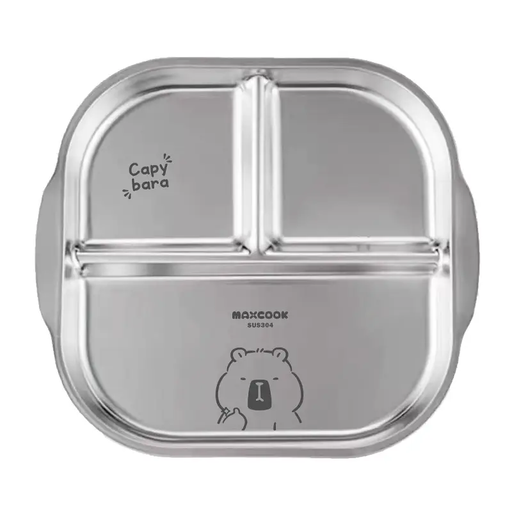
Why This Fits Their Persona: Its three-section format is straightforward for family dinners, school lunches and picnic meals without adding the extra divisions of a larger tray.
The listing identifies 304 stainless steel and a single three-compartment layout, making the material and intended use clearer than a generic “metal plate” description.
Square shape; three independent areas; smooth edges; listed as suitable for dishwasher cleaning.
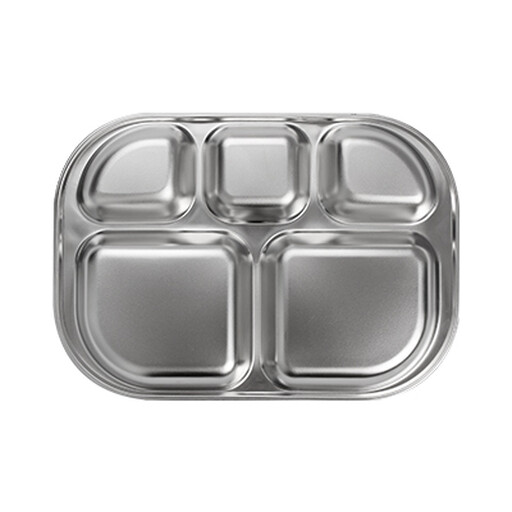
Why This Fits Their Persona: Adults organising structured meals, families serving varied foods and caterers needing several distinct portions may prefer five sections.
The listing specifies five independent 304 stainless steel compartments and a single-piece construction, reducing uncertainty about food separation and assembly.
Food-grade 304 stainless steel; five sections; listed as scratch-resistant, shatterproof and dishwasher safe.

Why This Fits Their Persona: This is not a divided plate, but it suits campers and busy kitchens that need a deeper, reusable dish for saucy meals, steaming or serving.
Its clearly stated single deep format avoids the common mistake of buying several small compartments when the main requirement is capacity.
24 cm diameter; deepened design; listed compatibility with ovens, steam ovens and induction cookers; dishwasher safe.
Rinse food residue before it dries, particularly around divider joints and raised rims. Wash with a soft sponge and mild detergent, then dry thoroughly to reduce water marks. Avoid abrasive tools and sharp utensils where the listing advises against them.
For hot food, allow the plate to cool before carrying it, especially when serving children. If a product is listed for oven, steaming or induction use, follow its specific temperature and heating guidance rather than assuming every unbreakable plate is suitable for direct heat.
Some are, but this is product-specific. Check for an explicit dishwasher-safe statement in the listing. Use a mild cycle where practical and avoid abrasive cleaning products that may affect the surface finish.
A 304 stainless steel plate may be practical for children because it is reusable and less likely to shatter than ceramic. Select a manageable size, rounded edges and sections that match the child’s portions. Always allow hot food to cool before serving.
Yes, separate sections can make meal portions easier to organise visually. A three-section design may suit a main item with two sides, while five sections can separate smaller servings. It is a serving aid rather than medical or dietary guidance.
We have compiled a complete, real-time list of products that fully satisfy these strict selection criteria and UK safety regulations.