
24/7 Customer Support

Free returns

Same-day & Next-day Delivery

Quality Guaranteed

Unlock Your Welcome Offers: FREE Delivery | Up to 80% OFF | Free 30-day JoyPlus trial
Download the APP
Stainless steel food storage containers can simplify packed lunches, leftovers and weekly meal preparation, but the wrong design may quickly become inconvenient. A container that looks substantial online may have a lid that is difficult to clean, a capacity that does not suit your portions, or a seal that is unsuitable for transporting soup.
For UK households, office workers, students, parents and commuters, the important question is not simply whether a container is made from metal. You also need to check the steel grade, lid construction, compartment layout, stated temperature limits and storage dimensions.
Metal containers should not be placed in a microwave unless the manufacturer specifically provides clear instructions that permit it. The products featured in this guide include stainless steel models marked as unsuitable for microwave heating. If you regularly reheat food at work, you may need a separate microwave-safe dish rather than transferring a metal lunch box directly into the microwave.
Marketing terms such as airtight, sealed and leak-resistant can describe different lid designs. A fitted lid may help reduce air exchange and contain ordinary leftovers, but it may not prevent liquid escaping when the box is tipped inside a rucksack.
Look for practical details such as:
A divided lunch box may also have separate compartments without creating a liquid-tight barrier between them. Sauces and soups are safer in a dedicated sealed container.
A 600ml container may suit snacks, fruit or a smaller lunch, while 1,100ml to 2,200ml capacities are more appropriate for larger meals, batch cooking or family leftovers. Check the external dimensions as well as the volume: a box that fits in the fridge may still be too wide for your work lunch bag.
The product descriptions in this category commonly refer to 304 stainless steel, 316 stainless steel or 316L stainless steel. These are material grades, not guarantees that every lid or seal has the same composition.
The complete product should still be assessed, including plastic lids, silicone seals, clips and hinges. Wash the container before first use and dry it thoroughly to reduce water spots and lingering odours.
For airtight food storage containers, inspect how the lid closes rather than relying on the product title. Secure-fitting lids can be suitable for fridge storage and ordinary lunch packing, while locking clips may provide a more secure hold during commuting.
A removable silicone seal is useful because it can be taken out for cleaning. However, it also needs to be refitted correctly after washing. A damaged, stretched or missing gasket can affect the seal.
A divided lunch box helps separate sandwiches, fruit, snacks and side dishes. A single-compartment model is generally more adaptable for leftovers and meal prep because it can hold larger portions without fixed dividers.
For kitchen organisation, look for stackable food containers or sets with several capacities. Confirm whether the containers stack when full, nest when empty or simply sit securely on top of one another. These details make a noticeable difference in a smaller UK fridge or cupboard.

Why This Fits Their Persona: A useful starting set for shoppers who want reusable food containers for leftovers, fridge organisation, packed lunches or occasional camping without committing to a large collection.
The stated sealed and stackable design addresses loose fridge storage, while the product warnings clearly state that it is not microwave or oven safe.
Three-piece 304 stainless steel set; listed for refrigerator storage, meal prep and stackable organisation.
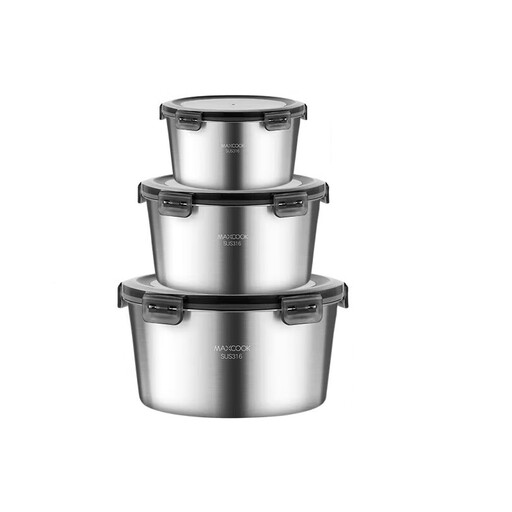
Why This Fits Their Persona: Suitable for households seeking several capacities in one purchase, from a 600ml snack container to a 2,200ml box for larger portions and leftovers.
The capacities are stated clearly, and the listing specifies dishwasher and freezer suitability while warning against microwave use.
316 stainless steel; 600ml, 1,100ml and 2,200ml capacities; suitable for freezer storage and dishwasher cleaning according to the listing.
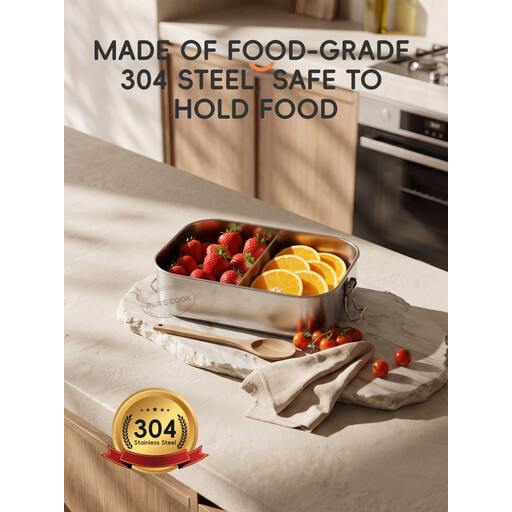
Why This Fits Their Persona: A practical match for office workers, students and commuters who prefer one portable metal bento box with separate spaces for a main meal and side dishes.
Its stated lockable clips and removable silicone seal provide more detail than a generic fitted-lid description. Liquids should still be checked before carrying.
304 stainless steel; dual compartments; dishwasher-safe specification and removable silicone seal.

Why This Fits Their Persona: The four-piece format suits households preparing several portions, storing leftovers and organising different foods in the fridge or freezer.
The listing identifies the steel grade, included lids and freezer suitability, helping shoppers compare the full set rather than just its headline material.
316L stainless steel; four containers with lids; listed for freezer storage and dishwasher cleaning.
We have compiled a complete, real-time list of products that fully satisfy these strict selection criteria and UK safety regulations.
Yes, provided their capacity and lid design match your meals. Sets with several sizes are useful for batch-cooked portions, snacks and leftovers. For sauces or soups, choose a container with a clearly described seal and keep it upright during transport.
Some are listed as freezer-safe, including selected Maxcook sets above. Always check the individual product information, leave expansion space and avoid placing a hot container directly into a freezer.
Their usable lifespan depends on dents, scratches, seal condition, dishwasher exposure and general handling. Stainless steel may remain serviceable for a long time, but lids and silicone gaskets are the parts most likely to need attention. Replacing a damaged seal, where available, can be more practical than replacing the entire container.