
24/7 Customer Support

Free returns

Same-day & Next-day Delivery

Quality Guaranteed

Unlock Your Welcome Offers: FREE Delivery | Up to 80% OFF | Free 30-day JoyPlus trial
Download the APP
Choosing stainless steel food storage containers can reduce reliance on disposable packaging, improve fridge organisation and make batch cooking easier. However, product listings often use broad terms such as “airtight”, “leak-proof” and “freezer-safe” without explaining what those features mean in everyday use.
Before buying a multi-pack, check how the lid seals, whether the dimensions suit your shelves and whether the materials are suitable for your intended food-storage routine. The right set should fit your household rather than simply offer the highest piece count.
A lid may help preserve freshness without being designed for transporting soup or sauces. Hinges, clasps and silicone seals vary considerably. If you need containers for packed lunches, work meals or car journeys, look for a clearly described seal and secure closing mechanism rather than relying on the word “airtight” alone.
It is also worth checking how the seal is cleaned. A removable gasket can be easier to wash thoroughly, while fixed components may collect residue around corners.
A multi-pack may appear economical, but oversized containers can waste space in a standard UK fridge or freezer. Rectangular food storage containers generally make better use of shelf depth, while round food storage containers can be convenient for individual portions and certain cupboard layouts.
Compare the stated capacity and external dimensions with your shelves, freezer drawers and cupboard space before ordering.
Stainless steel is durable and does not absorb food colour as readily as some plastics, but it should not be placed in a microwave unless the manufacturer specifically states that it is suitable. Lids may also use different materials from the container body.
For food-contact products sold in the UK, check the listing and packaging for appropriate food-contact information. Follow the manufacturer’s instructions for temperature limits, freezer use, dishwasher cleaning and oven compatibility.
Look for a clearly identified material rather than a vague reference to “metal”. The PURECOOK products below specify 304 stainless steel, a commonly used stainless-steel grade for kitchenware. This does not automatically confirm every other component, so check the lid material and care instructions separately.
Some shoppers prefer stainless steel for reusable food storage containers because it is robust and less likely to retain odours than certain plastic containers. Plastic food storage containers can still be useful where low weight, transparency or microwave compatibility is a priority.
Food containers with lids can use press-fit, clip, clasp or latching designs. A latching lid food container may provide a more secure closure for moving meals, but the hinges and seal still need regular cleaning.
For practical leak resistance, check:
Do not assume that a container labelled airtight is automatically suitable for liquid-heavy meals.
Capacity is often shown in millilitres or fluid ounces. A 1,500ml container may suit family portions or batch-cooked dishes, while smaller containers can work better for snacks, ingredients and individual meal prep.
For freezer-safe containers, leave space at the top for food to expand as it freezes. Avoid sealing very hot food immediately if the instructions advise cooling first, and allow containers to cool before moving them into a cold environment where sudden temperature changes could cause stress.
Dishwasher-safe containers can reduce washing-up time, but inspect the care guidance for lids. Some lids tolerate the dishwasher differently from stainless-steel bases.
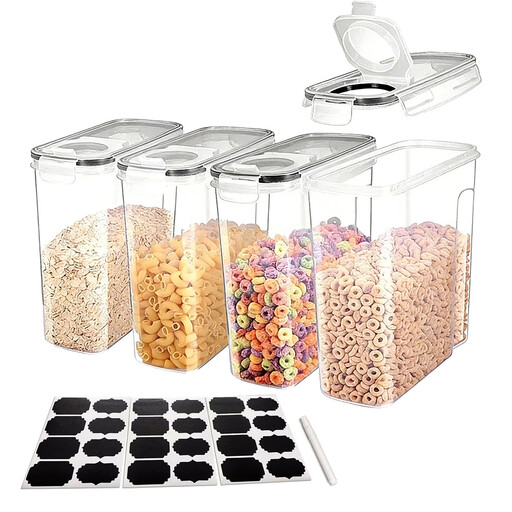
Why This Fits Their Persona: A four-piece transparent set can help households begin organising dry goods and everyday leftovers without committing to several different shapes.
The sealed and transparent design makes the closure and contents easier to inspect than an opaque container with an unspecified lid system.
Four-piece format; transparent bodies support quick identification of stored ingredients.
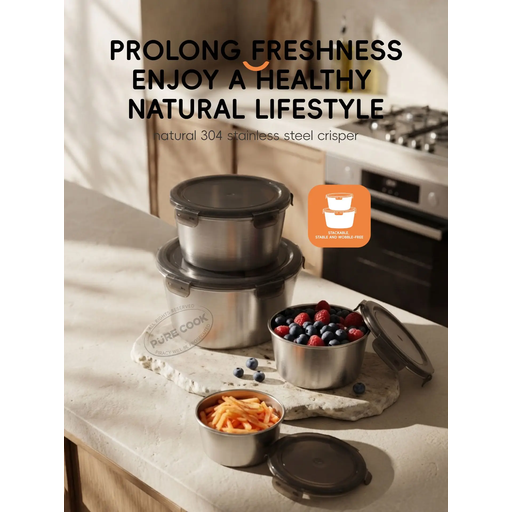
Why This Fits Their Persona: Suitable for shoppers who value a specified stainless-steel grade, clasped lids and a four-piece format for portioning meals or ingredients.
The product identifies 304 stainless steel and clasp closures, giving buyers more concrete information than a generic “premium” description.
304 stainless-steel containers; four round pieces with black transparent PP lids and clasps.
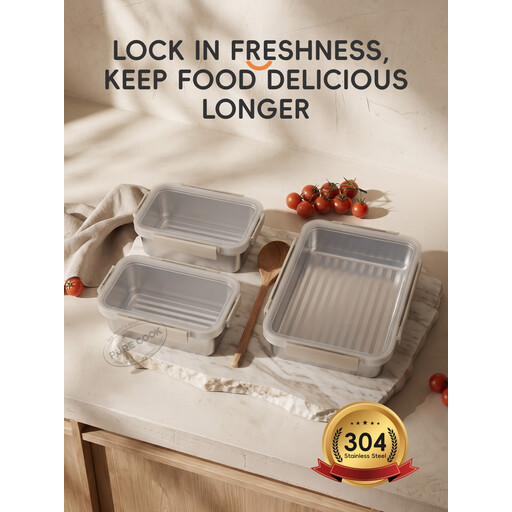
Why This Fits Their Persona: The combination of rectangular formats and listed capacities suits batch cooking, family leftovers and organised fridge or freezer storage.
The set lists 304 stainless steel, rectangular shapes and several capacities, helping address material ambiguity and inefficient shelf use.
Includes two 50.72fl-oz containers, two 1,500ml containers and one 2,400ml container with white PP latching lids.
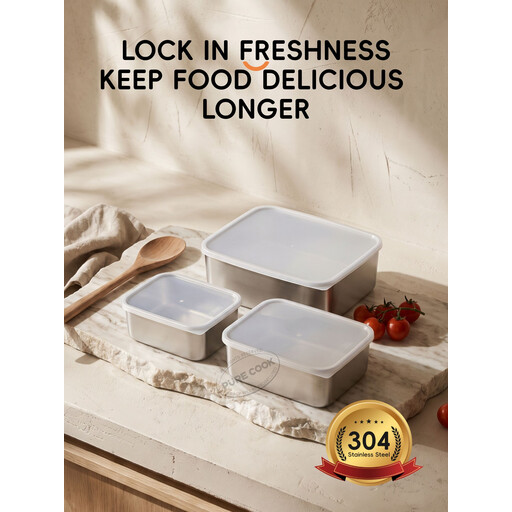
Why This Fits Their Persona: Deep containers can be useful for larger servings, prepared dishes and households that store food in fewer, higher-capacity portions.
A three-piece deep format avoids buying numerous shallow containers when the main requirement is storing larger cooked portions.
304 stainless-steel bodies; three deep containers supplied with PE lids.
We have compiled a complete, real-time list of products that fully satisfy these strict selection criteria and UK safety regulations.
Many stainless-steel containers can be used in a freezer, but suitability depends on the complete product, including the lid and seal. Confirm the listing’s freezer guidance, leave room for expansion and avoid forcing a frozen lid open. For more options, browse batch cooking containers for freezer.
Neither material suits every household. Stainless steel may appeal to shoppers seeking a robust, reusable container body, while plastic is often lighter and may offer transparent sides or microwave-compatible designs. Compare the lid, capacity, care instructions and intended appliance use rather than judging by material alone.
Lifespan depends on the steel thickness, lid components, frequency of use, washing method and handling. Stainless steel may remain serviceable for a long time, but seals and plastic lids can wear sooner. Replacing a damaged seal or lid, where available, can help maintain safe and practical everyday use.