
24/7 Customer Support

Free returns

Same-day & Next-day Delivery

Quality Guaranteed

Unlock Your Welcome Offers: FREE Delivery | Up to 80% OFF | Free 30-day JoyPlus trial
Download the APP
A quality stand mixer can transform your kitchen, turning laborious kneading, whisking and mixing into effortless tasks. However, the market is flooded with models that promise the world but often fall short. Many home bakers in the UK find themselves with a noisy, unstable or underpowered machine that gathers dust in a cupboard. Before you invest, it’s crucial to understand the common pitfalls that lead to a disappointing purchase.
As a Joybuy Product Recommendation Officer, my role is to help you see past the marketing jargon. Let's break down the key issues to avoid.
kitchen mixer boasting a 1500W motor. But high wattage means little without quality engineering. A poorly designed motor and gearbox will be inefficient, loud and prone to overheating when tackling heavy dough. A well-constructed 1000W stand mixer with efficient power transfer will consistently outperform a clunky, overpowered machine.food mixer for baking.stand mixer with dough hook is essential for bread, but if that hook is made from a flimsy coated alloy, it can chip or break. The same goes for whisks that bend and beaters that don't reach the bottom of the bowl. Focus on the quality of the three core tools: the dough hook, the whisk and the K-beater/flat beater.To choose a dependable electric stand mixer, focus on these three practical specifications.
Look for a motor of at least 800W, with 1000W being a solid benchmark for handling everything from light sponges to dense fruit cakes. More importantly, check for planetary mixing action. This is where the attachment not only spins on its axis but also sweeps around the inside of the bowl, ensuring all ingredients are thoroughly incorporated without you needing to constantly stop and scrape down the sides.
For most households, a 5L stand mixer bowl offers the perfect balance, providing enough capacity for family-sized bakes without being excessively bulky. A 4L to 4.5L bowl is also a great option, especially for those with smaller kitchens. Stainless steel is the standard for a reason: it's durable, lightweight and easy to clean. Some models offer glass bowls, which look elegant but are heavier and more fragile.
A robust cake mixer should feel solid. A die-cast metal body is a good indicator of durability and stability. The three essential tools—dough hook, whisk and beater—should be made from stainless steel or a high-quality, durable coated metal. Check if they are dishwasher-safe, as this significantly simplifies cleanup.
Instead of a one-size-fits-all approach, we've matched some models to the specific needs of different UK bakers.
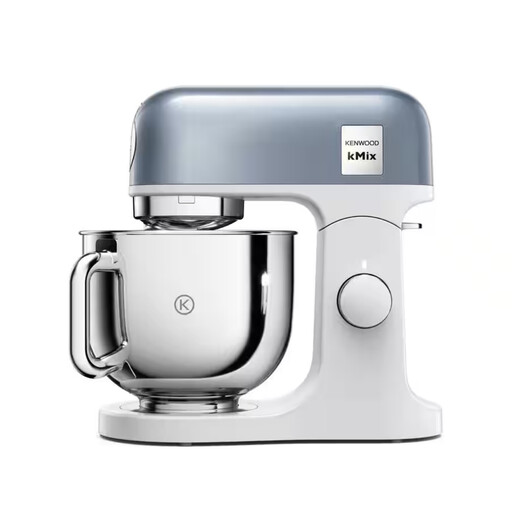
Why This Fits Their Persona: This baker needs a reliable workhorse for frequent use, from kneading sourdough to whipping up large batches of buttercream. The kMix combines a powerful motor with a stylish, durable body that looks great on the counter.
Its die-cast metal body provides excellent stability, preventing any "counter walking." The 1000W motor is engineered for performance, not just numbers and the included stainless steel tools are built to last.
Features a unique, gentle Fold Function for delicate mixtures like meringues. The generous 5L bowl and robust tools make it a versatile and long-lasting investment.

Why This Fits Their Persona: Ideal for those in smaller flats or with limited kitchen worktop space. This compact stand mixer delivers full-size power without demanding a large footprint, making it easy to store in a cupboard.
It proves that compact doesn't mean weak. With a genuine 1000W motor, it avoids the trap of underpowered small appliances, capably handling dough and heavy mixes despite its size.
Its main benefit is delivering the power of a larger Kenwood stand mixer in a space-saving design. The 4.3L bowl is still generous enough for most family baking tasks.
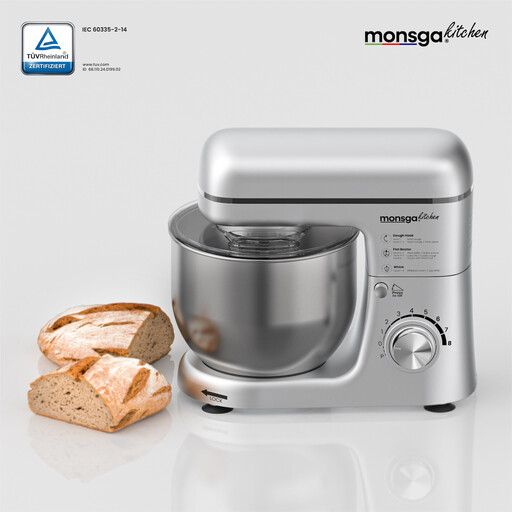
Why This Fits Their Persona: For someone new to baking or on a tighter budget, this mixer provides the essential specifications—good power and a large bowl—without the premium price tag, making it an excellent entry-level choice.
It prioritises core function over brand prestige, offering a 1000W motor and planetary mixing. The inclusion of suction cup feet is a practical solution to address the stability trap common in lighter, affordable models.
Offers a very large bowl (5.0L recommended usable capacity) and a powerful motor for its price point. The accessories are dishwasher-safe, adding practical convenience.
We have compiled a complete, real-time list of products that fully satisfy these strict selection criteria and UK safety regulations.
While it's tempting to chase the highest wattage, focus more on build quality. For most home baking, including bread dough and dense cakes, a well-engineered mixer with 800W to 1200W is more than sufficient. A quality 1000W stand mixer from a reputable brand will provide reliable performance for years.
For the vast majority of home kitchens in the UK, a tilt-head design is the most practical choice. It allows for easy access to the bowl to add ingredients or scrape the sides. Bowl-lift models, where the bowl is cranked up to the mixing head, offer exceptional stability and are typically found on larger, professional-style machines. Unless you are regularly mixing extremely large and heavy batches, a tilt-head offers better everyday convenience.
Always unplug the appliance before cleaning. Most stainless steel bowls and the main metal attachments (dough hook, whisk, beater) are dishwasher-safe, but always check the manufacturer's instructions. The mixer body should only be wiped with a damp cloth—never immerse the motor housing in water. If your mixer has an attachment hub on the front, keep the cover in place when not in use to prevent flour and dust from getting inside the mechanism.