
24/7 Customer Support

Free returns

Same-day & Next-day Delivery

Quality Guaranteed

Unlock Your Welcome Offers: FREE Delivery | Up to 80% OFF | Free 30-day JoyPlus trial
Download the APP
A stand mixer can make baking more convenient, but choosing the wrong one may leave you with a machine that struggles with dough, takes up too much worktop space or is difficult to clean. UK shoppers often compare motor wattage, bowl size and speed settings first, yet these figures do not always tell the whole story.
Before buying an electric stand mixer, look beyond attractive colours and large power numbers. Check the usable capacity, included tools, mixing movement, noise information, cleaning instructions and the manufacturer’s stated limits. These details have a greater effect on everyday use than marketing language alone.
A high wattage figure does not automatically mean a kitchen mixer is suitable for heavy bread dough. Some listings quote peak power, while others quote rated or continuous power. For example, the Monsga SM100 lists 1000W peak power alongside a 600W rated power specification.
Motor design, gearing, overload protection and the recommended dough capacity also matter. If bread is a regular part of your routine, check the manual’s maximum flour or dough quantity rather than relying on wattage alone.
A bowl described as 5 or 6 litres cannot necessarily be filled to the rim. Ingredients need room to move, particularly when kneading or whisking. The Monsga SM100, for instance, describes a 6-litre full bowl but recommends a 5-litre usable capacity.
A 5-litre stand mixer is generally a practical size for family baking, but the actual quantity of cake mix, flour or egg whites it can handle varies by recipe. Always compare the manufacturer’s capacity guidance with your usual batch sizes.
A stand mixer with dough hook, beater and whisk covers most home baking tasks, but attachment construction and cleaning requirements differ. Some tools are dishwasher-safe, while others may require hand washing to protect their finish.
Also consider whether you will use optional accessories. A slow-speed outlet can support additional functions such as pasta making or mincing, but these accessories are often purchased separately. Avoid paying extra for expandability if you only plan to make cakes and cream.
A food mixer should offer a sensible range of speeds rather than simply a large number on the dial. Low speeds help combine dry ingredients with less scattering, while medium settings suit cake batter and higher speeds are useful for cream or egg whites.
Planetary mixing action moves the attachment around the bowl while it rotates, helping it reach more of the mixture. A fold setting is useful for delicate ingredients such as whipped egg whites, meringue or choux pastry because it provides a slower, gentler movement.
For dough, look for a suitable dough mixer with a dedicated hook and clear limits for heavy mixtures. Follow the supplied instructions, including recommended operating time and cooling periods.
Stainless steel bowls are durable and relatively straightforward to clean. Glass bowls can make ingredients visible from the side, but they may be heavier and need more careful handling. A bowl handle and pouring area can also make preparation easier.
Measure the available space before ordering. Include room to lift a tilt-head mixer, remove the bowl and open cupboards above it. A heavier metal-bodied machine may stay steadier during kneading, but it will be less convenient to move after every use.
For everyday baking, the core set should normally include:
Check which parts are dishwasher-safe and which must be wiped by hand. The motor housing should not be immersed in water. Always switch off and unplug the appliance before changing tools, removing the bowl or cleaning.
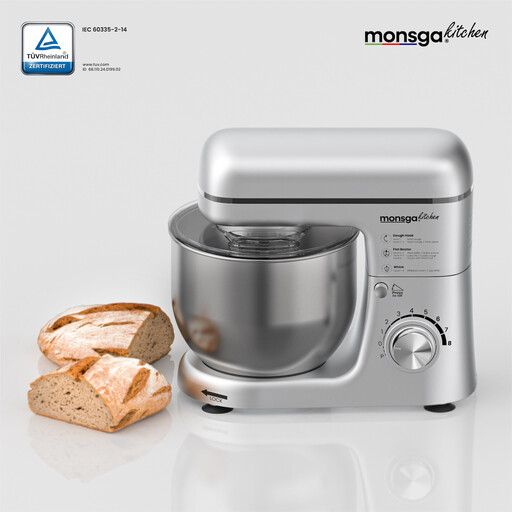
Why This Fits Their Persona: Its 8 speed settings, tilt head and core whisk, beater and dough hook set suit first-time home bakers making cakes, biscuits and occasional bread in a UK family kitchen.
The listing distinguishes its 6-litre full capacity from the recommended 5-litre usable capacity and states a noise level under 75 dB.
Stainless-steel bowl, suction feet, overload protection and dishwasher-safe accessories.
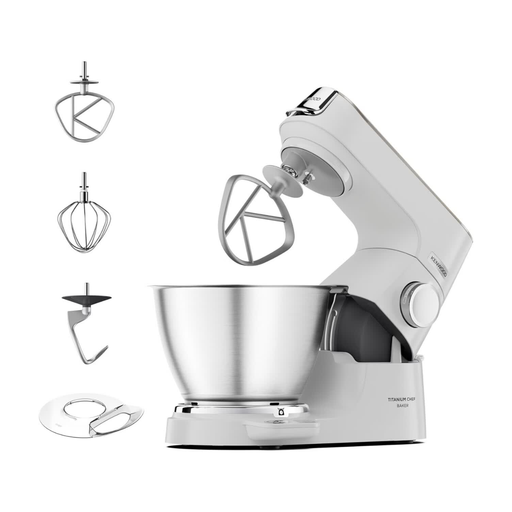
Why This Fits Their Persona: Designed for regular bakers who value integrated weighing and a metal-bodied appliance, it supports cakes, pastry and dough without requiring separate kitchen scales.
Its specifications state separate maximum quantities for cake, dough, egg whites and pastry flour, making capacity easier to judge.
1200W digitally controlled motor, in-built EasyWeigh scales and over 25 optional attachments.

Why This Fits Their Persona: The larger bowl and 10-speed control are suited to households preparing family-sized cakes, pizza dough, pastry and other repeated batches.
It includes overheat protection and a tilt-head lock; users should still follow the stated domestic-use quantities and timing limits.
6.2-litre stated bowl capacity, planetary mixing and three core attachments.
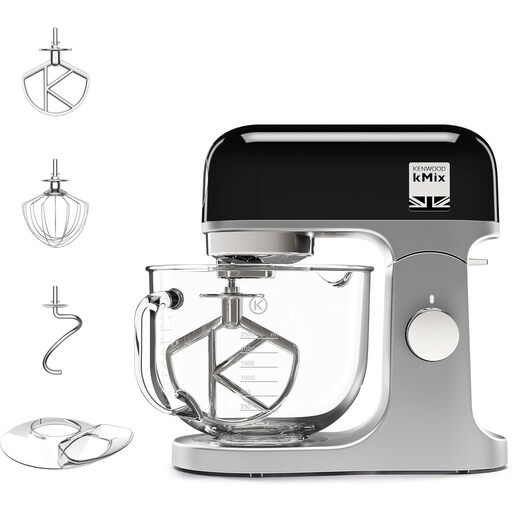
Why This Fits Their Persona: A suitable option for shoppers who want a retro-inspired metal design, family-sized bowl and the flexibility to add optional kitchen attachments later.
The listing specifies a 5-litre glass bowl, six speeds plus Fold and a slow-speed outlet rather than relying only on appearance-led claims.
1000W motor, planetary mixing action, Fold function and K-beater, whisk and dough hook included.
We have compiled a complete, real-time list of products that fully satisfy these strict selection criteria and UK safety regulations.
It can be worthwhile if you regularly make dough, cakes, pastry or whipped mixtures and prefer hands-free mixing. For occasional sauces, soups or small portions, a hand blender may take up less space and cost less to run. Choose a stand mixer when its bowl capacity and attachments match the recipes you actually prepare.
Lifespan depends on construction, frequency of use, ingredient quantities and maintenance. Avoid overloading the bowl, follow the recommended operating periods and use only compatible attachments. A metal body, replaceable accessories and a clearly stated warranty may support longer-term ownership, but no appliance should be assumed to last indefinitely.
Running cost depends on the appliance’s power rating, the selected speed and how long it operates. A 1000W mixer running for 10 minutes uses approximately 0.167 kWh, before considering the difference between rated and peak power. To estimate your cost, multiply actual electricity use in kWh by your tariff. Using the lowest suitable speed and avoiding unnecessary idle time can reduce consumption.