
24/7 Customer Support

Free returns

Same-day & Next-day Delivery

Quality Guaranteed

Unlock Your Welcome Offers: FREE Delivery | Up to 80% OFF | Free 30-day JoyPlus trial
Download the APP
A stand mixer can make bread dough, pastry and meringue preparation considerably easier, but choosing the wrong kitchen mixer may leave you with a bulky appliance, disappointing capacity or attachments you rarely use. UK shoppers often compare wattage and price first, yet these figures do not tell the whole story.
Three common buying traps deserve attention:
For occasional cakes and buttercream, a compact stand mixer with around 800W may be sufficient. Regular bread making and larger family batches call for careful attention to the stated dough or flour limit rather than wattage alone.
A 1000W electric food mixer may suit a wide variety of household recipes, but check whether the figure is rated power or peak power. For example, one Monsga SM100 listing states 1000W peak power and 600W rated power. That distinction gives a more useful picture of sustained operation.
If you often prepare enriched dough, pizza dough or fruit cake, look for:
Always follow the manual and avoid exceeding the stated maximum. A powerful stand mixer is not designed to run indefinitely under heavy load.
A 5-litre stand mixer is a practical middle ground for many UK households. It can accommodate everyday cake mixtures, pastry and family-sized batches without taking up the space associated with larger commercial-style machines.
Stainless steel bowls are durable, relatively easy to clean and do not retain food odours. Glass bowls can make ingredients visible while mixing, although they may be heavier and require more care when being removed or washed.
Do not compare capacity by litres alone. Check whether the listing states a recommended usable capacity. The Monsga SM100, for example, describes a 6-litre full bowl but recommends 5 litres for use. That is more relevant when planning bread or cake quantities.
A planetary mixer rotates the attachment around the bowl while the attachment itself turns, helping it reach more of the mixture. This is useful for creaming butter, combining cake batter and kneading dough.
For versatile baking, the essential combination is:
A tilt-head mixer gives easier access when adding ingredients or changing tools. Soft-start controls can help reduce flour clouds and splashing. A fold function is useful for delicate mixtures such as meringue or choux pastry, but it should not be mistaken for a replacement for careful hand folding.
Also consider the controls. Six speeds plus pulse or fold may be easier to use than ten settings that are closely spaced. A splashguard with an ingredient chute can reduce mess, particularly when preparing flour-heavy recipes.
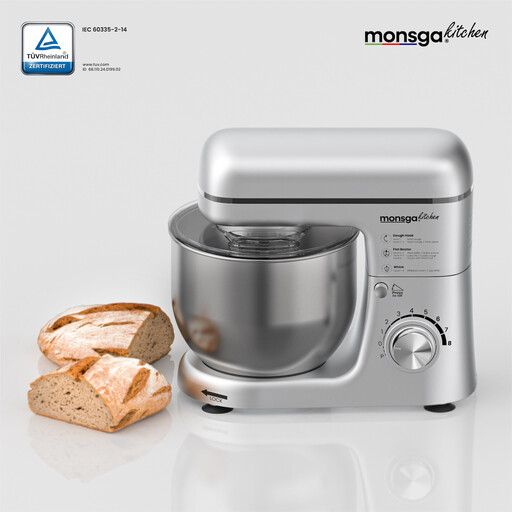
Why This Fits Their Persona: A practical choice for beginners moving up from a hand mixer and wanting one appliance for cakes, biscuits and occasional bread making.
Its listing separates 1000W peak power from 600W rated power and recommends a 5.0-litre usable capacity, making the specifications easier to interpret.
Includes a stainless steel bowl, whisk, beater, dough hook and splash guard, with eight speed settings.

Why This Fits Their Persona: Suits frequent home bakers who value integrated weighing and a broader attachment ecosystem for regular cooking as well as baking.
The product information gives separate cake and dough capacities rather than relying on bowl volume alone.
It has a 1200W digitally controlled motor, 4.6-litre stainless steel bowl, EasyWeigh scales and compatibility with over 25 optional attachments.
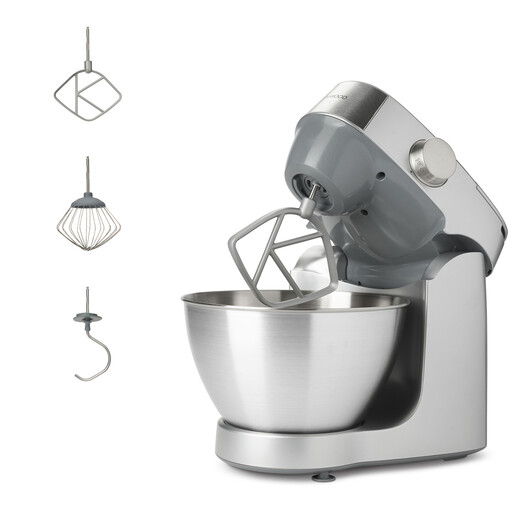
Why This Fits Their Persona: Designed for bakers who need a capable baking mixer but have limited cupboard or worktop space.
Its 4.3-litre bowl and stated 1.2kg flour-based dough limit help set realistic expectations for batch sizes.
The compact unit has five speeds plus pulse, a stainless steel bowl and dishwasher-safe bowl and tools.
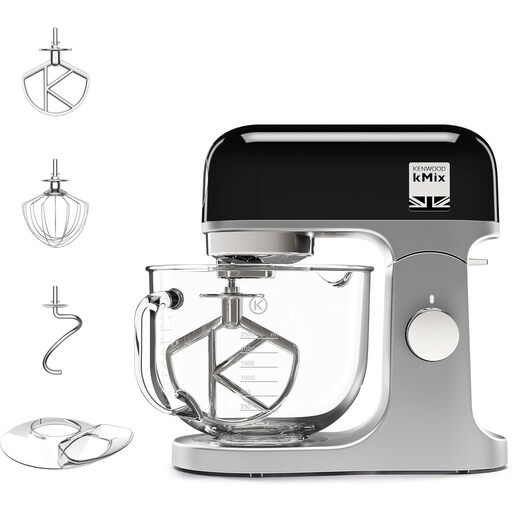
Why This Fits Their Persona: A substantial option for households making bread, cakes and delicate mixtures regularly, with room to expand into other kitchen tasks.
The specification lists six speeds, a fold function, planetary mixing action and a 1000W motor, giving more information than a wattage headline alone.
Includes a K-beater, balloon whisk and dough hook, plus a slow-speed outlet compatible with more than ten optional attachments.
Measure the available worktop and cupboard clearance, including the height needed when a tilt-head is raised. A heavy metal mixer may be stable during kneading but less convenient to move after every use.
Check the included tools rather than assuming every stand mixer with attachments contains the same accessories. Confirm whether bowls and tools are dishwasher-safe and whether replacement parts or optional accessories are available for the exact model.
For UK use, verify the product is supplied for 220–240V, 50Hz mains electricity and inspect the plug, warranty terms and safety instructions. Look for clear manufacturer or responsible-entity details and use the appliance only as instructed. Switch off and unplug it before changing tools or cleaning; never place hands or utensils near moving attachments.
We have compiled a complete, real-time list of products that fully satisfy these strict selection criteria and UK safety regulations.
For many households, yes. A 5-litre bowl is suitable for common cake, biscuit and pastry batches, but dough capacity is usually lower than the bowl’s total volume. Check the manufacturer’s flour or dough limit before preparing large bread batches.
It can handle many of the same tasks, including whisking, beating and creaming, while also supporting kneading with a dough hook. However, a stand mixer takes up more space and may be less convenient for very small quantities.
Running cost depends on the appliance’s power rating, speed and operating time. Short mixing periods generally use less electricity than extended kneading. Use the appropriate speed, avoid overloading the bowl and switch the appliance off when it is not mixing.