
24/7 Customer Support

Free returns

Same-day & Next-day Delivery

Quality Guaranteed

Unlock Your Welcome Offers: FREE Delivery | Up to 80% OFF | Free 30-day JoyPlus trial
Download the APP
A stand mixer can make baking more convenient, but the wrong model may end up taking valuable worktop space while struggling with dough or making more noise than expected. UK shoppers comparing an electric stand mixer, food mixer or kitchen mixer should look beyond wattage and colour.
The main buying traps are usually:
A suitable model should match your recipes, storage space, batch sizes and willingness to clean and store accessories.
Motor wattage provides a useful comparison, but it is not a complete measure of mixing ability. A dough mixer needs sufficient torque at lower speeds, while a cake mixer or baking mixer also needs controlled movement for butter, sugar and eggs.
Check the product’s rated power, maximum dough capacity and recommended operating time. Heavy mixtures such as bread dough place greater demand on the motor than whisking egg whites. Follow the manufacturer’s instructions and allow the machine to cool if required.
For occasional cakes and biscuits, a compact 800W to 1000W model may be suitable. If you regularly make bread, pizza dough or large fruit cakes, consider a model with published dough capacities and a stable metal body.
A 5 litre stand mixer is a practical size for many UK households. It can accommodate family baking while remaining more manageable than a commercial-style machine. However, capacity should be read alongside the maximum quantity for flour, cake mixture or egg whites.
Stainless steel bowls are durable, relatively easy to clean and resistant to odours. Glass bowls can make ingredients visible from the side, but they may be heavier and require more careful handling. Look for a secure locking mechanism, a useful handle and enough clearance to add ingredients without scraping the attachment constantly.
A planetary mixer moves the attachment around the bowl while rotating it, helping it reach more of the mixture than a simple fixed beater. A tilt-head mixer makes it easier to change tools and remove the bowl, although the head should always lock securely before operation.
For general baking, the useful minimum is:
Variable speeds, soft-start operation and a fold setting can provide more control. A splash guard may also reduce flour clouds and spills. Before purchase, check whether tools and bowls are dishwasher-safe, and confirm that optional attachments are available for the exact model.
For electrical safety, choose a product supplied for the UK market, check the conformity information, use a suitable earthed socket and follow the supplied manual. Keep hands, hair, clothing and utensils away from moving parts, and unplug the appliance before changing attachments or cleaning.

Why This Fits Their Persona: Its 4.3-litre bowl and compact footprint suit first-time home bakers or smaller UK kitchens where cupboard and worktop space are limited.
The listing states 1000W output, a maximum flour-based dough capacity of 1.2kg and five speeds plus pulse, giving clearer workload information than wattage alone.
Includes a kneading hook, mixing beater and balloon whisk; the bowl and tools are listed as dishwasher-safe.
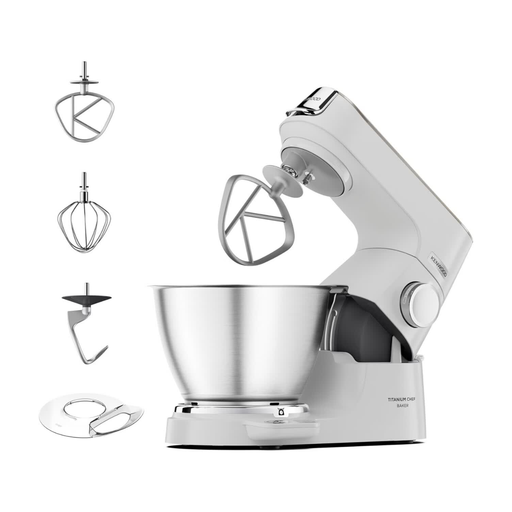
Why This Fits Their Persona: Designed for frequent bakers who value weighing ingredients directly in the bowl and want a flexible kitchen mixer for varied recipes.
Its stated capacities include 2kg cake mix, 1.3kg dough and up to 12 egg whites, while the integrated scales reduce the need for a separate weighing bowl.
Provides a 1200W digitally controlled motor, 4.6-litre stainless steel bowl and compatibility with over 25 optional attachments.
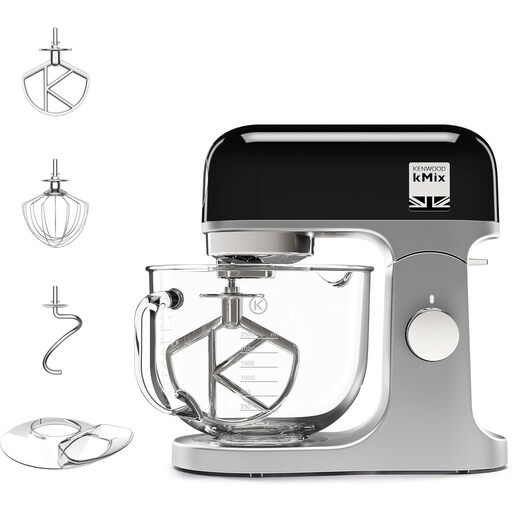
Why This Fits Their Persona: A 5-litre glass-bowl model with a metal body suits households making regular cakes, enriched doughs and larger baking batches.
The product information identifies six speeds plus a fold function, a 5-litre bowl and a planetary mixing action rather than relying on power claims alone.
Includes a non-stick K-beater, balloon whisk and dough hook, with a slow-speed outlet for more than 10 optional attachments.

Why This Fits Their Persona: The larger bowl and 10-speed control are aimed at families preparing bread, cakes, pizza, pastry and waffles in one kitchen appliance.
The listing states a 6.2-litre bowl, planetary mixing, tilt-head locking and overheat protection; users should still follow the model’s permitted quantities.
Includes a dough hook, whisk, beater and splash guard; the listing states a noise level below 60 dB.
We have compiled a complete, real-time list of products that fully satisfy these strict selection criteria and UK safety regulations.
It can be worthwhile if you regularly make cakes, buttercream, meringue or bread and want hands-free mixing. For pancakes or small batches, a handheld mixer or dedicated batter tool may take less space. Compare your usual recipes with the bowl capacity and storage requirements before paying for features you will rarely use.
There is no single safe time for every model. Use the manufacturer’s stated maximum duration and dough quantity. Start at a low speed, avoid overloading the bowl and stop if the motor becomes unusually hot or the appliance shows signs of strain. Always unplug the mixer before inspecting or changing the attachment.
A higher power rating can mean greater potential electricity use when operating at full load, but actual cost depends on the appliance’s power draw and running time. A simple calculation is:
Power in kilowatts × hours used × your electricity tariff = approximate running cost.
Short mixing cycles generally use less electricity than prolonged operation, so efficient preparation, correct quantities and suitable speed settings matter as much as the headline wattage.