
24/7 Customer Support

Free returns

Same-day & Next-day Delivery

Quality Guaranteed

Unlock Your Welcome Offers: FREE Delivery | Up to 80% OFF | Free 30-day JoyPlus trial
Download the APP
A stand mixer can make cakes, biscuits, pastry, bread and whipped cream much easier to prepare. However, comparing a Kenwood stand mixer with an affordable electric food mixer is not simply a matter of choosing the highest wattage or largest bowl. Specifications can be presented in ways that make products appear more capable than they are in everyday use.
This guide explains the key details to check before buying, highlights common purchasing traps and matches selected models to different UK household needs.
A product labelled as a 1000W stand mixer may quote peak power rather than rated or continuous power. For example, the MONSGA SM100 listings state 1000W peak power and 600W rated power. That does not automatically make it unsuitable, but it shows why motor figures should be read alongside the manufacturer’s capacity guidance.
For bread and other dense mixtures, check:
A higher number on the box cannot, by itself, confirm how a dough mixer will perform during repeated heavy batches.
A bowl described as 5 or 6 litres will not necessarily hold that quantity of every mixture safely. Ingredients need room to move, particularly when whisking or kneading. The MONSGA SM100 has a 6-litre maximum bowl volume but lists 5 litres as its recommended usable capacity.
For family baking, a 5-litre stand mixer is a practical size for many cakes, biscuits and moderate bread batches. If you mainly bake for one or two people, a smaller bowl may be easier to store and clean.
A mixer may include a dough hook, balloon whisk and beater, but attachment materials differ. Check whether tools are stainless steel, coated aluminium or non-stick coated, and confirm cleaning instructions before putting them in a dishwasher.
Also consider the shape of the bowl. A handle, splashguard and ingredient chute can make everyday use more convenient, while a heavy glass bowl may be more difficult to lift when full.
A suitable baking mixer should offer a low starting speed to reduce flour clouds and splashing, plus enough control for creaming butter, whisking egg whites and kneading dough. Six speeds with a dedicated fold function can be more useful than a long list of speed numbers if you regularly prepare delicate mixtures.
Models in this selection range from five speeds plus pulse to ten speeds plus pulse. Match the control layout to your recipes rather than paying solely for the highest number.
With planetary mixing action, the attachment rotates around the bowl while turning on its own axis. This helps the tool reach more of the mixture than a simple fixed rotation. It is particularly useful for cake batter, buttercream and dough, although you may still need to stop the mixer and scrape the bowl during some recipes.
A K-beater or flat beater is generally suited to cakes, biscuits and pastry mixtures. Use the balloon whisk for cream and egg whites, and the dough hook for yeast dough. Always follow the model’s manual for maximum quantities and recommended speeds.
A stainless steel mixing bowl is commonly chosen because it is durable, non-porous and relatively straightforward to clean. Glass can make ingredients visible but may add weight. Compare the bowl material, handle design and whether it is dishwasher-safe.
Counter space also matters. Measure the height with the head raised, not only the packaged dimensions. A tilt-head mixer is convenient for changing tools, while a heavier metal body and non-slip feet can help keep the appliance stable during kneading.
Noise is another practical consideration. The MONSGA SM100 lists a noise level of 75 decibels, while the Honinst model states less than 60 decibels. These figures are supplied product specifications rather than a guarantee of perceived noise in every kitchen, so consider where the mixer will be used.
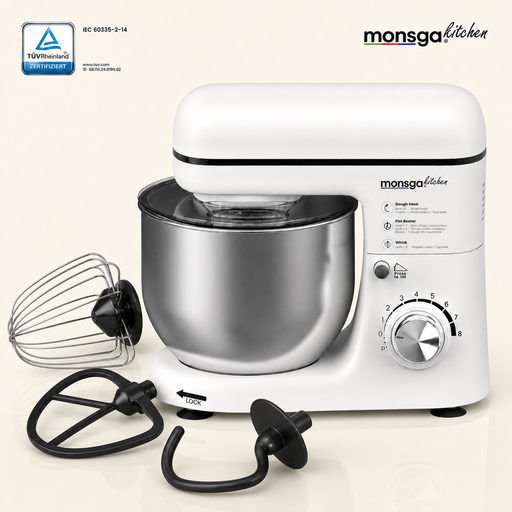
Why This Fits Their Persona: Its 5-litre recommended usable capacity, eight speed settings and included core tools suit households starting with cakes, biscuits and occasional dough.
The listing distinguishes between 1000W peak and 600W rated power, helping buyers assess the motor figure more realistically.
Stainless steel bowl, tilt head, splashguard and dishwasher-safe accessories are listed.

Why This Fits Their Persona: In-built scales and a metal body are useful for regular bakers who want to streamline preparation and keep the appliance on the worktop.
Its specifications state a 4.6-litre bowl and separate maximum capacities, including 1.3kg of dough, rather than relying only on bowl volume.
1200W digitally controlled motor, planetary action, EasyWeigh scales and over 25 optional attachments are specified.
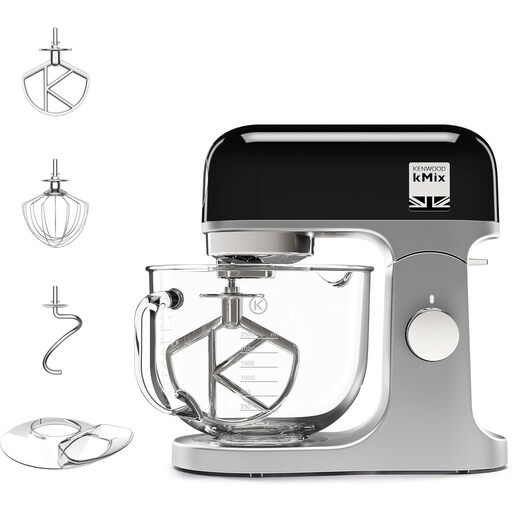
Why This Fits Their Persona: A 5-litre bowl, 1000W motor and dough hook make it suitable for family cakes, bread projects and larger weekend batches.
The specification identifies six speeds plus a fold function and lists the supplied K-beater, whisk and dough hook.
Planetary mixing action, fold function and a slow-speed outlet compatible with more than ten optional attachments are listed.
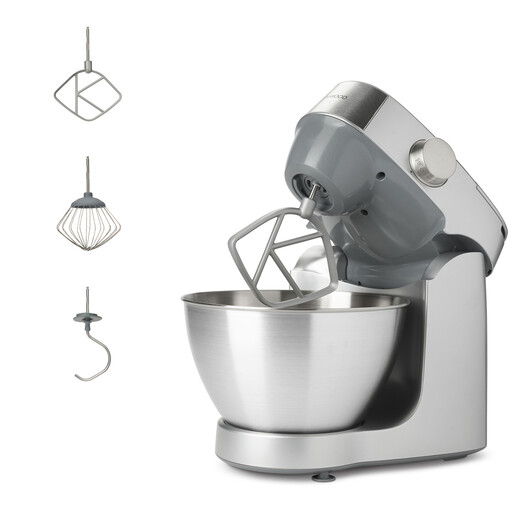
Why This Fits Their Persona: Its 4.3-litre bowl and stated compact dimensions make it a practical kitchen mixer where cupboard or worktop space is limited.
The listing states a 1.2kg flour-based dough limit, helping prevent buyers from confusing compact capacity with large-batch capability.
1000W output, five speeds plus pulse, dishwasher-safe bowl and tools, and optional attachment compatibility are specified.
We have compiled a complete, real-time list of products that fully satisfy these strict selection criteria and UK safety regulations.
Use this short checklist when comparing an electric food mixer:
It can be worthwhile if you regularly make mixtures that are tiring to whisk or knead by hand, or if you want hands-free preparation. For occasional small cakes, a hand mixer may take less storage space and cost less. A stand mixer becomes more useful when you make bread, pastry or family-sized batches.
Lifespan depends on construction, workload, cleaning and whether the mixer is used within its stated limits. Metal-bodied models may feel more substantial, but correct operating times and maximum dough quantities remain important. Avoid forcing the motor with oversized batches, and allow it to cool if the manual advises this.
Running cost depends on the appliance’s actual power draw and how long it operates. A simple calculation is:
Power in kilowatts × operating time in hours × your electricity tariff = approximate cost.
For example, a 1000W mixer is rated at 1kW, but it may not draw that amount continuously at every speed. Short mixing sessions generally use less electricity than prolonged heavy kneading.