
24/7 Customer Support

Free returns

Same-day & Next-day Delivery

Quality Guaranteed

Unlock Your Welcome Offers: FREE Delivery | Up to 80% OFF | Free 30-day JoyPlus trial
Download the APP
A stand mixer can make bread dough, cakes, biscuits, pastry and whipped cream easier to prepare, but the wrong model may become an expensive appliance that takes up worktop space. UK shoppers comparing an electric stand mixer, food mixer or cake mixer should look beyond wattage and appearance.
Marketing descriptions often highlight a large “peak power” figure while omitting the rated power, usable bowl capacity or attachment limitations. Noise claims can also be presented without explaining the measurement conditions. Before buying, check the specifications that affect everyday use rather than relying on headline numbers.
A stand mixer advertised as 1,000W may list that figure as peak power, while its rated operating power is lower. Peak wattage can indicate the motor’s maximum stated output, but it does not by itself confirm how long the machine can knead dough or how it performs under load.
For bread and pizza dough, check the operating guidance, recommended quantities and whether the manufacturer specifies overload or overheating protection. A dough mixer should be used at low to medium speed unless the manual states otherwise.
A bowl described as 6 litres or 6.5 quarts does not mean it should be filled to the rim. Ingredients need space to move around the attachments, particularly when whisking or mixing wet dough. A 5 litre stand mixer may therefore be more practical than a larger-looking bowl if the kitchen has a compact footprint or recipes are usually modest in size.
Look for a stated recommended usable capacity, not only the maximum full volume.
A noise figure in decibels is more useful than the word “quiet”, but sound can vary according to speed, dough density, floor surface and kitchen layout. A mixer with suction feet or other anti-slip features may also feel less disruptive because it remains stable during operation.
For general household baking, variable speed control is more useful than a high headline wattage alone. Low speeds help incorporate flour and start dough mixing with less splashing, while medium or higher settings are commonly used for batters, cream and egg whites.
An 8-speed stand mixer provides several adjustment points for everyday recipes. A 10-speed model may offer finer control, although the practical difference depends on the control design and included instructions. A pulse function can be useful for short bursts, but it should not replace the manufacturer’s recommended operating times.
A planetary mixing system moves the attachment around the bowl while it rotates, helping it reach different areas of the mixture. Check which tools are included:
Attachments should be checked for cleaning instructions. Dishwasher suitability may differ between the bowl, whisk, beater, hook and any connector or gearbox.
A stainless steel mixing bowl is durable and generally straightforward to wipe clean. Handles are useful when transferring batter or dough. A stable base is particularly important when kneading, so look for non-slip feet, suction cups or a secure locking mechanism.
For UK households, also check the supplied plug, voltage information, operating instructions, warranty details and relevant conformity markings. Always unplug the appliance before cleaning or changing attachments, and follow the manual’s maximum quantities.
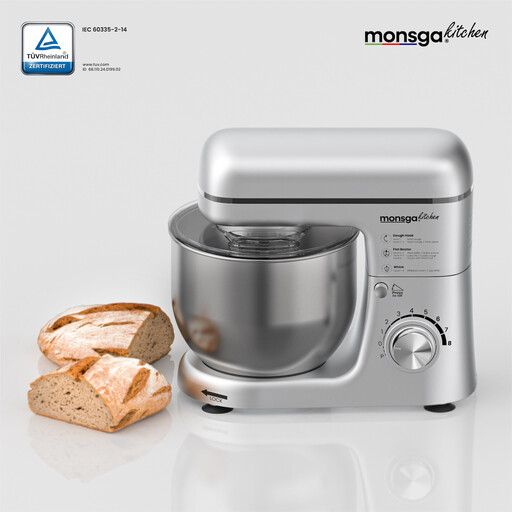
Why This Fits Their Persona: A practical starting point for UK households that want one machine for cakes, biscuits, cream and occasional bread dough without moving to a larger commercial-style appliance.
The listing separates 1,000W peak power from 600W rated power and states a recommended usable capacity of 5.0 litres, rather than suggesting the full 6.0-litre bowl should always be filled.
It has eight speed settings, a tilt-head design, a dough hook, whisk, beater, splash guard and four silicone suction feet. The listed noise level is under 75dB.
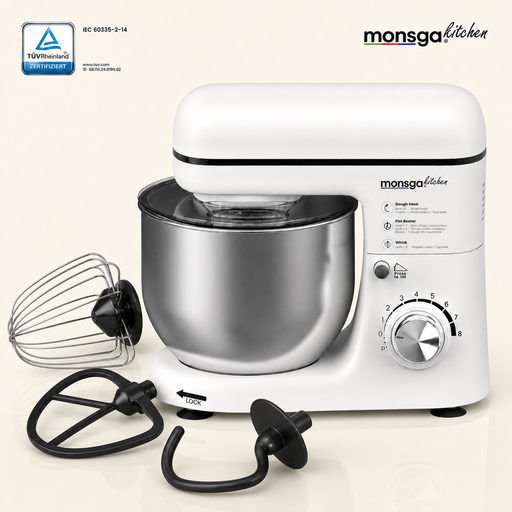
Why This Fits Their Persona: Suitable for bakers who value a coordinated kitchen appearance alongside a broad set of attachments and easier handling of sticky mixtures.
The product information identifies the 5.0-litre recommended working capacity and provides cleaning guidance instead of relying only on a large bowl-volume headline.
The dough hook and flat beater have a stated Teflon coating, while the stainless steel bowl and accessories are listed as dishwasher safe. It offers eight speeds and overload protection.

Why This Fits Their Persona: A larger-format option for families and frequent home bakers preparing bread, pizza, cakes, pastry or multiple batches.
Its specification lists 6.2 litres, 10 speeds plus pulse, and a model-dependent 660W–800W power rating, giving more useful detail than a single peak-power figure.
It includes a dough hook, whisk, beater and splash guard, with tilt-head locking, anti-slip suction feet and stated noise below 60dB.
We have compiled a complete, real-time list of products that fully satisfy these strict selection criteria and UK safety regulations.
Place the food mixer on a level, stable worktop with enough clearance for the tilt head. Lock the bowl and attachment in place before switching on. Start slowly when adding flour, and do not exceed the stated maximum dough quantity.
Unplug before changing tools or scraping the bowl. Wipe the motor housing with a damp cloth rather than immersing it. Stainless steel bowls should be dried thoroughly; avoid abrasive pads, wire brushes and bleach unless the manual specifically permits them.
For many households, yes. A 5 litre stand mixer can handle everyday cakes, biscuits, whipped cream and moderate dough batches, provided the recommended capacity is followed. Families making several loaves at once may prefer a larger bowl, but the worktop footprint and storage space should also be considered.
Lifespan depends on usage, recipe quantities, cleaning and maintenance. Avoid overloading the bowl, use the recommended speed for dough and observe rest periods if specified. Regularly check attachments, the power cable and bowl-locking mechanism, and keep the motor vents clear.
Running cost depends on the appliance’s rated power, time in use and your electricity tariff. A simple estimate is: rated kilowatts × hours used × your unit price. For example, a 600W appliance used for 10 minutes consumes approximately 0.1kWh, although actual consumption varies with load and motor design.