Large-batch bake-sale makers
If you plan to scale a recipe or mix several batches in one session, compare the recipe’s flour quantity with the machine’s stated pastry limit. Check its footprint before choosing a larger format.


For crumbly cheese-cracker dough, check the recipe’s attachment guidance and look for a mixer with a suitable flat or paddle beater; KitchenAid recommends that type of beater for normal-to-heavy mixtures and uses one for shortbread dough. Choose batch capacity by comparing your recipe’s flour quantity with the exact mixer’s stated pastry limit, not its bowl volume alone. A compact machine may suit smaller batches and cupboard storage, while a larger machine is worth considering if repeated bake-sale batches justify the space it takes up.
If you plan to scale a recipe or mix several batches in one session, compare the recipe’s flour quantity with the machine’s stated pastry limit. Check its footprint before choosing a larger format.
If you will usually put the mixer away after baking, cupboard space and a workable limit for your usual batch matter more than bowl size alone.
If crumbly dough is your main use, check the included beater and the recipe instructions rather than choosing a mixer solely because it has a dough hook. KitchenAid’s attachment guidance identifies its paddle for normal-to-heavy mixtures.
Start with the flour quantity and attachment your recipe calls for, then decide how much counter or cupboard space you can give the mixer.
| Concern | What to check | Who this matters to |
|---|---|---|
| Batch capacity | Compare your planned flour quantity with the exact model’s pastry or shortcrust limit; do not use bowl litres as a substitute. | If I need to scale up for the bake sale, I want to know whether the full recipe fits without exceeding the machine’s limit. Roughly 42% of consumers put batch capacity first. |
| Beater suitability | Check the recipe instructions and whether a suitable flat or paddle beater is included or compatible. | For a crumbly dough, I want the right mixing tool before I consider extra capacity. Around 33% of consumers prioritise beater suitability. |
| Space and future use | Measure storage and working clearance, and consider how often you will move or use the mixer after the sale. | If this is an occasional bake-sale purchase, I need somewhere practical to keep it afterwards. Approximately 25% of consumers put space and longer-term use first. |
A bowl’s volume does not tell you its pastry limit. Kenwood publishes different capacity guidance for its compact Prospero and larger Chef-format machines and warns against exceeding stated limits.
Write down the flour quantity for your intended batch, including any increase, and compare it with the exact model’s pastry guidance.
A crumbly cracker mixture may call for a flat or paddle beater instead. KitchenAid identifies its paddle for normal-to-heavy mixtures and uses a flat beater in its shortbread method.
Follow your recipe’s attachment instructions and check the contents and compatibility of the exact mixer you intend to buy.
If the required compatible beater is not included, it may need to be bought separately.
A larger format needs room to operate and somewhere practical to live between baking sessions. Bosch publishes different bowl sizes across its range, while KitchenAid offers a large bowl-lift format.
Measure the intended counter or cupboard, including clearance for a tilt-head mixer, and consider whether you will regularly lift the machine into storage.
Kenwood offers compact Prospero and larger Chef-format mixers with model-specific capacity guidance.
KitchenAid offers a 4.3L Classic tilt-head and a 6.6L Artisan bowl-lift format.
Bosch’s UK stand-mixer range includes Series 2, Series 4 and Series 6 machines.
These stand mixers offer different bowl sizes and formats to consider for cheese-cracker baking. Before choosing one for a bake-sale batch, confirm its suitable beater and model-specific pastry limit against your recipe.
 No image available
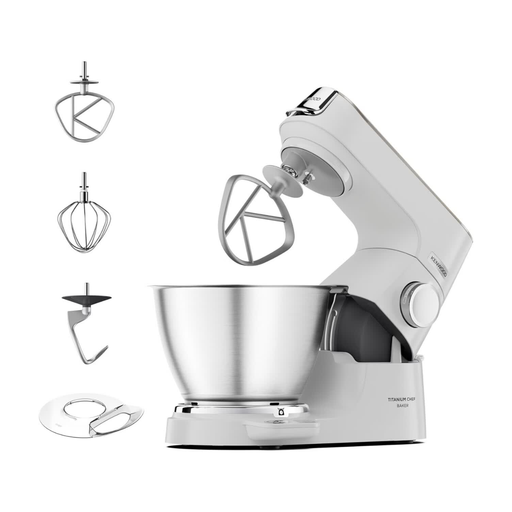
For a planned bake-sale batch, compare your recipe’s flour quantity with the KVC65.001WH pastry guidance before scaling it up. Check which beater comes with this variant and whether it suits your recipe.
 No image available
Consider this compact-mixer route if you expect to mix modest batches and store the appliance between uses. The product name specifies 1000W, a 4.3L bowl and three bowl tools; confirm the exact pastry limit and included beater before choosing it for cracker dough.
 No image available
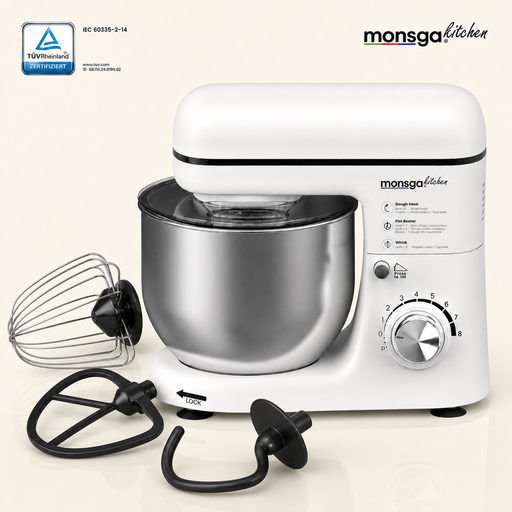
If a flat beater is essential to your cracker recipe, confirm the exact SM100 accessories before buying: the tool descriptions differ. The product name specifies a 5.0L bowl and eight speed settings; establish the pastry limit separately rather than judging batch size from bowl volume.
 No image available
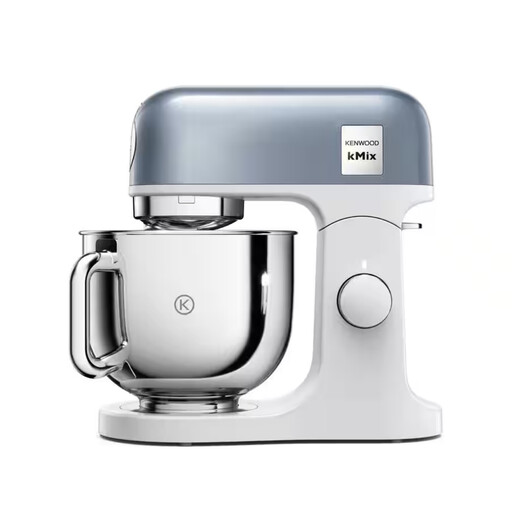
If you are considering this kMix for repeated cracker batches, check its exact pastry capacity against your scaled recipe. Confirm the supplied beater and the space needed to use and store this variant.
 No image available
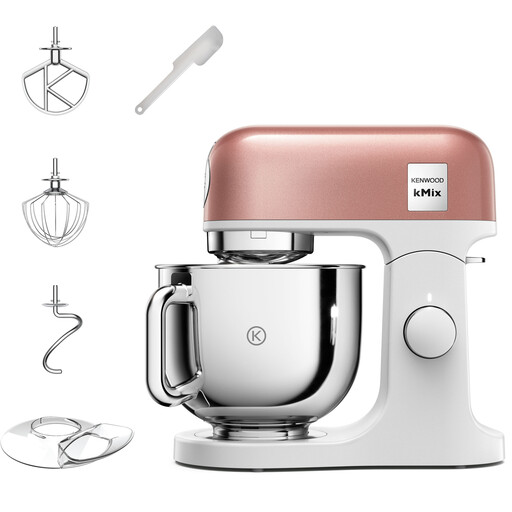
For a kitchen where the mixer will be put away between bakes, check the KMX760API dimensions and lifting weight as well as its pastry limit. Confirm that its supplied beater matches your cracker-dough method.
Follow your recipe’s instructions; for a crumbly, cookie-style mixture, check for a suitable flat or paddle beater. KitchenAid describes its paddle as a tool for normal-to-heavy mixtures and uses a flat beater to bring shortbread dough together.
Not on bowl size alone: compare the doubled flour quantity with the exact model’s stated pastry limit. Kenwood warns that exceeding its listed capacities can damage a machine, and its limits differ by mixer and dough type.
Follow the care instructions for the exact mixer and each attachment. Check which parts can be washed in a dishwasher rather than assuming the bowl, beater and whisk all need the same treatment.
For a mixer supplied in Great Britain, check the exact model’s documentation and applicable conformity marking with the seller. Government guidance for relevant Great Britain product rules recognises CE marking alongside or in place of UKCA marking; Northern Ireland has separate arrangements. A marking alone does not establish that a particular listing meets every applicable requirement.