One-off party bakers
If this is your main planned use, compare the recipe quantity with the bowl guidance and look for a suitable supplied beater. Worktop space and cleaning may matter more to you than a high dough-capacity figure.


Choose a stand mixer around the amount of doughnut batter you need to make at once, then check the supplied beater and the space the machine will occupy. A compact bowl can suit a modest batch, while a larger bowl or second bowl is worth considering for repeated mixes; neither bowl litres nor motor wattage alone establishes how much of your recipe a mixer can handle.
If this is your main planned use, compare the recipe quantity with the bowl guidance and look for a suitable supplied beater. Worktop space and cleaning may matter more to you than a high dough-capacity figure.
If you would rather not keep stopping to scrape down sticky batter, check the exact beater supplied. Sage positions its scraper beater for sticky batters, but that accessory should not be assumed to come with other mixers.
If you plan several mixes or want separate bowls for batter and another mixture, a larger or two-bowl machine may be useful. Check its weight and where it will live between baking sessions.
Start with your recipe quantity and the manufacturer’s guidance for that type of mixture. Then compare beaters, storage and the baking tasks you expect after the party.
| Concern | What to check | Who this matters to |
|---|---|---|
| Batch size and headroom | Compare your recipe quantity with the exact model’s food-specific capacity guidance; do not treat a dough or cake limit as a doughnut-batter limit. | If I need enough batter for the party without repeatedly emptying the bowl, usable mixing headroom is my priority. Around 36% of consumers put batch capacity first. |
| Mixing and scraping | Check whether a flat beater or scraper beater is supplied, and follow the model’s attachment and speed instructions. | For sticky batter, I want to spend less time stopping to scrape the bowl sides. Roughly 29% of consumers prioritise mixing coverage and scraping. |
| Space and cleaning | Measure the worktop or cupboard, consider the machine’s weight, and check which parts the manual permits you to put in a dishwasher. | If I have to put the mixer away after baking, lifting and cleaning it affect whether I will use it again. About 21% of consumers put handling and clean-up first. |
| Use beyond the party | Check the included bowl tools and distinguish them from optional attachments before planning other recipes. | If I will also whisk toppings or make other baked goods, I want the supplied tools to cover those jobs. Around 14% of consumers make wider baking use their primary concern. |
A bowl’s volume is not a maximum for every mixture. Kenwood and KitchenAid give food-specific capacity figures, which cannot be converted directly into a limit for your doughnut batter.
Check your recipe quantity against the exact mixer’s instructions and allow the mixing headroom they require.
A standard flat beater and Sage’s scraper beater are different accessories. A photograph of an attachment, or its inclusion with another variant, does not establish what comes in your box.
Confirm the supplied tools and their compatibility with the exact model before choosing it for batter.
A preferred scraper beater may be an optional, model-specific accessory.
Large bowls can be useful for repeated mixes, but the Kenwood Titanium Chef Baker XL is listed at 11.5kg. Regularly lifting a machine of that weight may be inconvenient.
Measure both its intended worktop position and the route to storage before ordering.
Electrical Safety First advises checking for a UK three-pin plug and fuse and buying from a reputable retailer rather than an unverified third-party seller.
Confirm the plug and seller documentation for the appliance you intend to buy. Unplug it before cleaning and follow its manual.
Bosch’s MUM Series 2 MUMS2VM40G illustrates a smaller-bowl route, with a 3.8L usable volume, seven speeds plus pulse and planetary mixing.
The 4.7L Artisan 5KSM125 is a tilt-head mixer supplied with a paddle, whisk and dough hook; KitchenAid specifies 10 speeds and planetary action.
Sage’s Bakery Boss BEM825BALUK has 4.7L and 3.8L bowls and a supplied double-sided scraper beater.
The Titanium Chef Baker XL KVL85.004SI illustrates a two-bowl route, with 7L and 5L bowls, a timer and direct-to-bowl weighing.
These stand mixers offer bowl sizes and supplied mixing tools to compare for birthday-party batter. Match the exact recipe quantity to the manufacturer’s instructions before choosing a model; the products below are not the same models as the brand examples above.
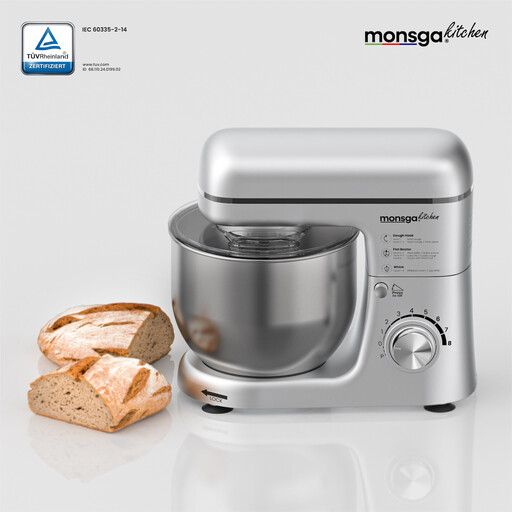 No image available
Consider this bowl size if your planned batch fits the manufacturer’s mixing guidance. The title specifies a stainless-steel bowl, eight speed settings, a whisk, dough hook and splash guard; its 1000W figure is peak power, not a continuous rating.
Confirm the suitable tool for your recipe and the appliance’s UK plug and fuse before buying.
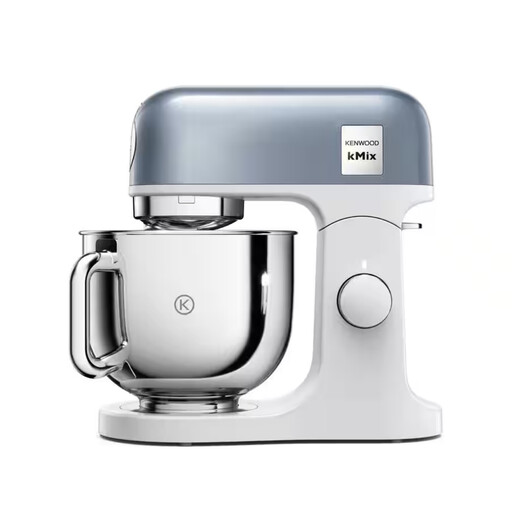
 No image available
Consider this model if mixing batter and weighing ingredients into the bowl are both useful to you. Confirm its supplied mixing tool and food-specific capacity against your recipe rather than using a cake or dough maximum as a batter limit.
Check the UK plug and fuse for the item offered.
 No image available
Consider this model if you want a stand mixer for batter and other home baking. Before deciding, compare the planned batch with its food-specific instructions; a cake-mix figure is not a doughnut-batter limit.
Check the supplied beater and UK plug and fuse for this variant.
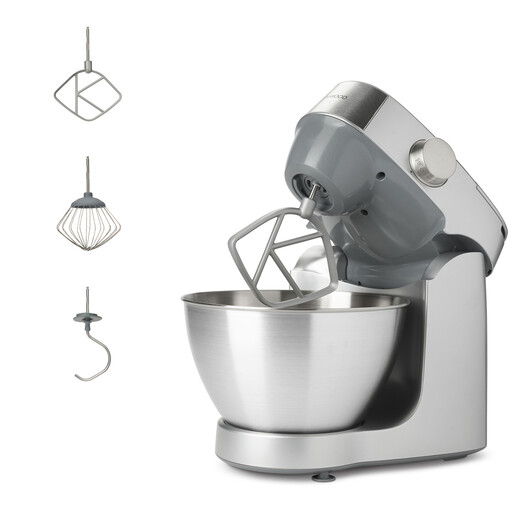 No image available
Consider this 4.3L model if storage space matters alongside batter preparation. Its title specifies a 1000W rating and three bowl tools; check which tool the recipe requires and whether your batch fits the manufacturer’s instructions.
Confirm the UK plug and fuse for the item offered.
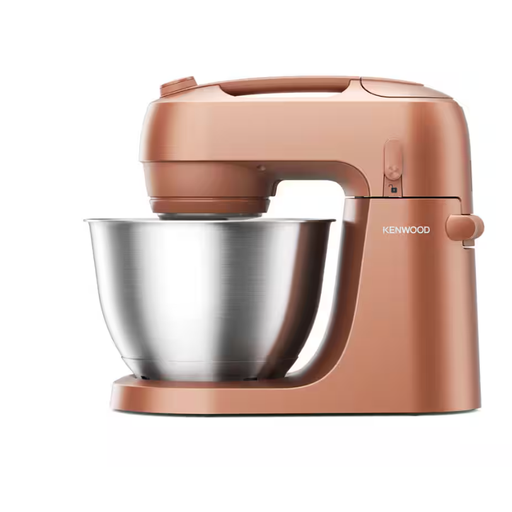 No image available
Consider this model if limited storage space is central to your choice. Check its bowl guidance against the planned batter quantity, and confirm the supplied beater suits your recipe.
Read the bowl and tool cleaning instructions and confirm the UK plug and fuse before buying.
Not necessarily. Decide from your recipe quantity and mixing instructions: a stand mixer is worth considering if you want a stable bowl and suitable capacity for the party batch, but use only the attachment and method specified for the recipe and machine.
No. A 7L bowl is useful to consider when your recipe or repeated mixes warrant the space, not simply because the occasion is a party. Manufacturer capacities vary by food and model, so check the exact recipe against the mixer’s instructions.
No single wattage figure establishes batter capacity or mixing quality. Compare the exact model’s bowl guidance, supplied beater and speed instructions with the quantity you plan to make; distinguish peak power from a rated-power figure where both are given.
Check the appliance’s plug, fuse and seller documentation for your delivery location. Electrical Safety First advises a UK three-pin plug and fuse and recommends buying from a reputable retailer rather than an unverified third-party seller.
Unplug the mixer first, keep the motor unit out of water and follow the model’s instructions for washing its bowl and tools. Check which individual parts are dishwasher-safe rather than assuming every attachment can go in the dishwasher.