Buffet bakers planning large dough batches
If you are making enough buns, rolls or brioche-style items for a buffet, the stated dough limit matters more than an attractive bowl-litre figure.


Choose a stand mixer by the exact model’s stated dough limit and dough-tool setup before judging its bowl volume or convenience features. Manufacturers’ bread-, yeast- and generic-dough figures are not interchangeable tests of enriched dough, so check the manual against your recipe and plan a smaller first batch where needed.
If you are making enough buns, rolls or brioche-style items for a buffet, the stated dough limit matters more than an attractive bowl-litre figure.
You want to weigh ingredients, handle the dough and move between buffet tasks without choosing solely on maximum stated capacity.
You need a mixer for dough now but also want to check whether compatible attachments could serve future slicing, mincing, blending or pasta-making plans.
For buffet-scale enriched dough, establish a workable batch size first, then decide which preparation features and physical dimensions suit your kitchen.
| Concern | Buying checks | Who this matters to |
|---|---|---|
| Dough-batch capacity | Check the exact model’s limit and the type of dough it describes. Use its manual and your recipe to set a smaller rich-dough batch if necessary. | If I need enough rolls for a buffet, I want to know how many batches I must make rather than rely on bowl size; around 46% of consumers put declared dough capacity first. |
| Mixing workflow | Check the supplied dough tool and bowl arrangement, then decide whether scales, a timer or a second bowl would ease preparation. | When several buffet dishes need attention, I want a mixing routine that is easy to manage between tasks; workflow is the primary concern for around 36% of consumers. |
| Space and versatility | Measure counter and overhead clearance. If you plan to add accessories, check compatibility with the exact mixer model. | If the mixer must fit beneath cupboards and serve other prep jobs later, I need room to use and store it; roughly 18% of consumers prioritise space and versatility. |
A large bowl does not establish how much dough its mixer is specified to handle. Kenwood, for example, states a 2.56 kg dough capacity for the KVL85.004SI despite its 7 L main bowl.
Find the dough limit for the exact model and start with a conservative batch of your enriched-dough recipe.
KitchenAid’s figure for the 5KSM60SPX describes bread dough, Bosch’s Series 6 figure describes yeast dough, and Kenwood’s KVL85.004SI lists dough capacity. Those labels do not establish a like-for-like result for rich dough.
Use the figures to narrow your choices, then follow the chosen model’s manual when setting a batch size for a buttery or sugary recipe.
Kenwood’s attachment guidance distinguishes mixer models, and some attachments require an adaptor.
Match the accessory and any required adaptor to your exact mixer model before buying them.
A mixer that fits on the worktop may still need space above it to lift its head or use an attachment.
Measure the intended position and the clearance needed to operate the mixer, not just its storage footprint.
The 5KSM60SPX bowl-lift model is relevant if you are considering a large stated dough batch and have space for its taller format.
Series 6 is worth considering if weighing and timed preparation matter alongside a stated yeast-dough capacity.
The Chef Baker XL KVL85.004SI offers a two-bowl arrangement for cooks who want to move between buffet preparation tasks.
These Kenwood mixers are options to consider for buffet dough preparation. Before planning a full enriched-dough batch, check each exact model’s manual against your recipe rather than using bowl volume as its dough limit.
 No image available
Consider this model if weighing ingredients at the mixer would help you manage several buffet recipes. Check the supplied dough tool and the exact model’s manual before settling on an enriched-dough batch size.
 No image available
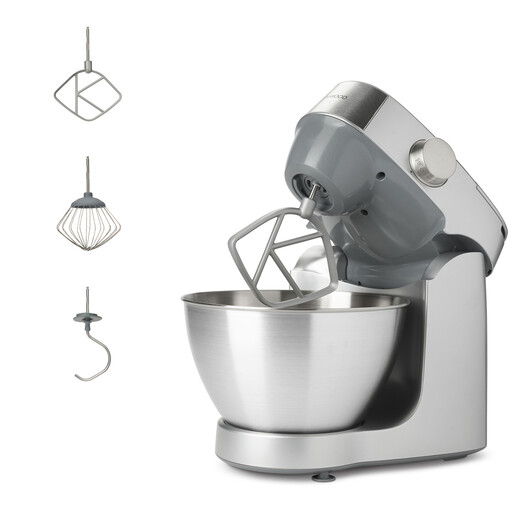
If counter space affects your choice, compare this model’s dimensions with the spot where you will use it. Its named configuration is 1000 W with a 4.3 L bowl and three bowl tools; confirm the supplied tools and a suitable dough-batch size for your recipe.
Choose around the dough mass you intend to mix, using the exact model’s stated limit rather than its bowl litres. KitchenAid states up to 3.7 kg of bread dough for the 5KSM60SPX, Bosch lists up to 3.0 kg of yeast dough for Series 6, and Kenwood specifies 2.56 kg of dough for the KVL85.004SI. Because those figures describe different dough categories, consult the manual and start below the stated maximum for a new rich-dough recipe.
No: bowl volume and stated dough capacity are different specifications. Kenwood gives the KVL85.004SI a 7 L main bowl but a 2.56 kg dough limit, so check the limit for the precise mixer and dough type you plan to use.
A bowl-lift model is worth considering if a firmly locked bowl suits your mixing routine and you can accommodate a taller appliance. KitchenAid says the 5KSM60SPX bowl locks at three points, but that feature alone does not establish how much of your particular enriched dough it can knead.
Not necessarily: check the attachment against your exact mixer model before ordering. Kenwood’s compatibility guide identifies model-specific connections, and some attachments require an adaptor.