Bake-sale batch makers
If you are filling several trays for a school, charity or community sale, bowl headroom matters more than a compact footprint. Check whether the recipe can be mixed in one load rather than assuming bowl volume alone tells you.


Choose a stand mixer around the amount of oat-bar mixture you make and how thick it is: a larger bowl makes more sense for repeated or oversized batches, while a smaller machine may suit an occasional tray and limited space. Check the supplied beater, the model's loading guidance and its dimensions before buying; a published cake-batter capacity is not an oat-bar-specific limit. If the bars are for a sale, mixer choice does not replace food-safety and allergen-information checks.
If you are filling several trays for a school, charity or community sale, bowl headroom matters more than a compact footprint. Check whether the recipe can be mixed in one load rather than assuming bowl volume alone tells you.
For one tray or an occasional sale, consider where the mixer will stand, how it will be stored and whether you will use it for everyday baking afterwards.
If your oat-heavy mixture is sticky, look for a supplied flat beater or equivalent and check the exact model's loading instructions. Headline wattage alone does not establish how much of your recipe it can mix.
Decide whether batch size, handling a thick mixture or kitchen space would change your purchase first; then compare the exact models against that need.
| Concern | What to check | Who this matters to |
|---|---|---|
| Batch capacity | Compare bowl volume with the maker's relevant food-capacity guidance, leaving room for the ingredients to move. | If I am filling several trays, I want to avoid dividing the mixture into many loads. Around 50% of consumers put batch headroom first. |
| Thick-mixture handling | Confirm that a flat beater or equivalent is supplied and follow the model's loading and speed instructions. | When my recipe is sticky and oat-heavy, I care most about having the right mixing tool and knowing how much the machine can take; around 30% of consumers prioritise that concern. |
| Space and everyday use | Measure the operating and storage space, including clearance for adding ingredients or raising the head. | If I make one tray occasionally, I need a mixer I can keep and use comfortably after the sale. For around 20% of consumers, that practical fit comes first. |
A power figure does not tell you the permitted load for a particular oat-bar recipe. Bowl size, the supplied tool and the model's food-capacity guidance answer different parts of that question.
Compare those details for the exact model, then follow its manual when mixing a thick batch.
Manufacturers such as Kenwood and Bosch publish capacities for specified foods, including cake batter. An oat-bar mixture may differ in moisture and added ingredients, so those figures are not guaranteed limits for it.
Leave headroom and divide an oversized recipe rather than filling the bowl to a cake-batter figure.
Even a bowl that suits the batch may come with a machine that is awkward to position, open or store.
Measure the worktop and storage location, including the clearance needed to add ingredients and operate the head or bowl-lift mechanism.
GOV.UK and the Food Standards Agency state that food supplied, sold or provided at community and charity events must comply with food law and be safe to eat. The cited guidance applies to England, Northern Ireland and Wales.
Before the event, check the applicable local-authority guidance and the allergen-information requirements for how the bars will be offered. For an event in Scotland, consult the guidance applicable there.
These model and range examples illustrate different sizes and formats; check the specification of the particular mixer you intend to buy.
The Chef range includes larger-bowl mixers, with the Chef XL KVL4100W illustrating a batch-focused option.
The cited models offer a choice between a 4.3 L tilt-head format and a 6.6 L bowl-lift format.
Bosch Series 4 is a smaller-bowl route for bakers balancing an occasional batch against kitchen space.
These stand mixers offer bowl sizes and formats to consider for an oat-bar batch. Compare the named variant's tools, loading guidance and fit in your kitchen before choosing.
 No image available
Consider this for a home-scale batch if its loading guidance accommodates your recipe.
The named variant states 1000 W and three bowl tools; confirm that the tool you want for combining the mixture is supplied.
 No image available
If you want to prepare a sizeable batch, check this model's guidance for your recipe quantity rather than relying on its bowl size alone.
Confirm the supplied beater and measure your counter and storage space before ordering.
 No image available
Consider its larger named bowl size if you plan to make a substantial batch, but check the permitted mixture load separately.
The named set includes a beater, dough hook and whisk. Measure the space needed to raise its tilt head.
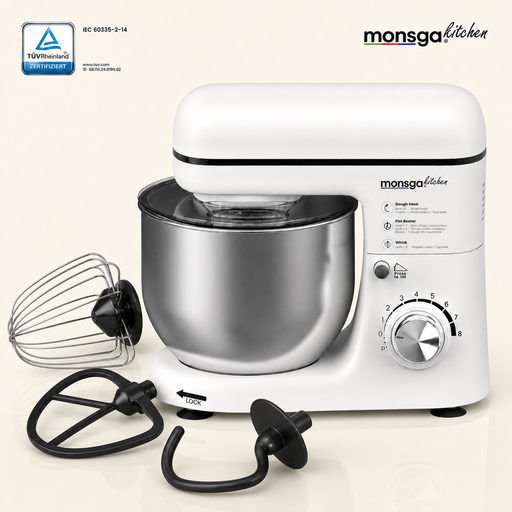 No image available
If a beater is central to your oat-bar recipe, this named set includes one; check the model instructions for the appropriate load.
It also names eight speed settings, a whisk, dough hook and splash guard. Confirm the usable bowl capacity and available worktop space.
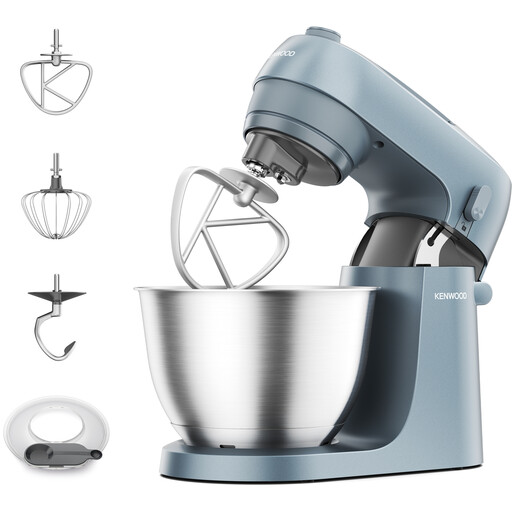 No image available
Consider this for an occasional batch where a smaller mixer is easier to accommodate; check whether your recipe needs dividing.
Confirm the bowl capacity, supplied beater and colour of this exact variant before ordering.
Start with your recipe yield and whether you intend to double it. Kenwood GB lists a 6.7 L bowl and 5 kg cake capacity for the Chef XL KVL4100W, while Bosch Home UK lists a 3.9 L bowl for Series 4; neither figure establishes a safe maximum for a thick oat-bar mixture. Check the model's loading guidance and split the recipe if necessary.
Check for a flat beater, paddle or equivalent mixing tool for combining the ingredients. Kenwood GB lists a K-beater with the Chef XL KVL4100W, and KitchenAid UK lists paddles with the cited Classic and Artisan models. Follow the chosen model's instructions for the tool, speed and load.
It depends on the exact attachment and model. KitchenAid UK says the bowl, paddle and dough hook for its Classic 5K45SS can go in the dishwasher, while its whisk should be washed in warm soapy water. Check the care instructions for any other mixer or accessory.
Check the allergen-information requirements that apply to how you offer and package the oat bars. GOV.UK and Food Standards Agency guidance for food businesses covers allergen information in England, Northern Ireland and Wales; consult the relevant local authority about your event and use guidance applicable in Scotland if the sale is held there. Keep the ingredients you communicate consistent with the recipe you make.
Yes, ask the relevant local authority whether registration applies to your planned activity rather than assuming that a bake sale is exempt. GOV.UK and Food Standards Agency community-event guidance for England, Northern Ireland and Wales states that food supplied, sold or provided at such events must comply with food law and be safe to eat; check the guidance applicable to an event in Scotland separately.