Party-scale pasta planners
If you are preparing dough for several guests, check the model’s stated ingredient or dough limit against your recipe. Bowl volume alone will not tell you how many mixes you will need.


Choose a stand mixer by the amount of dough your recipe requires and the exact model’s stated dough or flour limit, rather than bowl size alone. If you also want the mixer to roll or cut pasta, check the attachment and its compatibility separately; a smaller machine may be easier to store, but could mean mixing more batches for the party.
If you are preparing dough for several guests, check the model’s stated ingredient or dough limit against your recipe. Bowl volume alone will not tell you how many mixes you will need.
If the mixer will also be used for baking and future pasta nights, consider the dough tool alongside the roller or cutter you might add later. Check that any attachment fits the exact mixer.
If this party is an occasional reason to make pasta, weigh the batch size you need against the space the mixer will occupy when it is not in use.
Work out your recipe’s flour quantity and how many batches you can make before choosing a mixer. Then decide whether powered rolling is worth adding and where the machine will be stored.
| Concern | What to check | Who this matters to |
|---|---|---|
| Batch capacity | Check the exact model’s dough or flour limit and the recipe it applies to; leave room to divide your planned dough into batches. | I need dough for several guests without spending the party preparation time on repeated mixes; around 42% of consumers put batch capacity first. |
| Pasta workflow | Confirm whether a roller or cutter is included or optional, which shapes it makes and whether it fits the mixer’s connection. | If I plan to make pasta again, I want to know how the dough will become sheets or cut shapes after mixing; roughly 33% of consumers prioritise that workflow. |
| Space and occasional use | Compare the machine’s dimensions and weight with your worktop, overhead clearance and storage space. | For occasional gatherings, I need a mixer I can use and put away without committing too much kitchen space; about 25% of consumers place that need first. |
Capacity figures need their original context. Bosch Home UK lists maximum yeast-dough quantities for its mixer series, while KitchenAid UK publishes flour limits for particular models. Neither measure can be converted directly into a fresh-pasta serving count. Use your recipe and the exact mixer’s instructions to plan the batches.
A bowl’s volume is not a fresh-pasta-dough limit. KitchenAid UK’s flour limits and Bosch Home UK’s yeast-dough limits describe different measures, so even their published capacities cannot be compared as pasta portions.
Check the limit and recipe basis for the exact model, then plan whether your own recipe needs more than one mix.
KitchenAid UK says its 5KSMPSA roller fits all KitchenAid stand mixers. Kenwood’s compatibility guide instead distinguishes mixer families and connection types, with an adapter needed in some cases.
Match the attachment code and connection to the precise mixer model before ordering.
An adapter may be another item to obtain where the specified connection requires one.
The dough hook is for mixing and kneading; rolling sheets and cutting shapes are separate stages. A mixer purchase does not, by itself, establish which pasta tools are included.
Decide whether you need mixing, rolling, cutting or all three, then check the contents of the exact package and any optional attachments.
The machine must fit where you will use it, not just where you intend to store it. Bosch Home UK advises allowing worktop space, access to an electrical outlet and overhead room for attachments that connect on top.
Measure the working and storage positions, including clearance beneath cabinets.
These product lines illustrate different capacity and attachment checks; compare the specifications and compatibility of the model you intend to buy.
Worth considering if you want to choose a mixer now and add a mixer-powered pasta roller or combined roller and cutter later.
A brand to compare if you want a mixer for dough and other cooking, with optional pasta tools as part of the decision.
Useful for comparing smaller and larger kitchen-machine formats when batch planning and storage both matter.
These mixers are relevant to mixing party pasta dough, with different bowl sizes and tools named in their listings. Choose against your recipe and storage space; check the exact model’s dough limit and any pasta-attachment compatibility before relying on it for the full preparation workflow.
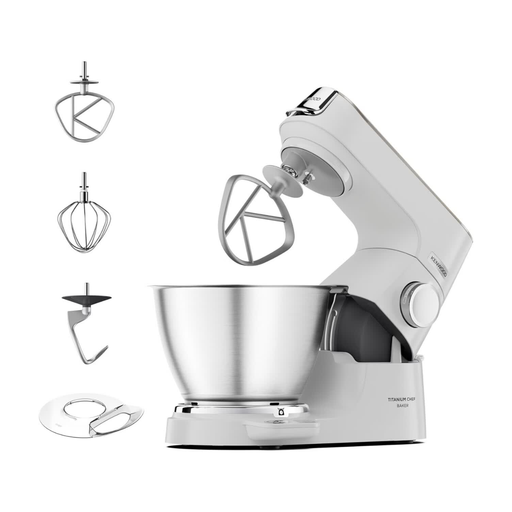 Image unavailable
Consider this model for mixing the party dough if its stated limit accommodates your recipe and planned number of batches. Its listing identifies a dough hook; check the exact manual before treating the listed dough limit as a fresh-pasta limit, and confirm any roller or cutter separately.
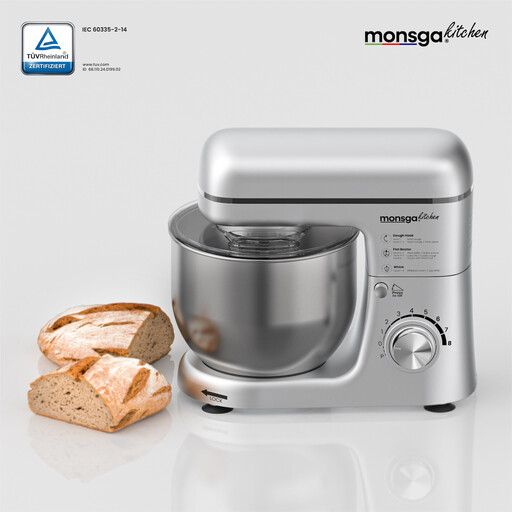 Image unavailable
The named dough hook makes this a mixing option, but plan party batches using the exact model’s dough limit rather than its bowl volume. The product name specifies a 5.0 L stainless-steel bowl, eight speed settings and 1000 W peak power; check roller or cutter compatibility separately.
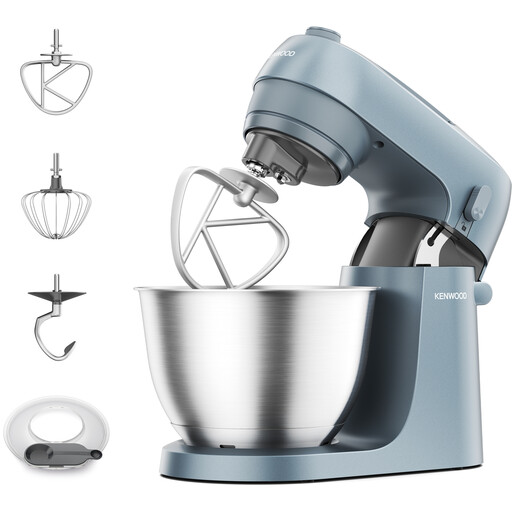 Image unavailable
This compact-model option may suit a kitchen where the mixer must be put away after the party. The listing identifies a dough hook, while the exact model’s dough limit needs checking before you decide how many batches to prepare; the product name identifies the KZM35.000GY variant.
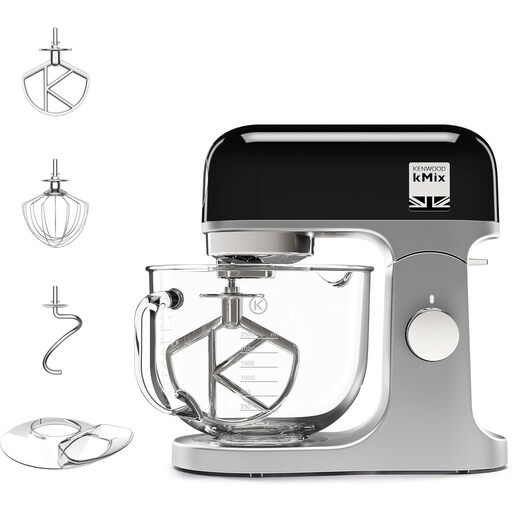 Image unavailable
Consider this variant if you want to mix dough now and might add pasta-making tools later. Its product name specifies a 5 L bowl, 1000 W rating and dough hook; check the KMX754BK’s dough limit and the compatibility and inclusion of any optional pasta attachment rather than applying figures from another kMix model.
 Image unavailable
The named dough hook makes this relevant to mixing, but the 6.5QT bowl does not establish how much pasta dough to make in one batch. The product name also specifies ten speeds, a whisk and a beater; check the exact dough limit and any roller or cutter compatibility for this mixer.
Choose using your recipe quantity and the exact mixer’s published ingredient or dough limit, not bowl litres alone. Bosch Home UK lists yeast-dough capacities of 1.7 kg, 1.9 kg and 3.0 kg across its Series 2, 4 and 6, while KitchenAid UK publishes model-specific flour limits; neither measure states how many fresh-pasta portions you can make.
No: the hook mixes or kneads dough, while rolling and cutting require other tools. KitchenAid UK says its 5KSMPSA attachment rolls pasta at eight thickness settings; its 5KSM3MPA combines a roller with fettuccine and spaghetti cutters. Check which tools are included with the package you choose.
Handle the eggs and dough hygienically and check guests’ allergies and dietary requirements. The Food Standards Agency notes that no egg can be guaranteed free from Salmonella; its guidance on eating raw or lightly cooked eggs has conditions concerning the eggs used and the people eating them. Follow applicable food-handling guidance rather than assuming every egg dish has the same risk.
A private party should not be treated as a food business simply because you make pasta for guests. If you are supplying food as a business, including from home, Food Standards Agency guidance says to register with the local authority; check the requirements that apply before starting that activity.