Occasional picnic cake bakers
You make ordinary home-sized cakes and want to weigh the space a stand mixer will occupy against how often you will use it. A suitable bowl and cake-mixing tool matter more to you than maximum batch capacity.


For an ordinary home-sized chocolate cake, start with a stand mixer that includes a paddle or beater, offers adjustable speeds and has a bowl that fits your recipe; a 4.7–5L model is a sensible size to consider. A larger bowl, integrated scale or second bowl is more relevant if you regularly make several cakes or prepare separate components, but check the machine’s storage demands as well as its stated cake-mixture capacity.
You make ordinary home-sized cakes and want to weigh the space a stand mixer will occupy against how often you will use it. A suitable bowl and cake-mixing tool matter more to you than maximum batch capacity.
You often make more than one cake or prepare separate components. Stated cake-mixture capacity, a second bowl and direct-to-bowl weighing are worth checking for your usual baking routine.
You want a cake-mix programme or integrated scale to reduce manual steps. Check what the exact model’s programme does, while still using the appropriate attachment and following your recipe.
For a picnic chocolate cake, check the batter tool and your usual batch size first. Weigh preparation conveniences against the space the mixer will need between bakes.
| Concern | What to check | Who this matters to |
|---|---|---|
| Mixing the batter | Check that the exact package includes a paddle or beater and has adjustable speeds. Consider whether you may need to stop and scrape the bowl. | If evenly combined batter is my main concern, I want control over mixing without assuming the tool reaches every part of the bowl; roughly 33% of consumers would put this need first. |
| Batch size | Compare stated cake-mixture capacity with your recipe, not just bowl volume; check whether an additional bowl is supplied. | When I am making several cakes or separate components, I need enough mixing capacity without repeatedly emptying the bowl. Around 27% of consumers would prioritise that batch workflow. |
| Preparation and washing-up | Check whether the exact package includes direct-to-bowl weighing or a splashguard, if either would simplify your routine. | I would rather measure ingredients into the mixing bowl than use more separate equipment; approximately 20% of consumers would make this convenience their primary concern. |
| Space between bakes | Measure the storage spot and the clearance needed to access the bowl or raise a tilt head; consider the mixer’s weight. | For an occasional cake, I need an appliance I can store and bring out comfortably. Roughly 20% of consumers would place space and handling first. |
A wattage figure does not tell you which batter tool comes in the box or how much cake mixture the machine is stated to handle.
Compare the exact package’s attachments, cake-mixture capacity, bowl size and speed controls before considering wattage.
For example, Kenwood GB lists the Titanium Chef Baker XL KVL85.004SI at 11.5kg and 22.5 × 37 × 40cm. Those dimensions matter if you plan to move or store it after each bake.
Measure its intended position and leave room to reach the bowl or raise the head.
Which? reports that stand mixers in its testing differed in whether attachments reached every area of the bowl, sometimes requiring a pause to scrape the sides.
Use the appropriate paddle or beater and follow the recipe’s mixing stages, stopping to scrape the bowl when needed.
Its range includes 5L kMix models and larger Chef machines, so the exact model matters when comparing an occasional cake with regular batch baking.
The Artisan 5KSM125 is a tilt-head option for bakers considering manual speed control and standard mixing tools.
The cited Series 6 model is relevant if you want a larger bowl, integrated weighing and a cake-mix programme.
Smeg’s stand-mixer range offers retro styling alongside planetary mixing and variable speeds.
These stand mixers offer different bowl sizes and cake-mixing tool packages to consider for a picnic bake. Match the exact model to your recipe quantity, available space and preferred way of controlling the mix.
 No image available
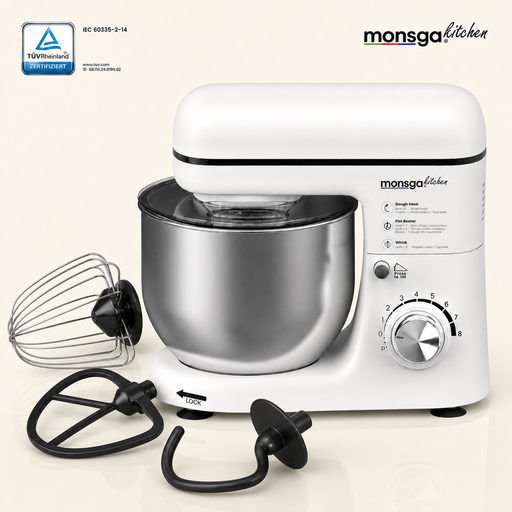
For a home cake batch, this variant lists a 5.0L bowl, beater and eight speed settings. Check its stated cake-mixture capacity against your recipe rather than relying on bowl volume alone.
 No image available
If direct-to-bowl weighing would help with cake preparation, check the exact KVC65.001WH package and its supplied mixing tools. Plan a convenient counter or storage position before choosing this variant.
 No image available
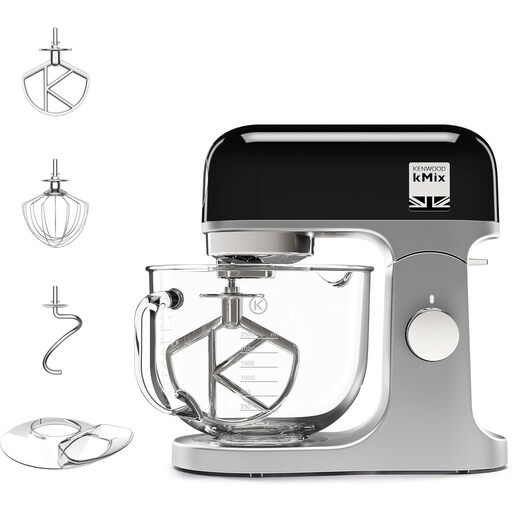
For routine cake mixing, this 5L variant lists a K-Beater and six speeds. Confirm the supplied bowl material before ordering, as the product information gives conflicting descriptions.
 No image available
If you expect to make larger batches, this variant lists a 6.5QT bowl and a beater. Check its stated cake-mixture capacity and physical dimensions for your recipe and storage spot; bowl volume alone does not settle either question.
 No image available
For smaller home cake batches, this 4.3L variant lists three bowl tools. Check that its bowl fits your recipe and that its mixing action and supplied beater meet your batter-making needs.
Not necessarily: for an ordinary home-sized cake, consider a 4.7–5L mixer with a suitable paddle or beater and adjustable speeds. Check your recipe against the model’s stated cake-mixture capacity; a larger bowl becomes more relevant if you regularly make multiple cakes or larger batches.
Check that the exact package includes a paddle or beater for cake mixing. KitchenAid UK lists a paddle, wire whisk and dough hook with the cited Artisan 5KSM125 package, but accessories should be checked for the variant you intend to buy.
No; it is a preparation convenience if you prefer to weigh ingredients into the mixer. Kenwood GB and Bosch GB describe integrated weighing on the cited Chef Baker XL and Series 6 models, but you can weigh ingredients separately when using a mixer without that feature.
Check the exact product’s documentation, supplied plug and voltage for where you will use it. GOV.UK explains that UKCA or CE marking indicates the manufacturer believes a product meets relevant requirements; the applicable marking rules depend on the product and whether it is placed on the Great Britain or Northern Ireland market. Do not treat a marking alone as an independent performance assessment.
No; mixing the batter and transporting the finished cake are separate tasks. Allow for cooling and packaging, and plan suitable temperature control if its filling or topping needs refrigeration.