Family-batch icing makers
If you are icing biscuits, cupcakes or a cake for relatives, you need to match the bowl and supplied whisk to the quantity you will prepare, rather than choosing capacity in isolation.


For royal icing at a family gathering, choose a stand mixer with a whisk supplied for the exact model, adjustable speeds and a bowl that suits the amount you usually make. A compact mixer may suit an occasional batch and limited storage; a larger or second bowl becomes more relevant if you regularly make several colours or other large baking batches. Whatever the mixer size, check the icing’s consistency as you work.
If you are icing biscuits, cupcakes or a cake for relatives, you need to match the bowl and supplied whisk to the quantity you will prepare, rather than choosing capacity in isolation.
If you plan to pipe details and fill larger areas, adjustable speed and a suitable whisk matter alongside the recipe-led texture checks needed for each consistency.
If the mixer will be put away between gatherings, consider where it will fit and how easily you can move it, while still checking the bowl and whisk against your usual batch.
Start with the whisk and speed controls, then match bowl capacity to your batch and check where the mixer will live. Good Food’s iced-biscuit recipe calls for icing beaten until fairly thick and glossy; a mixer does not remove the need to judge its texture.
| Concern | What to check | Who this matters to |
|---|---|---|
| Icing control | Confirm the exact bundle includes a whisk and offers adjustable speeds; check how its lowest setting starts. | If I am piping details and filling biscuits, I want to adjust the mix without losing track of its texture. Around 40% of consumers put icing control first. |
| Batch workflow | Compare usable bowl capacity and whether a second bowl or splashguard is supplied; consider the smallest quantity the whisk will reach. | When I have several colours to prepare, I want enough room and a manageable way to move between mixes. For around 30% of consumers, batch workflow is the primary need. |
| Storage and value | Measure worktop and cupboard space, including clearance to lift a tilt-head mixer; compare the tools supplied with each model. | If I bake mainly for occasional gatherings, I do not want a machine that is awkward to put away. Storage and value come first for around 30% of consumers. |
Extra capacity can be useful for repeated batches, but it does not establish how well a whisk will reach a small quantity. A larger machine also needs a suitable place to store it; Kenwood lists its Titanium Chef Baker XL at 11.5 kg.
Choose capacity around the quantities and number of colours you usually prepare, and check the whisk’s suitability for your smallest batch.
Wattage figures do not, by themselves, tell you how a mixer will handle your icing or which tools come in the box.
Check the supplied whisk, speed controls and bowl first, then consider wattage as one model-specific specification.
Smeg identifies its SMWW02 wire whisk as compatible with the SMF03 stand mixer, but not the SMF05.
Check both the precise mixer model and the whisk included in its bundle before ordering an accessory.
A separately purchased whisk means another item to source if the bundle does not contain the one you need.
These model ranges illustrate different bowl sizes and layouts; a brand name alone does not establish what comes with a particular bundle.
Kenwood has compact and larger-bowl models relevant to different batch sizes. Its Titanium Chef Baker XL specification lists 7 L and 5 L bowls and a stainless-steel whisk.
KitchenAid lists a 4.7 L bowl and ten speeds for the tilt-head Artisan 5KSM125; its 5KSM175 package includes both 4.7 L and 3 L bowls.
Bosch specifies a 3.9 L usable bowl volume and seven switching stages for the MUM58259GB.
Smeg offers a wire-whisk accessory identified for the SMF03 stand mixer.
These stand mixers include compact-batch and larger-bowl choices. Match each exact bundle to your icing quantity, storage space and need for a whisk rather than treating bowl size as a measure of icing quality.
 No image available
Consider the 4.3 L bowl for a moderate family icing batch if it suits your usual quantity.
The product name lists three bowl tools and a 1000 W rating; check the exact bundle for the whisk you need and whether it reaches a smaller batch.
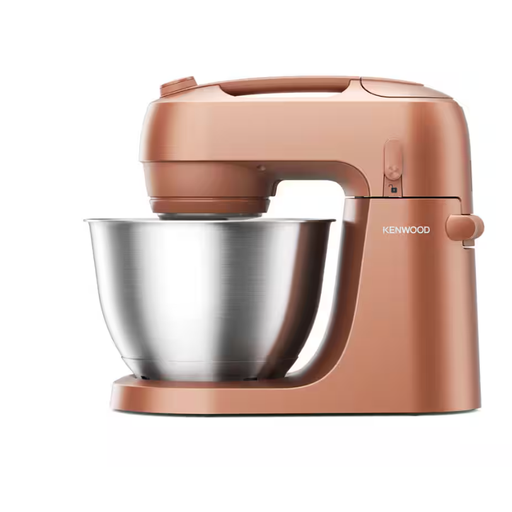 No image available
Consider this option if putting the mixer away between family baking sessions is a priority.
Before choosing it for icing, check the exact bundle’s whisk, bowl size and suitability for the amount you plan to make.
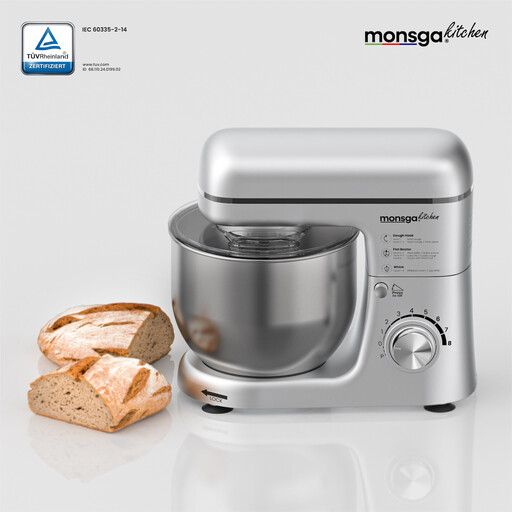 No image available
Consider the larger stated bowl if you expect to make several icing colours or repeat batches.
The product name specifies eight speed settings, a whisk and a splashguard. Check whisk reach for your smallest mix and measure the space available for the machine.
 No image available
Consider this larger-bowl option if you plan to prepare repeated icing batches alongside other family baking.
The product name specifies ten speeds, a whisk and a beater. Check whisk reach for small quantities and allow room to lift the tilt head before choosing where to use or store it.
Choose a whisk compatible with the exact mixer and check that it comes with your bundle. Good Food’s iced-biscuit recipe calls for beating the icing until fairly thick and glossy; follow your recipe when adjusting the consistency for decoration.
Not necessarily: choose bowl size around the quantity you will actually mix. A larger or second bowl is more relevant if you regularly prepare separate colours, repeated batches or other large mixes; also check whether the whisk reaches your smallest quantity.
Start at the lowest suitable speed and increase it as your recipe requires. If ingredient containment matters to you, check whether the exact mixer bundle includes a splashguard or pouring shield.