Occasional bakers with limited space
If you usually make one loaf or a modest batch of muffins, consider where the mixer will stand or be stored. A compact body helps only if you also have room to access the bowl and lift or tilt the head.


For mainly one-loaf banana-bread batches, choose a stand mixer by its bowl setup, storage footprint and access for adding ingredients—not by wattage or maximum capacity alone. KitchenAid's 5KSM175PS includes a smaller 3 L bowl, while the Kenwood Go KZM35.000RD offers a 30 cm-high body with a 4 L bowl. Neither specification establishes how well the beater will handle your exact quantity, so check the model's minimum-batch guidance before relying on it for a particular recipe.
If you usually make one loaf or a modest batch of muffins, consider where the mixer will stand or be stored. A compact body helps only if you also have room to access the bowl and lift or tilt the head.
If your usual batter quantity looks small against a full-size bowl, compare the bowls supplied with each model and ask about minimum quantities for its mixing tool. A smaller bowl is a useful option, not proof that every one-loaf recipe will mix without scraping.
If banana bread is only the starting point, check the supplied whisk and dough tools as well as bowl capacity. Decide whether those future uses justify a larger setup in your kitchen.
Start with the amount of batter you normally make, then check where the mixer will live. Treat extra capacity and accessories as reasons to choose a larger setup only if you expect to use them.
| Concern | What to check | Who this matters to |
|---|---|---|
| Small-batch bowl fit | Ask about the exact model's minimum quantity for its beater; check whether a smaller compatible bowl is supplied. | If I usually make one loaf, I want the tool to reach my modest amount of batter without assuming bowl volume tells me that. Around 40% of consumers put small-batch fit first. |
| Counter and cupboard space | Measure storage height and worktop space, including the clearance needed to open the mixer. | When cupboard space is tight, I need a mixer I can store and set up without moving everything around it. Space is the leading concern for roughly 30% of consumers. |
| Use beyond banana bread | Check the tools included with the exact model and whether its capacity suits the larger batches you actually plan to make. | If I expect to whisk or make occasional dough as well, I want the supplied tools to cover those recipes. About 20% of consumers prioritise that broader use. |
| Adding ingredients | Look at low-speed control, bowl access and whether a pouring shield or tool-parking feature is included. | When I add flour and mix-ins in stages, I want room to do it neatly and pause when needed. Around 10% of consumers make that workflow their primary concern. |
A bowl's stated volume does not tell you whether its beater will engage the amount of batter in your usual loaf recipe. Even a supplied smaller bowl cannot establish that on its own.
Ask the manufacturer or retailer for minimum-quantity guidance for the exact model and tool. If that remains uncertain, check the retailer's applicable return terms before buying rather than assuming a trial will qualify for a return.
KitchenAid describes bowl-lift models as aimed more towards frequent heavy use and larger mixtures. Their extra capacity does not resolve the question of how a small banana-bread batch mixes.
Compare compact or tilt-head options first if small bakes are your main use. Consider a larger bowl-lift format when frequent heavy dough or larger batches are genuine plans.
Banana-bread recipes can involve staged additions of flour and mix-ins. Awkward bowl access can make those steps less convenient, even if the mixer fits your storage space.
Check how the head opens, whether a pouring shield is supplied and whether the tool moves clear of the filling area. Follow the model's safety instructions when pausing or adding ingredients.
The 5KSM175PS is worth comparing if a supplied smaller bowl matters alongside a larger main bowl.
The Kenwood Go KZM35.000RD is a compact-format option when placement and storage are leading concerns.
The Series 2 MUMS2VM40G offers another compact general-baking setup, particularly if ingredient access matters.
These stand mixers offer different bowl sizes and tools to consider for banana bread and other baking. Check the exact model's minimum-batch guidance before choosing one chiefly for a small loaf.
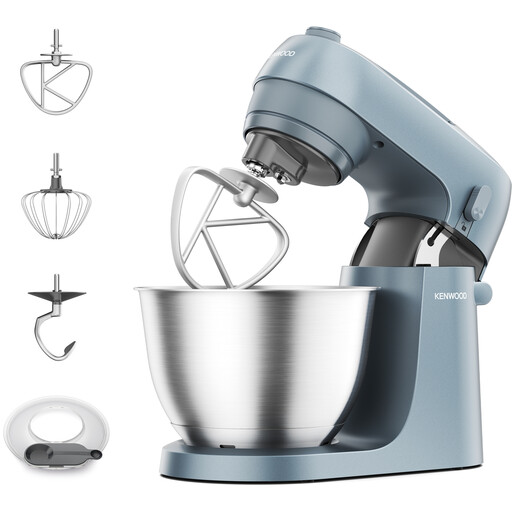 No image available
Consider this variant if storage space is your main concern, while checking its minimum mixing quantity for your usual batter.
The product title calls the colour blue, while other variant information describes it as grey; confirm the colour before ordering.
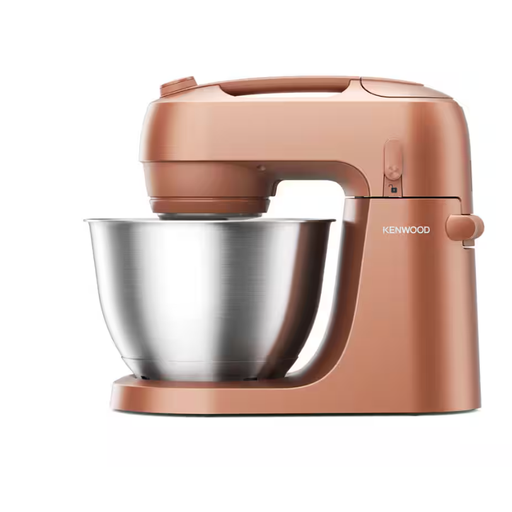 No image available
Consider it when a mixer's storage height matters alongside tools for other baking tasks.
Kenwood GB specifies a 30 cm height, 4 L bowl, six speeds and supplied K-Beater, whisk and dough tool for this model. Confirm the minimum quantity for the K-Beater if you mainly make one loaf.
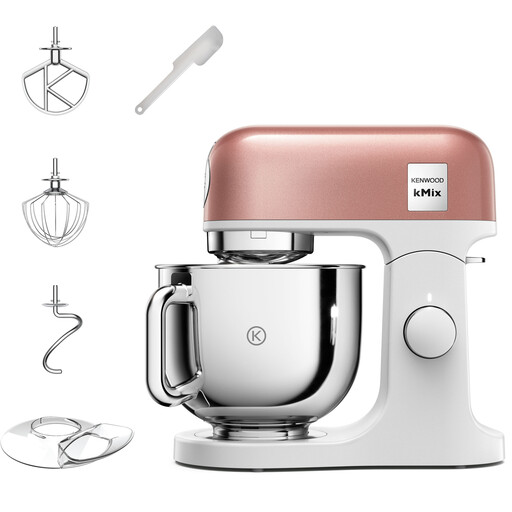 No image available
Consider this model if you want a stand mixer for banana bread and plan to compare its setup for other recipes too.
Before choosing it for a small loaf, confirm the minimum batter quantity for its mixing tool; a larger bowl alone cannot answer that question.
 No image available
Consider this model if you want the three bowl tools named in its product title for baking beyond banana bread.
The title specifies a 4.3 L bowl and 1000 W rating. Check minimum-batch guidance for the mixing beater rather than treating those figures as a measure of one-loaf performance.
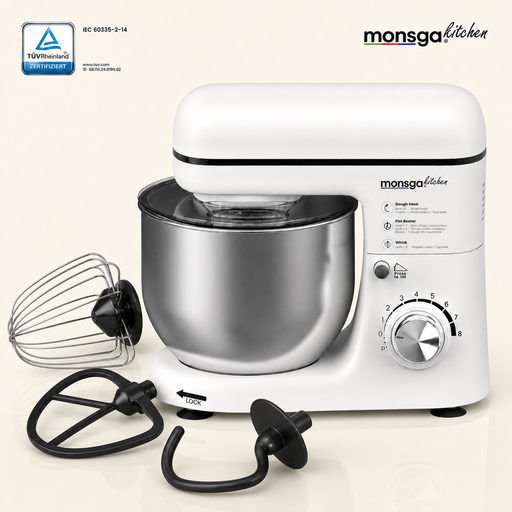 No image available
Consider this model if you also want the whisk, dough hook and beater named in its title, but assess its 5.0 L bowl against the small batches you normally make.
The title describes 1000 W as peak power and lists eight speed settings and a splash guard. Check minimum-batch guidance before relying on it for a one-loaf recipe.
No: stated bowl capacity does not establish the smallest amount a beater can mix effectively. If you usually make one loaf, ask about the exact model's minimum quantity and check whether a smaller bowl is supplied.
For mainly small everyday bakes, start by comparing bowl access and the space each format needs. KitchenAid describes tilt-head models as quick to access and bowl-lift models as more oriented towards frequent heavy use; a larger format makes more sense if you expect those heavier or larger batches.
Use a low speed to combine the ingredients, pause to scrape the bowl when the model's instructions allow it, and stop once the dry ingredients are incorporated. Follow the recipe and mixer instructions rather than assuming every model needs the same mixing time.
If you operate a food business in England, Northern Ireland or Wales, allergen information and allergen management need to be part of your preparation process, according to GOV.UK and Food Standards Agency guidance. Check the ingredients you use and clean shared mixer tools appropriately; in Scotland, check Food Standards Scotland and local-authority guidance for the applicable requirements.