Small-batch brioche bakers
If you usually make one loaf or a tray of buns, the important question is whether the hook can work with your normal recipe quantity—not how much dough the bowl can hold at most.


For occasional small batches of brioche, start with a compact tilt-head or mid-size mixer with a supplied dough hook, then check the exact model against the flour quantity in your usual recipe. A larger machine makes more sense if you also regularly make bigger batches, but its maximum capacity does not establish how well it will handle a small dough.
If you usually make one loaf or a tray of buns, the important question is whether the hook can work with your normal recipe quantity—not how much dough the bowl can hold at most.
If the mixer must fit beneath cupboards or be put away between bakes, measure the space it needs both when stored and when accessing the bowl. KitchenAid UK describes its 3.3L tilt-head model as an option for a small kitchen.
If brioche is only part of what you make, consider the supplied tools, attachment compatibility and whether weighing ingredients in the bowl would be useful alongside the mixer’s dough capability.
For small-batch brioche, match the mixer to your usual flour quantity before choosing extra bowl capacity or convenience features. Manufacturer dough and flour limits describe maximums, not a workable minimum for every recipe.
Consider it when: Worktop space and access to the bowl matter more than room for much larger bakes.
Check: A smaller bowl alone does not establish that the hook will pick up your smallest brioche recipe.
Consider it when: You also make cakes and would use weighing in the bowl while preparing ingredients. Bosch GB lists this feature for the 3.9L MUM5XW49GB.
Check: An integrated scale adds convenience but says nothing about the smallest dough quantity the hook can handle.
Consider it when: Small brioche batches sit alongside frequent larger dough batches or other higher-capacity baking.
Allow for: The space and lifting involved; Kenwood GB lists the Chef XL KVL4100W with a 6.7L bowl and a 7.84kg machine weight.
| Concern | What to check | Who this matters to |
|---|---|---|
| Handling a small batch | Note your usual flour quantity and check the exact model’s guidance for a workable quantity and dough-hook use. Do not treat bowl volume or a maximum rating as a minimum. | If I usually make one modest brioche batch, I want the hook to gather that amount of dough. Around 34% of consumers put small-batch handling first. |
| Kneading capacity | Check that a dough hook or tool is supplied and that the stated dough limit covers batches you actually intend to make. | When I sometimes make a larger batch as well as brioche, I need enough capacity without choosing solely for an unlikely biggest bake; around 33% of consumers make kneading capacity their primary concern. |
| Space and access | Measure storage space and clearance for opening the head or removing the bowl; consider the machine’s weight if it must be moved. | I need to add ingredients and remove the bowl comfortably in a kitchen with limited space. For around 20% of consumers, access and storage come first. |
| Weighing and other uses | Decide whether an integrated scale is useful and confirm optional attachment compatibility with the exact model. | If I also bake cakes and regularly weigh ingredients as I work, I value those conveniences alongside the dough hook; around 13% of consumers prioritise weighing and versatility. |
A maximum flour or dough rating helps you avoid overloading a mixer, but it does not show whether the hook will gather your particular small recipe. Wattage alone is not a comparable measure of kneading performance across different designs.
Write down your usual flour quantity and check the exact model’s instructions or ask the manufacturer about that batch before buying.
Extra capacity also means accommodating the appliance in your kitchen. Kenwood GB lists the Chef XL KVL4100W at 7.84kg, making its weight relevant if you plan to put it away after every bake.
Measure the worktop and storage route, including the clearance needed to fit and remove the bowl and hook.
Bowls and accessories can be model-specific; KitchenAid UK advises checking compatibility with the particular mixer.
Match the accessory product code to your exact mixer model before ordering it.
An incompatible bowl or attachment can mean arranging a return or obtaining a different part.
These ranges illustrate different sizes and features to assess for brioche; a brand name alone cannot establish that a model suits your recipe quantity.
KitchenAid UK describes 3.3L, 4.3L and 4.7L tilt-head options, including a 3.3L model positioned for smaller kitchens.
Bosch GB lists 3.9L bowls in the MUM5 range, with integrated scales on the MUM5XW49GB.
The Chef XL KVL4100W is a larger-bowl option for considering when brioche is one of several baking tasks.
The Assistent Original is another stand-mixer option to assess against a specific brioche recipe.
These stand mixers cover compact and larger-bowl choices, including models with listed dough hooks. Use your normal brioche recipe quantity to narrow the choice: bowl size and a dough hook alone cannot establish small-batch handling.
 No image available
Consider this model if weighing ingredients while preparing brioche is important to you; check the exact model’s dough guidance against your usual batch.
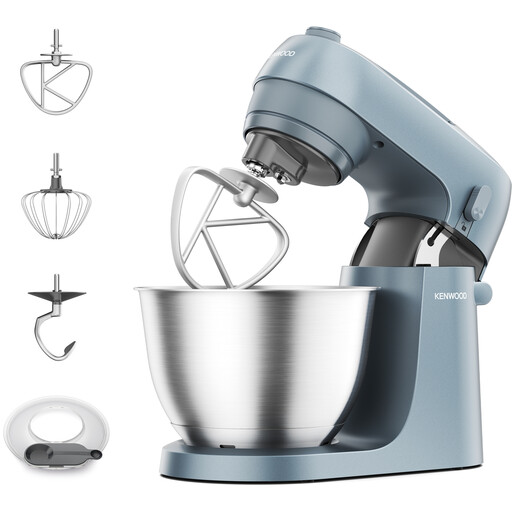 No image available
Consider this model when worktop space and access to the bowl are priorities. Compare your usual brioche quantity with the exact model’s dough guidance before choosing it.
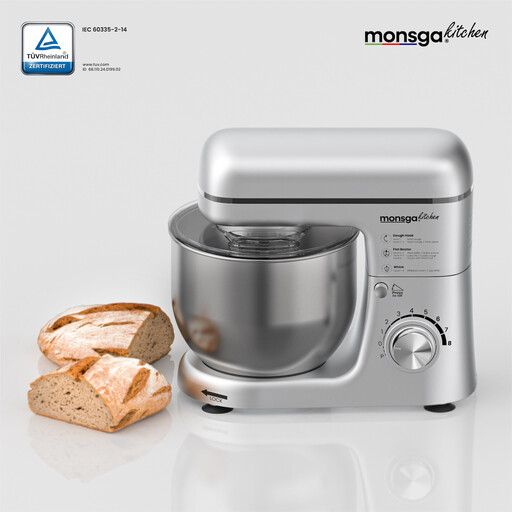 No image available
Consider this tilt-head model if you want a dough hook supplied with a 5.0L bowl. Its title also specifies eight speed settings and a whisk; confirm that the hook can handle your normal brioche quantity.
 No image available
Consider this model if you want the stated larger bowl size as well as a supplied dough hook. The title specifies ten speed settings, a whisk and a beater; check the model’s guidance for your smaller brioche batches.
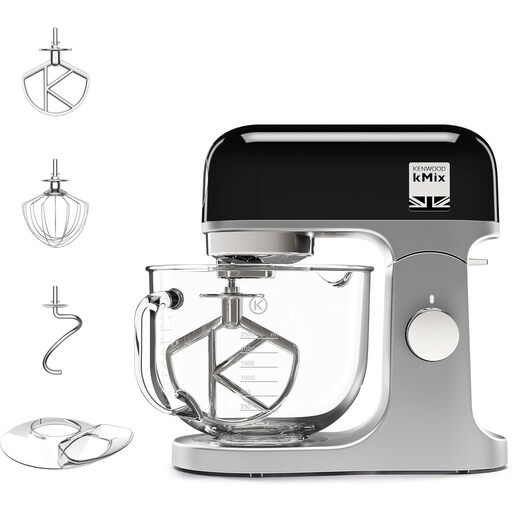 No image available
Consider this model if you want a 5L mixer with a dough hook for brioche and other baking. Its title also lists a K-beater and whisk; confirm the exact bowl supplied and check the dough guidance for your recipe.
Choose by your usual recipe quantity rather than assuming a particular bowl size will work. KitchenAid UK lists 3.3L, 4.3L and 4.7L tilt-head options, but bowl volume and published maximum flour limits do not establish how each model handles a very small batch.
No—not solely because the dough is enriched. KitchenAid UK positions larger bowl-lift models for larger quantities or frequent bread-making; if you mainly make modest brioche batches, compare bowl access and the exact model’s dough guidance before opting for extra capacity.
It can make weighing ingredients in the bowl more convenient. Bosch GB says the MUM5XW49GB has this feature, but a scale does not establish whether its dough tool will gather your smallest recipe.
Follow the instructions for your exact mixer and its supplied dough tool, including its stated capacity limits. Switch off and unplug the machine before fitting or removing the bowl or attachments; KitchenAid UK’s tilt-head bowl instructions also specify setting the speed control to 0.