High-volume bake-sale organisers
If you want to make fewer, larger batches, compare the cake-mixture limit for each exact model rather than choosing by bowl size. Bosch UK and KitchenAid UK publish model-specific limits that can help you plan.


Choose a stand mixer by its stated cake-mixture capacity for the exact model, then decide whether its included beater, controls and cleaning routine suit the number of batches you plan to make. A larger stated capacity may mean fewer batches, while integrated scales are worth considering if weighing ingredients into the bowl would simplify repeated preparation.
If you want to make fewer, larger batches, compare the cake-mixture limit for each exact model rather than choosing by bowl size. Bosch UK and KitchenAid UK publish model-specific limits that can help you plan.
If several manageable mixes suit your baking schedule, use the manufacturer’s cake-mixture limit to decide how to divide the recipe. Bosch UK, KitchenAid UK and Kenwood GB give limits for the models discussed below.
If repeated weighing is the part you most want to simplify, consider an exact model with integrated scales. Bosch UK specifies them for the MUM5XW49GB and MUMS6ZM00G.
Start with the amount of batter you need per mix; once a model can accommodate that amount, weigh the value of integrated scales against the tools, controls and clean-up you will use for every batch.
| Concern | What to check | Who this matters to |
|---|---|---|
| Batch capacity | Compare your recipe quantity with the exact model’s stated maximum cake-mixture capacity, not its bowl volume. | If I have many cakes to make, dividing every recipe into smaller mixes could slow preparation; around 42% of consumers put batch capacity first. |
| Weighing workflow | Check whether the exact model has integrated scales and still accommodates your intended batter quantity. | When I repeat a recipe, I would rather weigh ingredients into the mixing bowl than move them between containers. Around 33% of consumers prioritise that preparation workflow. |
| Tools and clean-up | Confirm the included cake-mixing beater, speed controls and washing instructions for each component. | If I am making several batches, straightforward mixing and washing matter after every one; around 25% of consumers put controls, tools and clean-up first. |
Bowl volume does not tell you how much cake mixture the manufacturer recommends for that model. Bosch UK, KitchenAid UK and Kenwood GB publish separate cake-mixture figures for the cited mixers.
Plan batches around the limit for the exact model and your recipe quantity.
Peak and rated power are different figures: the MONSGA SM100 product information, for example, gives 1000W peak power and 600W rated power. Neither figure alone establishes a suitable cake-batter batch size.
Check how power is described, then look for the cake-mixture limit, suitable tool and operating guidance.
A mixer choice does not settle how cakes must be prepared or sold. GOV.UK says food provision at community and charity events may amount to a food business, while Food Standards Scotland says occasional provision is unlikely to require registration in Scotland.
Keep ingredient and allergen information available, and ask the relevant local authority about your sale if its frequency, organisation or packaging leaves your obligations unclear.
Repeated batches mean repeated tool changes and washing. KitchenAid UK specifies different care for the whisk and the bowl, paddle and dough hook of its cited 5K45SS model.
Confirm that a cake-mixing beater is included and check the care instructions for every component you expect to use.
The cited MUM 5 and Series 6 models offer different stated cake-mixture limits for planning repeat batches.
The cited kMix variant is a reference point for a conventional mixer with variable speed control and core baking tools.
The cited 4.3L Classic is a tilt-head option with a paddle for cake mixing.
These stand mixers offer different ways to approach repeated yoghurt-cake batches. Before choosing one, compare its cake-mixture limit and included mixing tools with your recipe.
 Image unavailable
If weighing ingredients as you prepare each batch matters to you, check this model’s scales and cake-mixture limit against your recipe.
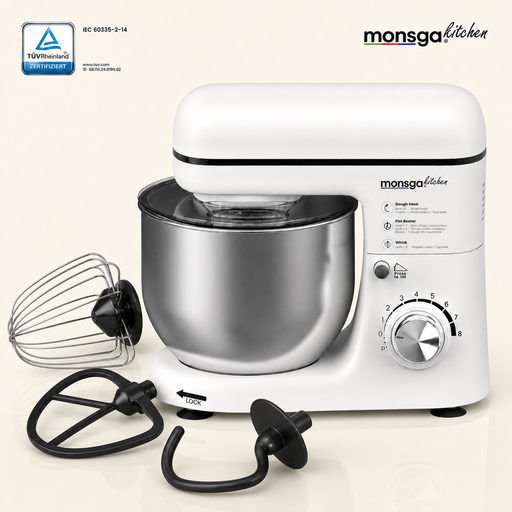 Image unavailable
For cake mixing with a listed beater, check how much batter this SM100 variant can accommodate per batch. Its name specifies a 5.0L stainless steel bowl, eight speed settings, a beater, whisk, dough hook and splashguard; 1000W is described as peak power, not a cake-capacity measure.
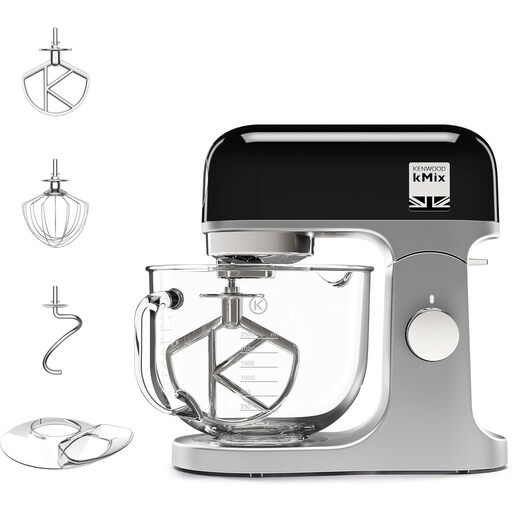 Image unavailable
If you prefer a listed K-Beater for cake mixing, compare this variant’s cake-mixture limit with your planned batch. Its name specifies a 5L bowl, K-Beater, whisk and dough hook. Confirm the supplied bowl material before buying, as the product descriptions differ.
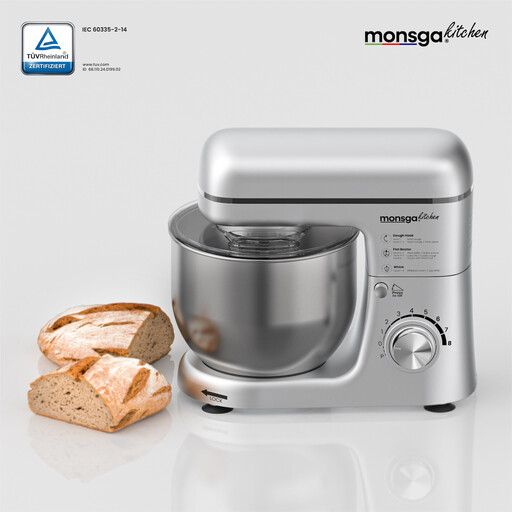 Image unavailable
If you are considering this SM100 variant for yoghurt cake, confirm which cake-mixing tool comes with it and how much batter it can mix per batch. Its name specifies a 5.0L bowl, eight speed settings, a whisk, dough hook and splashguard; bowl volume is not a cake-mixture limit.
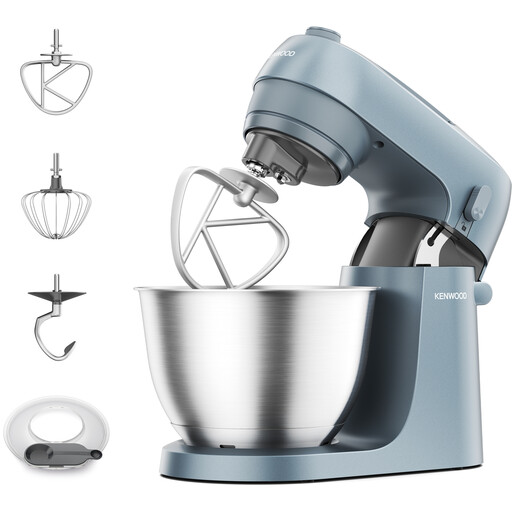 Image unavailable
If worktop space is tight, compare this model’s dimensions and cake-mixture limit with your kitchen and recipe. Confirm the supplied colour if it matters to you: the product title says blue, while its descriptions say grey.
Choose a stated cake-mixture limit that accommodates the amount you want to mix at once, or plan to divide the recipe into batches. As model-specific reference points, KitchenAid UK gives 2.5kg for its cited 4.3L Classic, Bosch UK gives up to 2.7kg for its cited MUM 5 models and up to 3.5kg for its cited Series 6, and Kenwood GB gives 2.72kg for the cited KMX754APP listing.
Wattage alone does not establish a bigger cake-mixture limit. Check whether the stated figure is peak or rated power, then use the exact model’s cake-mixture guidance to plan your batch; the cited MONSGA SM100 information distinguishes 1000W peak from 600W rated power.
An occasional sale does not automatically settle the registration question. GOV.UK says food provision at community and charity events may be considered a food business, while Food Standards Scotland says occasional provision in Scotland is unlikely to require registration; ask the relevant local authority if your activity is regular, organised or otherwise unclear.
Check the ingredient and allergen-information rules that apply to your food format and activity before packaging cakes. For food businesses in Scotland, Food Standards Scotland says food prepacked for direct sale needs a product name and full ingredients list, and food businesses must provide allergen information; ask your local authority how the requirements apply to your sale.