Frequent buffet bakers
If you regularly fill several platters, compare the weight of your complete recipe with the maker’s limit for the exact mixer. Bowl size alone will not tell you whether one batch fits.


Choose a stand mixer by comparing your full savoury-scone recipe with the exact model’s stated load limit, not by bowl litres alone: a flour limit and a total-dough limit mean different things. If you regularly prepare several trays at once, greater declared capacity may help; for occasional buffets, splitting the recipe into batches may suit your space better. Whichever mixer you use, stop mixing soon after the liquid brings the dough together and shape it by hand, as prolonged mixing can make scones tough.
If you regularly fill several platters, compare the weight of your complete recipe with the maker’s limit for the exact mixer. Bowl size alone will not tell you whether one batch fits.
If tender scones matter more than hands-free mixing, look for a way to mix briefly and with control. King Arthur Baking cautions that overmixing can make scones tough and dense; finish shaping by hand.
If buffet baking is infrequent and storage is tight, consider whether making two smaller batches is preferable to keeping a larger mixer on the worktop.
Start with the weight and mixing method of your recipe, then decide whether preparing it in one batch matters more than storage space or a simpler measuring routine.
| Concern | What to check | Who this matters to |
|---|---|---|
| Scone texture | Check the available mixing controls and supplied tools; plan to stop when the dough is just combined. | If I want tender scones, I need to avoid working the dough for too long after adding liquid. Around 36% of consumers put preventing overmixing first. |
| Batch capacity | Compare your full recipe weight with the exact model’s stated limit for a relevant mixture, allowing headroom. | Making several platters in one session makes repeated batches inconvenient; for around 29% of consumers, fitting the intended batch is the primary concern. |
| Measuring workflow | If weighing in the bowl would help, check whether the exact model has an integrated scale and what it can weigh. | I want to measure flour consistently while preparing a buffet without moving between extra tools. Around 21% of consumers prioritise that workflow. |
| Storage space | Measure the worktop or cupboard space and allow clearance to access the bowl. | For an occasional buffet, I can split the recipe rather than store a larger appliance year-round; space is the leading concern for around 14% of consumers. |
A bowl-volume figure is not a dough-load figure. KitchenAid UK publishes maximum flour quantities for specified mixers, while Bosch GB lists maximum bowl content for dough on specified models; those measures cannot be exchanged directly.
Weigh your complete recipe and check the exact model’s limit for the closest relevant mixture, leaving room below the stated maximum.
According to King Arthur Baking, continued mixing can develop gluten and leave scones tough and dense. The convenience of a mixer does not remove that risk.
Mix briefly after adding liquid, stop when the ingredients have just come together, then shape the dough by hand.
Kenwood UK distinguishes smaller-quantity mixers from its Chef and Chef XL ranges, which it positions for regular use.
KitchenAid UK publishes ingredient-capacity guidance for specified tilt-head and bowl-lift configurations.
Bosch GB publishes model-specific bowl and dough-content figures across its MUM mixer range.
These mixers offer different bowl sizes and formats to consider for savoury-scone preparation. Before choosing one for a buffet batch, check its model-specific load limit against your recipe; a stated bowl size does not settle that question.
 No image available
Consider this model if you want a 4.3 L bowl for preparing scones in batches rather than choosing solely for a single large mix.
The product title states 1000 W and three bowl tools. Confirm which tool suits your recipe and compare its applicable load limit with the full batch weight.
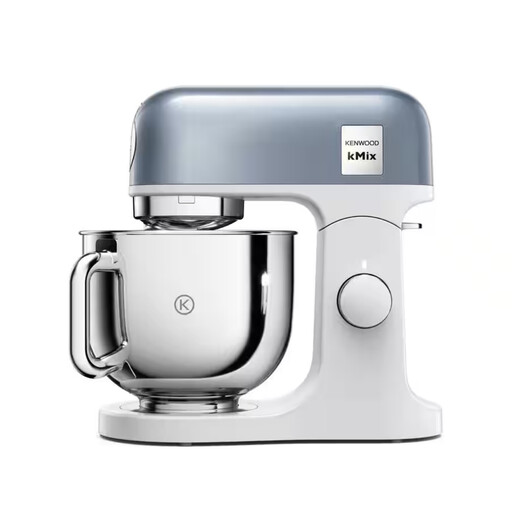 No image available
Consider it if you want a household mixer for buffet preparation as well as other baking, while keeping scone mixing brief.
Before planning a single large batch, confirm the limit relevant to your recipe rather than treating a stiff-yeast-dough limit as a savoury-scone-dough limit.
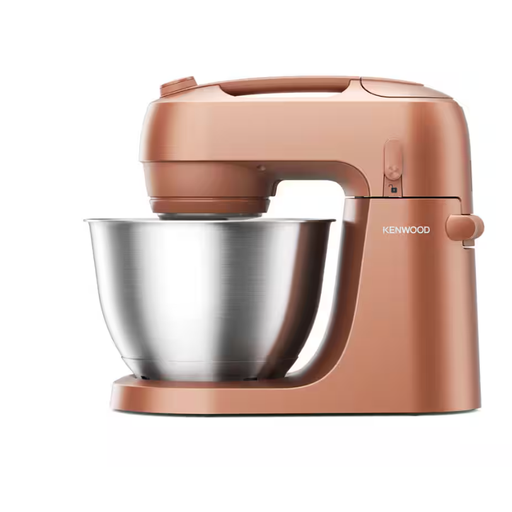 No image available
Consider this version if storage space makes smaller, separate scone batches acceptable.
Check its dimensions against your cupboard or worktop and confirm a relevant maximum dough load before deciding how much to mix at once.
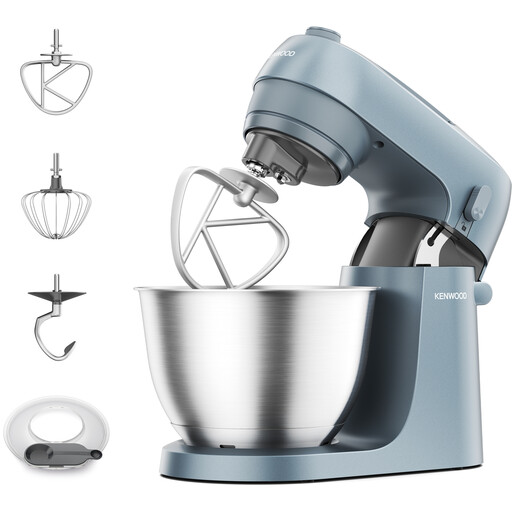 No image available
Consider this Go variant where a smaller mixer and split buffet batches suit your kitchen.
Confirm its maximum load for the intended mixture before sizing a batch. Check the selected colour variant too, as the product information uses differing colour wording.
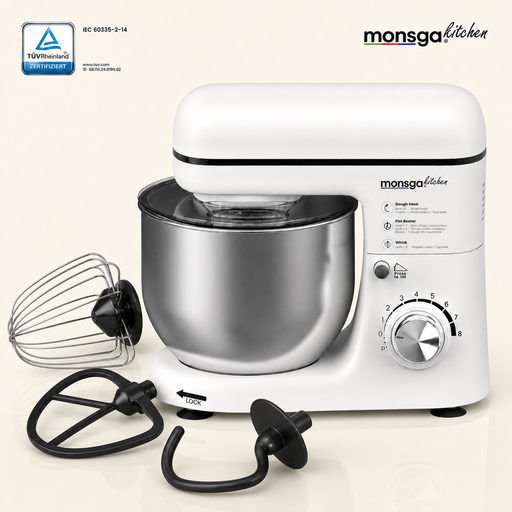 No image available
Consider its listed mixing-tool options if you are preparing savoury scones, but stop the mixer as soon as the dough comes together.
The product title specifies a 5.0 L stainless-steel bowl, eight speed settings, a dough hook, beater, whisk and splashguard. Confirm a relevant dough-load limit separately; bowl volume is not that limit.
Yes, provided you use it for brief, controlled mixing rather than prolonged kneading. King Arthur Baking warns that overmixing can make scones tough and dense, so stop when the dough is just combined and shape it by hand.
Weigh the complete recipe and compare it with the exact mixer’s stated limit for a relevant mixture, leaving headroom. KitchenAid UK’s published flour limits and Bosch GB’s published bowl-content-for-dough figures measure different things; neither bowl litres nor a flour figure alone gives a ready-mixed scone-dough capacity.
An integrated scale can make ingredient weighing more convenient, but it cannot prevent overmixing. Check whether the particular model includes one, and keep the mixing stage brief regardless of how you measure the flour.
Yes, supplying food at a community event can bring food-safety responsibilities. GOV.UK guidance for England, Northern Ireland and Wales says food provided at charity or community events must be safe to eat, and food business operators must provide allergen information for prepacked and non-prepacked food. If you are unsure what applies to your event, ask the local authority; in Scotland, check with Food Standards Scotland or the local authority.
Yes. Plan storage and buffet service around the requirements of any chilled filling or topping rather than assuming the baked scone determines how the whole serving can be kept. Follow the accompaniment’s storage instructions.