Party-batch bun bakers
If you want to make the birthday buns in one batch, compare your recipe’s finished dough mass with a model-specific capacity figure. A bowl measurement in litres does not tell you how much dough it can handle.


Choose a stand mixer by comparing your recipe’s finished dough mass with the exact model’s stated dough capacity, rather than relying on bowl size or wattage alone. A compact mixer may suit a modest birthday batch and limited storage; larger planetary or spiral machines are worth considering for repeated large batches, provided the recipe meets their stated operating limits.
If you want to make the birthday buns in one batch, compare your recipe’s finished dough mass with a model-specific capacity figure. A bowl measurement in litres does not tell you how much dough it can handle.
If the mixer will be stored between occasional bakes, its dimensions matter alongside capacity. Kenwood describes its compact mixers as intended for smaller quantities, so check that a space-saving choice still accommodates your planned batch.
If birthday buns are part of a regular large-batch baking routine, a larger planetary or specialist spiral machine may be relevant. Check the exact model’s dough limit and, for a spiral mixer, its minimum batch and recipe requirements.
Work out the finished mass of your cinnamon-bun dough first. Then check the model’s stated limit for the relevant dough type, the space it occupies and whether its other functions will be useful after the party.
| Concern | What to check | Who this matters to |
|---|---|---|
| Batch capacity | Compare finished dough mass with the exact model’s limit; check whether that limit describes enriched dough, bread dough, yeast dough or flour. | I want enough buns for the party without splitting the recipe into several mixes. Around 36% of consumers would put documented batch capacity first. |
| Dough handling | Check for an appropriate dough tool and a model-specific dough limit, including any operating conditions. | If kneading is my main reason for buying a mixer, I need to know its stated capability suits my dough, not just that a hook is supplied. Roughly 29% of consumers would prioritise dough handling. |
| Kitchen space | Check appliance dimensions and weight against your worktop and storage space, as well as its dough capacity. | I will use the mixer after the birthday, but it needs somewhere practical to live between bakes. Around 21% of consumers would make space their primary concern. |
| Wider baking use | Check which attachments or weighing functions the exact model has and what is included. | Once the buns are made, I would also like the machine to help with other recipes. About 14% of consumers would put wider baking use first. |
A bowl’s volume does not establish an enriched-dough limit. Kenwood, KitchenAid and Bosch publish capacities using different descriptions, including dough, bread dough, yeast dough and flour.
Calculate your recipe’s finished dough mass and compare it with the exact model’s relevant specification. If the published limit uses another dough type, check its applicability before planning one large batch.
Specialist machines can have minimum quantities and recipe limits. Ooni states a 1 kg minimum mixture weight and a 55–80% hydration range for the Halo Pro.
Check your usual cinnamon-bun recipe as well as the larger party recipe against the model’s operating range.
GOV.UK’s electrical-equipment guidance covers Great Britain and directs readers to separate guidance for Northern Ireland.
Before buying a mains-powered mixer, confirm the supplied plug and the market and conformity information appropriate to where you live.
Its Go and Chef lines offer different sizes to consider for occasional and larger dough batches.
Its tilt-head and larger bowl-lift models are relevant when weighing kitchen space against batch size.
Series 6 is relevant if you want a larger planetary mixer with weighing features.
Halo Pro is a specialist spiral option for people making large dough batches regularly.
SMF05 is a conventional planetary stand mixer to consider for a broader home-baking routine.
These stand mixers offer different bowl sizes, controls and storage considerations for a birthday bake. Check each model against your recipe’s finished dough mass before deciding whether to make one batch or several.
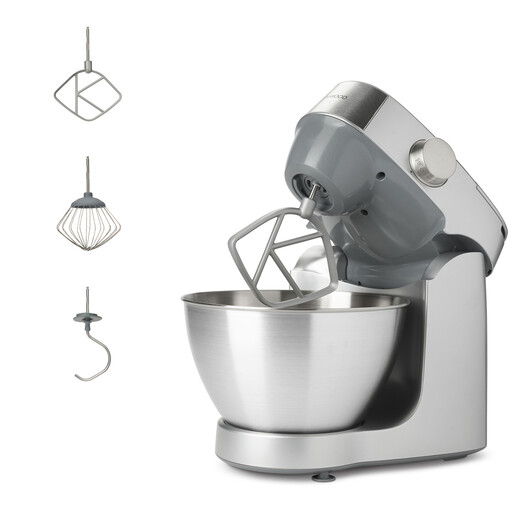 No image available
Consider this model if you need a stand mixer that fits a smaller kitchen. Its name specifies a 4.3 L bowl, 1000 W and three bowl tools; confirm that its dough limit applies to your finished enriched batch before buying.
 No image available
Consider this model if weighing ingredients during bun preparation matters to you. Check its dough-capacity guidance against the type and finished mass of your enriched recipe.
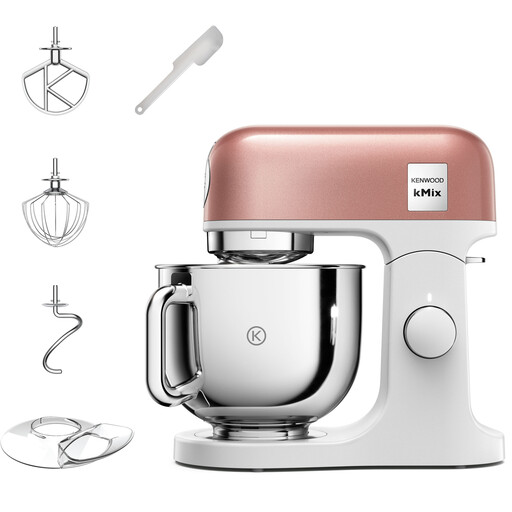 No image available
Consider this model if you want mixing controls for baking beyond the birthday buns. Its stated 1.35 kg limit concerns stiff yeast dough, so check the guidance for your enriched recipe; heavy mixtures also have a stated 10-minute running limit followed by at least 45 minutes of cooling between batches. Check the appliance dimensions if storage space is tight.
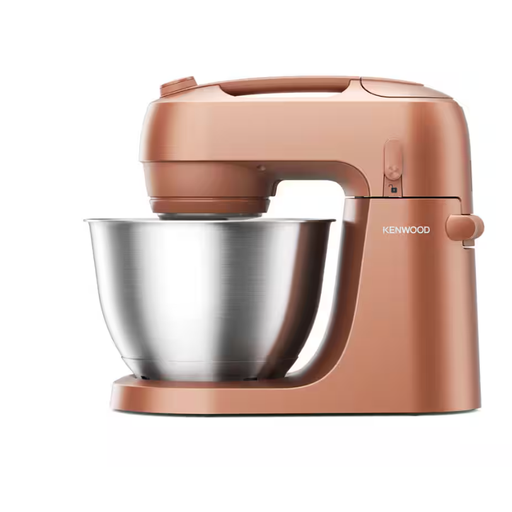 No image available
Consider this compact route if storage space matters and your recipe fits the model’s limit. Kenwood states that Go can handle 1.5 kg of enriched dough; compare that figure with your finished batch and check the exact product’s supplied tools.
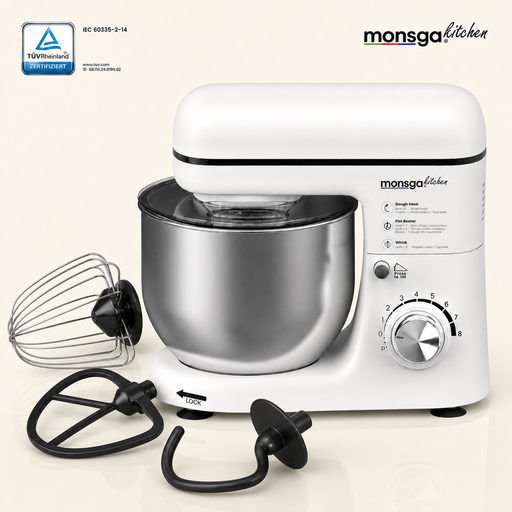 No image available
Consider this model if you want a mixer named with a 5.0 L bowl and supplied mixing tools for several baking tasks. Bowl volume does not establish how much cinnamon-bun dough it can knead: confirm the applicable dough limit and the appliance dimensions before choosing it.
Start with the finished dough mass of your recipe and choose a model whose relevant stated limit accommodates it. Bowl litres are not a dough-capacity figure: Kenwood states 1.5 kg of enriched dough for Go and 2.42 kg of dough for Chef XL KVL4100W, while KitchenAid’s stated 3.7 kg limit for its 5.6 L Artisan bowl-lift model concerns bread dough.
Not automatically: a spiral mixer makes sense only if your batches and recipe meet its operating limits. Ooni states a 1–5 kg dough range and 55–80% hydration range for Halo Pro, so check both conditions for the recipe you normally make.
Follow the instructions for the exact mixer and attachments you buy. Keep the model number so you can use its specific manual rather than applying cleaning or maintenance advice intended for another set of tools.
Compare the terms for the exact model, including duration, covered parts and labour, and how to arrange a repair. KitchenAid lists a five-year guarantee and 15 years’ reparability for its 5.6 L Artisan bowl-lift model, while Bosch describes a 10-year motor and housing warranty for Series 6; those statements cover different things, so check the current terms before relying on either.
Yes: GOV.UK’s Great Britain guidance applies to England, Scotland and Wales and points to separate guidance for Northern Ireland. For a mains-powered mixer, check that the seller identifies the appropriate market version, supplied plug and conformity information for your location.