Small-loaf bakers with limited space
If you usually make one or two loaves, a dough hook and manageable storage matter alongside the mixer’s instructions for your usual recipe.


For one or two loaves at a time, choose a stand mixer by comparing your usual dough quantity with the exact model’s kneading instructions, rather than relying on wattage or bowl size alone. A compact model makes sense when storage matters and its stated dough limits cover your recipe; a conventional or larger machine is worth considering if you also regularly need other baking tools or more batch capacity. Check the smallest workable dough quantity in the exact model’s instructions before buying.
If you usually make one or two loaves, a dough hook and manageable storage matter alongside the mixer’s instructions for your usual recipe.
If you also make cakes and batters, check the supplied mixing tools and how convenient the bowl is for those tasks, not just the dough capacity.
If you expect to increase your dough quantities or prepare several mixtures regularly, weigh extra capacity and features against the space the machine occupies.
Consider it when: storage is tight and the exact model’s dough limits cover your usual recipe; Kenwood positions its Go range as easy to store.
Trade-off: compact size does not establish how little dough its hook can knead effectively.
Consider it when: bread is one of several regular baking tasks; Bosch lists a dough hook for its 3.8L Series 2 model, while KitchenAid lists one for its 4.3L Classic.
Trade-off: neither bowl volume nor maximum dough capacity establishes a workable minimum batch.
Consider it when: larger batches or multiple mixtures are a regular need; Kenwood lists 5L and 7L bowls for its Titanium Chef Baker XL.
Trade-off: allow more worktop and storage space without assuming the larger bowls will suit your smallest recipe.
For one- or two-loaf baking, start with your normal flour and dough weights. Then decide how much storage space, everyday versatility and room to scale up matter to you.
| Concern | What to check | Who this matters to |
|---|---|---|
| Usual dough quantity | Compare your flour and total dough weights with the exact model’s stated dough limits, hook instructions and permitted kneading time. | I need the hook to work my usual small recipe without exceeding the machine’s instructions; around 40% of consumers put workable dough quantity first. |
| Storage and working space | Measure the appliance, its storage spot and the clearance needed to operate its head or attachments. | If I have to put the mixer away after each occasional bake, I need to be able to move and store it easily; roughly 30% of consumers prioritise that space constraint. |
| Other baking tasks | Check which bowl tools are included and whether any attachments you want fit the exact model. | I want the same machine for bread, whisking and cake mixtures, so its other tools matter to my decision; around 20% of consumers make versatility their main concern. |
| Room for larger batches | Check the stated maximum for the relevant dough type, alongside the space a larger machine would occupy. | If I expect to make heavier doughs or several mixtures regularly, I do not want today’s batch size to be my only guide; about 10% of consumers put future capacity first. |
Neither figure tells you whether the dough hook will work your smallest recipe. A published dough load may describe an upper limit, not a minimum.
Compare your normal flour and total dough weights with the exact model’s dough-hook, speed and run-time instructions.
A stated limit can come with operating conditions. For Kenwood Go bread dough, Kenwood specifies up to 800g flour at speeds 1–2 for 5 minutes and a rest between heavy loads.
Follow the instructions for your exact model and dough type, particularly if you knead heavy batches frequently.
Features such as multiple bowls can be useful for regular varied baking, but a larger machine also needs suitable worktop and storage space.
Measure both spaces before choosing a larger format for a routine centred on one loaf.
A voluntary change-of-mind policy is distinct from remedies for a faulty or misdescribed appliance. Citizens Advice provides separate guidance on legal rights when goods are broken, unfit for purpose or not as described.
Keep your order details and the product description, and contact the retailer if the mixer arrives faulty or differs from its listing.
Kenwood’s range runs from the compact Go to larger Chef Baker machines, so the useful comparison is between specific models and your usual dough quantity.
Bosch’s MUM range includes compact Series 2 and larger options for buyers balancing storage with broader baking use.
KitchenAid’s 4.3L Classic tilt-head mixer is a multi-purpose option for bread kneading alongside routine baking.
These mixers include compact Kenwood Go models and machines with larger stated bowls or tools for baking beyond bread. Match the exact variant’s dough instructions to your recipe before deciding which format suits a small batch.
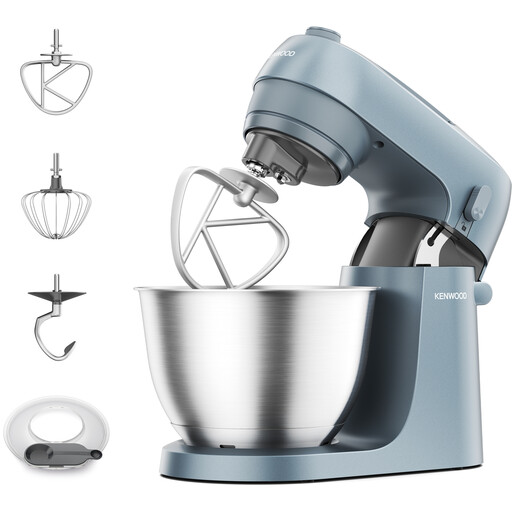 Image unavailable
Consider this Go model if easy storage matters, but compare your recipe with Kenwood’s Go bread-dough limit of 800g flour at speeds 1–2 for 5 minutes and check the exact model’s instructions for smaller quantities.
Confirm the colour before ordering: the title says blue, while the accompanying product information also identifies it as grey.
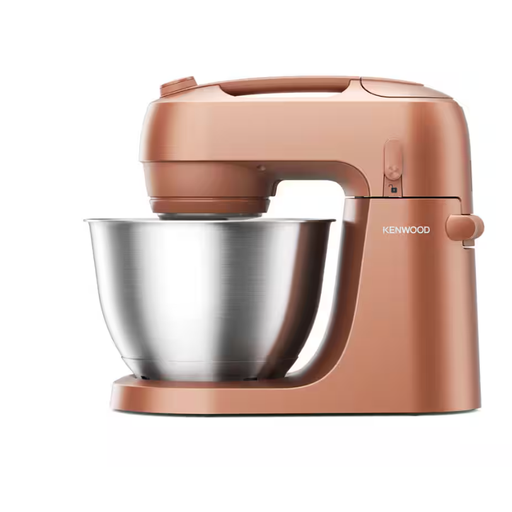 Image unavailable
This Go variant is worth considering when storage is a priority. Kenwood’s Go bread-dough guidance gives a maximum of 800g flour at speeds 1–2 for 5 minutes; confirm the exact variant’s supplied dough tool and instructions for your smaller recipe.
 Image unavailable
Consider this Chef Baker if you want a mixer for bread alongside other regular baking tasks. Before choosing it for small doughs, confirm the supplied tools and the KVC65.001WH kneading quantities and operating instructions.
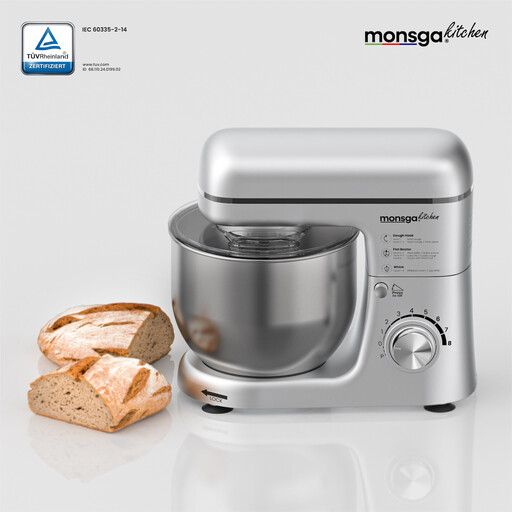 Image unavailable
For bread alongside other mixing tasks, the named package includes a dough hook and whisk. Its title states a 5.0L bowl, eight speed settings and 1000W peak power; none of those figures establishes the smallest workable bread batch, so check the SM100 dough instructions against your recipe.
 Image unavailable
Consider this model if bread is one of several mixing tasks and you have space for its stated bowl size. The named package includes a dough hook, whisk and beater; check the exact variant’s kneading quantities and instructions before using it for a small recipe.
Not necessarily. Bowl volume and maximum dough capacity do not establish the smallest quantity a hook can work effectively, so check the exact model’s instructions against your usual recipe.
Kenwood specifies up to 800g flour for bread dough at speeds 1–2 for 5 minutes, with at least 15 minutes’ rest between heavy loads. Follow the instructions for your exact model and dough type rather than applying those limits to a different mixer.
Measure both where you will store it and where you will operate it, including clearance above a moving head or top-mounted attachments. Bosch also advises planning for worktop space and a nearby electrical outlet.
Contact the retailer and keep the order details and product description. Citizens Advice explains that consumers in England may have legal rights when goods are broken, unfit for purpose or not as described; its guidance directs readers in Scotland, Wales and Northern Ireland to their respective advice.
Check your local authority’s electrical-recycling arrangements or an approved electrical-recycling service before disposing of it. GOV.UK explains that waste electrical and electronic equipment is regulated to encourage recovery, reuse and recycling; the available household collection route depends on your location.