
24/7 全天候客户支持

免费退货

当日/次日达

品质保障

开启新人专享福利: 全场免邮 | 低至 2 折 | 免费试用 30 天 JoyPlus 会员
下载 Joybuy
Buying stationery supplies can appear straightforward until pens skip halfway through a meeting, notebook pages show ink through to the other side or a project book becomes too bulky for your bag. Attractive colours and large pack sizes can be useful, but they do not always indicate that a product suits your routine.
This guide focuses on the practical details that matter when choosing gel pens, A5 notebooks, project books, desk diaries, bullet journals and other note-taking supplies for school, work or home.
A vibrant ink colour may look appealing online, but the important questions are whether the tip matches your handwriting and whether the ink dries quickly enough. Broad nibs can be less suitable for small notes, while very fine pens may feel scratchy if the tip or ink flow is poorly matched to the paper.
Left-handed users should also consider drying time. Ink that remains wet on the page can transfer onto the hand, particularly during fast note-taking.
Paper weight is usually shown in gsm, meaning grams per square metre. A higher gsm generally indicates a heavier sheet, but paper finish and ink type also affect show-through and smearing. A notebook with a decorative cover may still contain lightweight pages that are less suitable for gel pens or markers.
Check the page count, ruling, paper weight and cover construction rather than relying on appearance alone.
A compact A5 notebook is convenient for commuting, but it may not provide enough room for diagrams or lengthy project notes. An A4 project book offers more writing space, although it takes up more room in a backpack or desk drawer.
Likewise, a desk diary may be useful for appointments and deadlines, while a bullet journal or plain notebook gives greater flexibility for lists, habit tracking and creative layouts.
For everyday writing, 0.5mm fine point gel pens offer a balance between precise lines and comfortable readability. They are suitable for forms, revision notes, meeting minutes and detailed journalling. A 0.7mm medium point can provide a bolder line for headings or corrections.
Consider the ink colour according to the task:
Retractable pens are convenient for desks and bags because the tip can be protected without a loose cap. A soft grip or shaped barrel may also be useful for extended writing sessions.
For regular pen use, 80gsm paper is a common practical choice. Heavier 100gsm or 120gsm paper can provide a more substantial writing surface and may reduce show-through, although results vary by ink and pressure.
Also check whether pages are:
If you are buying journalling stationery, a lay-flat binding can make it easier to write across the full page. For office stationery and school stationery, dividers and storage pockets may be more useful than decorative features.
A5 measures approximately 148mm by 210mm, making it portable for commuting, lectures and meetings. A4 provides a larger workspace for project planning, diagrams and loose documents.
A durable cover is worth considering if the notebook will be carried daily. Polypropylene covers can be wiped clean, while textured card or hardcover designs may provide a more traditional finish. Wiro binding can allow pages to turn easily, but avoid placing heavy objects on top of spiral-bound books, as the binding can become distorted.
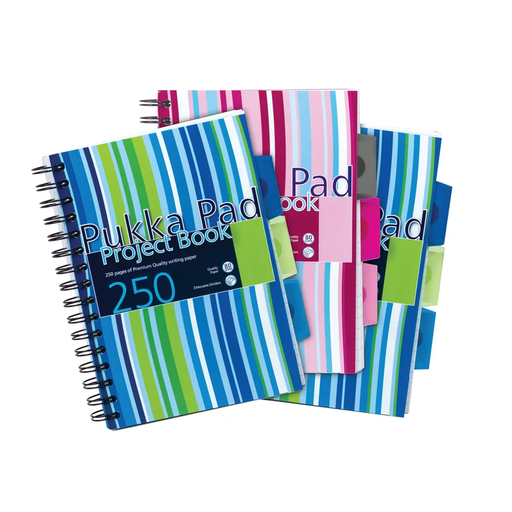
Why This Fits Their Persona: A pack of three gives students, parents and new home workers separate books for different subjects, tasks or household planning.
The A5 format is portable, while three repositionable dividers and storage pockets help prevent mixed-up notes and loose papers.
Each book has 250 pages of 80gsm lined FSC Certified paper and repositionable dividers with pockets.
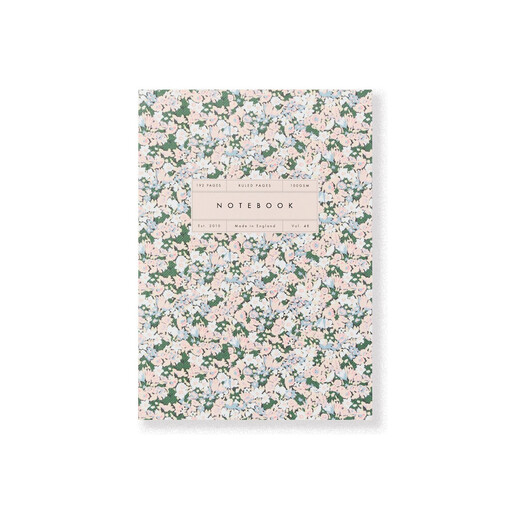
Why This Fits Their Persona: Its portable format and decorative textured cover suit professionals, creatives and stationery enthusiasts who want a polished notebook for meetings or journalling.
The specification clearly states 100gsm paper, 196 ruled pages and a textured cover, rather than relying only on decorative presentation.
The A5 notebook has 196 ruled pages, ivory 100gsm paper and a textured 300gsm cover.
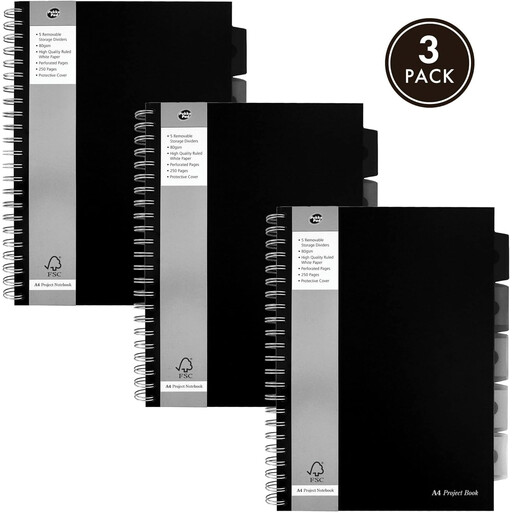
Why This Fits Their Persona: The larger A4 format is suited to teachers, office professionals, home workers and students handling substantial project notes or documents.
The wipe-clean polypropylene cover and five repositionable dividers provide practical structure for busy work or study environments.
Each book contains 250 pages of 80gsm feint-ruled paper, perforated pages and storage pockets.
We have compiled a complete, real-time list of products that fully satisfy these strict selection criteria and UK safety regulations.
Use separate storage for writing tools and paper products. Keep gel pens with their tips retracted or caps secured to reduce drying. Store notebooks and project books in a dry place, away from excessive moisture and direct sunlight.
For a functional desk set-up, consider combining:
When buying stationery for children, check the product warning and recommended age. Items containing small parts, such as charms or detachable accessories, may present a choking hazard for children under three.
A practical starter set may include black gel pens, coloured pens for organising subjects, an A5 notebook for daily notes and a project book for larger assignments. Add sticky notes or repositionable notes for reminders, revision prompts and page markers.
100gsm paper is a useful option for many gel pens because it provides a more substantial writing surface than standard lightweight paper. However, ink flow, writing pressure and drying time still influence show-through and smearing. If using broad tips or markers, check the paper specification and try a small sample where possible.
Retract click pens after use, replace caps securely and store paper products somewhere dry. Avoid pressing heavily on notebook covers and do not overfill project book pockets. Choosing the correct size and binding for your routine can also reduce bending, torn pages and unnecessary replacement costs.