Dark-room stealth players
Students who play atmospheric stealth games after dark and care about black depth and distinguishing detail in shadowed scenes. RTINGS.com explains why contrast matters particularly in dark rooms.


For stealth games played in a dim student room, start with dark-scene contrast and a screen that fits the desk, rather than choosing by refresh rate alone. A 27-inch-class QHD OLED monitor is worth considering if deep blacks are the priority and you are comfortable following its panel-care guidance; compare a high-refresh non-OLED QHD monitor if long sessions with static coursework windows weigh more heavily in your choice. Check that your PC and connection can use the resolution and refresh rate you select.
Students who play atmospheric stealth games after dark and care about black depth and distinguishing detail in shadowed scenes. RTINGS.com explains why contrast matters particularly in dark rooms.
Students fitting one gaming and study screen alongside their other essentials on a compact desk, who need to consider screen size, resolution and the stand together.
Students who alternate between games and static coursework windows, making OLED care, screen positioning and energy information relevant alongside game image quality.
For a student-room stealth setup, decide how much dark-scene contrast matters to you, then weigh desk space and study habits against the resolution and frame rate your PC can use.
Consider it when: You mainly play in a dim room and prioritise deep blacks.
Bear in mind: Long periods displaying static coursework make the model's panel-care guidance and warranty important.
Consider it when: One screen will spend substantial time displaying static study work as well as games.
Bear in mind: Refresh rate alone says nothing about black depth; compare contrast information for the exact model.
Consider it when: Extra desktop detail matters to you and your PC delivers a frame rate you find satisfactory at 4K.
Bear in mind: Rendering games at 4K demands more from the GPU than QHD; OLED panel care still applies.
| Concern | What to check | Who this matters to |
|---|---|---|
| Dark-scene visibility | Compare model-specific contrast information; if HDR matters, check the exact VESA DisplayHDR or DisplayHDR True Black certification. | When I play in a dim room, I want to distinguish objects in shadow without choosing a screen solely for its speed. Around 31% of consumers would put dark-scene visibility first. |
| Desk fit and resolution | Measure usable desk space and the stand footprint; compare QHD and 4K against your PC and intended game settings. | My monitor has to leave room for coursework and peripherals, so its stand and resolution need to work on the desk I have. Desk fit would be the main concern for around 25% of consumers. |
| Smooth motion | Check refresh rate at your chosen resolution and adaptive-sync compatibility across the monitor, GPU and connection. | If camera movement and tearing distract me, I want the display and PC to work together at my usual game settings. Around 25% of consumers would prioritise smooth motion. |
| Study use and ownership | Read OLED care and warranty terms where applicable; check the energy information for the exact display. | I keep documents and taskbars on screen for long study sessions, so ongoing use matters as much as gaming. For around 19% of consumers, that would be the deciding concern. |
A 240Hz or 280Hz specification neither tells you how dark scenes will look nor means your PC will produce that many frames in your preferred settings.
Assess contrast first if shadows drive the purchase, then check the resolution, achievable game frame rate, connection and adaptive-sync compatibility.
VESA defines specific DisplayHDR and DisplayHDR True Black certification tiers; generic HDR wording is not a substitute for an identified tier.
If HDR affects your choice, look up certification for the precise model rather than relying on an unqualified label.
Coursework can leave the same interface elements on screen for extended periods. Manufacturer OLED-care features aim to reduce burn-in risk, not remove it.
Read the model's care guidance and warranty, and compare a non-OLED QHD option if prolonged static use dominates.
GOV.UK sets out energy-information requirements for electronic displays in scope and electrical-equipment safety requirements for products placed on the Great Britain market.
Check the exact model identifier, the applicable energy label and product information sheet, and the seller's details before ordering.
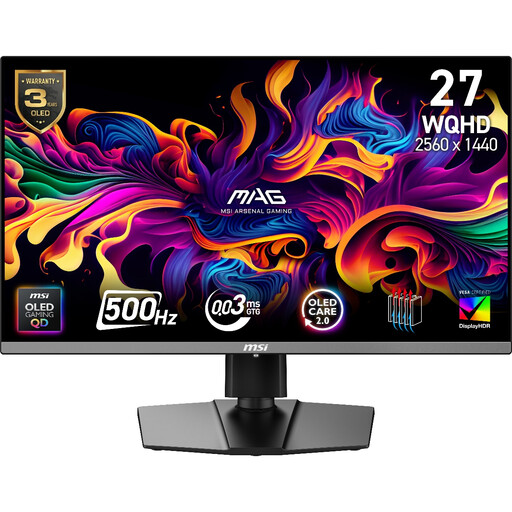
MSI's MAG 271QP QD-OLED X28 is a 27-inch-class QHD QD-OLED example specified by MSI at 280Hz, with DisplayHDR True Black 400 and OLED Care 2.0.
The ROG Strix OLED XG27AQDMGR is a 26.5-inch QHD WOLED model that ASUS specifies at 240Hz with a glossy panel treatment.
Dell UK lists the Alienware AW2726DM as a QHD QD-OLED model and the AW2725Q as a 4K QD-OLED model; both are specified at up to 240Hz.
These models are 27-inch-class QHD OLED options for a contrast-led student-room gaming setup. Compare their stated features with your desk, PC and static-study use; the refresh-rate figures do not indicate what frame rate your games will achieve.
 No image available
Consider this QD-OLED model if dark-room gaming is your priority and you can check whether its stand fits your desk.
2560 × 1440 WQHD; 500Hz and 0.03ms as stated in the product name; AMD FreeSync.
Check whether your PC and connection can use the refresh rate you want, and read the OLED care and warranty terms for static study use.
 No image available
This QD-OLED model is relevant if you want to assess dark-scene contrast alongside fit on a shared study and gaming desk.
2560 × 1440 WQHD; 240Hz, 0.03ms and Adaptive-Sync as stated in the product name.
Check the stand footprint and OLED care terms. If HDR certification matters, confirm the precise certification for this model.
 No image available
Consider this QHD OLED model if you are balancing dark-room gaming with a 27-inch screen size.
240Hz and 0.03ms as stated in the product name.
Check stand dimensions, panel-care guidance and warranty terms if the screen will also show static coursework for long periods.
 No image available
This is a QHD QD-OLED option to consider when dark-scene contrast matters more than pursuing a higher resolution.
MSI specifies 2560 × 1440, 280Hz, 0.03ms GTG, DisplayHDR True Black 400 and OLED Care 2.0 for this model.
Confirm the stand footprint for your desk and read the OLED care and warranty terms before using it extensively for coursework.
 No image available
This 26.5-inch model is relevant if you want a QHD QD-OLED screen and need to assess its fit on a smaller desk.
The product name states 2560 × 1440, 240Hz, 0.03ms response, HDR10, FreeSync Premium Pro and G-SYNC Compatible.
Check the stand footprint and OLED care guidance. HDR10 wording alone does not establish VESA DisplayHDR certification.
No: if reading dark scenes is your main concern, assess contrast before paying attention to the highest refresh-rate figure. A higher rate is useful only to the extent that your PC, game settings and connection can make use of it; compatible adaptive sync can help reduce tearing and stuttering, as AMD explains for FreeSync.
Yes, but prolonged static windows make the exact model's panel-care guidance and warranty worth reading. MSI and ASUS describe care features intended to reduce burn-in risk, not eliminate it; compare a non-OLED QHD monitor if static study work is your overriding concern.
Measure the usable desk width and depth, allowing room for your other equipment and cables. Compare those measurements with the exact monitor's stand footprint and adjustment or mounting specifications, rather than relying on screen diagonal alone.
Check the exact model and seller, and look for the energy label and product information sheet where electronic-display energy-information rules apply. GOV.UK also sets out the Electrical Equipment (Safety) Regulations 2016 requirements for electrical equipment placed on the Great Britain market; keep your order and model details.
Use an appropriate electrical-waste collection route rather than putting a monitor in ordinary household waste. GOV.UK explains that waste electrical and electronic equipment rules support recovery and recycling; check your local authority's service or a retailer take-back route where offered.