Frequent linen-batch presser
If you press several tea towels at once, continuous-steam output and tank capacity are useful comparison points for repeated creases and refill interruptions.


For regular batches of linen tea towels, compare continuous-steam output, tank capacity and the descaling routine rather than choosing by the steam-boost figure alone. ARKET recommends pressing linen while it is slightly damp; follow each towel’s care label, and weigh longer sessions against storage space and maintenance.
If you press several tea towels at once, continuous-steam output and tank capacity are useful comparison points for repeated creases and refill interruptions.
If linen is part of a wider ironing load, automatic steam or one-setting operation may reduce adjustments. Each textile’s care label still determines how you should press it.
If the generator must fit a cupboard and an existing ironing board, check the base dimensions, tank arrangement and model-specific descaling routine before choosing.
Start with the tea towel’s care instructions and the size of your usual batch, then check whether the generator will fit your board, storage space and cleaning routine.
| Concern | What to check | Who this matters to |
|---|---|---|
| Repeated batches | Compare continuous steam in g/min and tank capacity; a boost figure describes intermittent output, not the continuous rate. | If I press several crease-prone tea towels together, I want to avoid stopping to refill part-way through. Around 33% of consumers put uninterrupted batch pressing first. |
| Fabric care | Read the towel’s fibre content and care label, particularly for prints, blends or finishes; check whether its instructions permit steam. | With a printed or blended towel, I would rather follow its own instructions than rely on an iron’s automatic setting. Protecting the fabric comes first for roughly 27% of consumers. |
| Storage and handling | Measure the board rest and storage space; check the base dimensions and how the tank is filled. | I need to put the generator away after each session and have somewhere stable to set its base. About 20% of consumers prioritise fit and handling. |
| Limescale care | Check the exact model’s water guidance and descaling steps before deciding whether its routine suits you. | If I expect to descale regularly, I need a procedure I can realistically follow. For around 20% of consumers, manageable upkeep is the primary concern. |
A boost is intermittent. It does not tell you the continuous-steam rate or how often a tank might need refilling during a batch.
Compare continuous steam in g/min, tank capacity and the refill arrangement for the exact model. Manufacturer figures are specifications, not a like-for-like test of how quickly each iron presses linen.
A printed, blended or finished tea towel may need treatment different from that of plain linen, regardless of an iron’s fabric-care mode.
Follow the towel’s label first. Where permitted, ARKET recommends pressing linen slightly damp and suggests ironing inside out to protect its visible surface.
Philips says scale develops faster with harder water and can be associated with weaker steam, staining or leaks.
Choose a descaling routine you can follow, and use the exact model’s instructions for water, cooling and cleaning.
A steam-generator base needs a stable place to rest. Tefal UK also recommends a perforated board so steam can pass through the fabric.
Measure the board rest and storage area, then check the chosen model’s dimensions and carrying arrangement.
The Pro Express range is worth comparing if continuous-steam specifications and tank capacity matter most to your usual batch.
PerfectCare models offer a route for households interested in automatic steam when ironing mixed loads.
CareStyle includes compact-positioned generators for buyers balancing storage and tank capacity.
Selected Serie 6 generators provide a one-setting route with a dedicated limescale-cleaning approach.
These steam generator irons offer different tank, setting and handling considerations for pressing linen tea towels. Compare each exact model with your batch size, care labels and available space.
 Image unavailable
For repeated tea-towel batches, consider whether its 1.8 L tank suits the length of your session.
Rated power: 2800 W. Check the SV8154G0 manual for water and descaling instructions, and follow the towel’s care label.
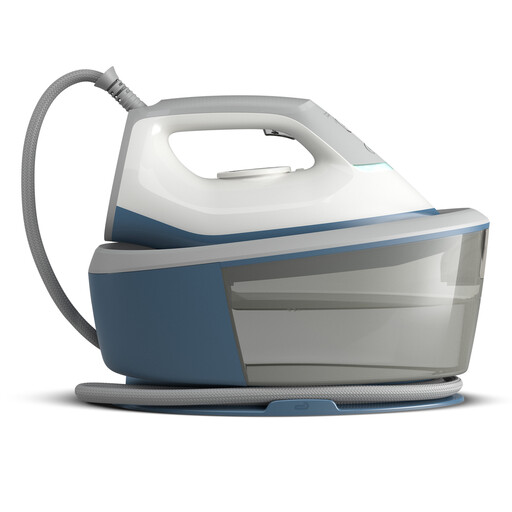 Image unavailable
If you prefer selecting a fabric temperature, check its settings against the linen tea towel’s care label.
Rated power: 2400 W. Check the PSG2000/20 dimensions against your board and storage space, and use its own cleaning instructions.
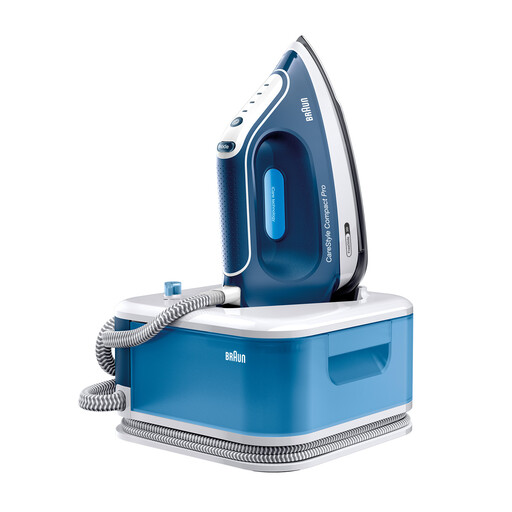 Image unavailable
For a storage-conscious household, measure your shelf and board rest before choosing this compact-positioned model.
Stated pressure: 7.5 bar; tank: 1.5 L. Its FreeGlide 3D feature may be less relevant to flat towels than to garments with obstacles. Check the IS2565BL manual for water and descaling instructions.
Follow the towel’s care label first. Where its instructions permit, ARKET recommends pressing linen while it is slightly damp, using medium-to-hot heat or steam, and ironing inside out to protect the visible surface. Use a stable, perforated board so steam can pass through the fabric.
No-setting operation does not override an individual towel’s care instructions. Philips and Bosch describe such systems for ironable fabrics; check the label particularly carefully for blends, prints and special finishes.
Descaling is part of owning a steam generator, especially where the water is hard. Philips says harder water makes scale develop faster; follow your exact model’s cleaning and cooling instructions rather than transferring a procedure from another generator.