Shared-house batch ironers
Residents pressing several pairs of school trousers or other laundry in one session, who would rather limit refill interruptions than minimise the appliance’s footprint.


For regular school-trouser pressing in a shared house, prioritise continuous steam and a tank that suits the length of your ironing sessions, then check where the separate base can be used, cooled and stored. A larger tank may mean fewer refills during a shared session, while noise, fabric-care settings and scale maintenance may matter more if housemates iron at different times or share the appliance.
Residents pressing several pairs of school trousers or other laundry in one session, who would rather limit refill interruptions than minimise the appliance’s footprint.
People ironing while others study or rest, who need to consider operating noise and where the separate base will sit during use and storage.
Parents, older pupils or housemates sharing an appliance across mixed laundry, who want straightforward fabric settings, shut-off features and limescale upkeep.
Start with the school trousers’ care label and the length of a typical ironing session. Then check whether the generator base, power lead and cooling appliance can be accommodated safely in the shared space.
| Concern | What to check | Who this matters to |
|---|---|---|
| Repeated crease pressing | Compare continuous steam output for sustained passes; treat the steam boost as a separate, short-burst figure. | If I press school trousers regularly, I want to finish repeated passes without choosing solely by a boost figure. Around 33% of consumers put this pressing need first. |
| Shared-space practicality | Check tank capacity, the base’s stored dimensions and any carry-lock or noise-related features on the exact model. | When ironing happens near housemates, I need somewhere to use and store the base without taking over a communal surface. For roughly 20% of consumers, shared-space practicality is the primary concern. |
| Mixed-fabric use | Read the trouser care label and the model’s fabric-setting conditions; check for automatic shut-off if that feature matters to your household. | With several people ironing uniforms and other laundry, I want to avoid unsuitable settings or a hot appliance being forgotten. Around 27% of consumers prioritise simpler, lower-risk shared use. |
| Upkeep and power use | Check the model’s scale-maintenance instructions and, if an extension device is needed, its marked rating and the combined connected load. | I need an upkeep routine I can follow and a socket arrangement that will not be overloaded. For about 20% of consumers, maintenance and electrical use come first. |
A boost is a brief burst, not the continuous output used during sustained ironing. Tefal publishes both figures for its cited steam generators; the larger boost number does not establish how quickly a particular pair of trousers will be pressed.
Compare continuous steam, boost and tank capacity separately on the exact model.
Philips and Tefal describe fabric-protection settings for ironable fabrics. A school uniform may still have a care-label restriction or a trim that needs different handling.
Read the garment’s care label before ironing, including instructions for badges, coatings and trims.
A steam generator includes a base and hose as well as the handheld iron. Tefal’s cited instructions require the appliance to cool after unplugging before storage.
Plan a stable ironing position and a cooling place that keeps hot parts clear of shared walkways; check the exact model’s storage instructions.
Overloaded or daisy-chained extension devices can overheat. Electrical Safety First advises using only one socket extension device per wall socket.
Check the device’s marked current limit and the combined load. If using a cable reel at its full rating, unwind it fully.
These model-specific features offer useful points of comparison; a feature described for one model should not be assumed to apply across its brand’s range.
The PerfectCare 7000 PSG7130/20 is relevant when several people want a shared appliance with a removable tank and fewer temperature-setting decisions.
The cited Pro Express Protect and Express Protect models give shared households removable-tank and handling features to compare.
The Silence DG8960G0 is worth considering when operating noise matters alongside targeted work on creases.
These two steam generators have stated tank capacities to consider for repeated school-trouser pressing. Compare the space each unit needs and confirm fabric-care and maintenance instructions for the exact model before choosing for a shared household.
 No image available
The stated 1.8 L tank is worth considering if several residents press trousers in one session and want to limit refill interruptions.
The product name also specifies a 2800 W rating. Check the garment care label and the model’s instructions before using it on uniform fabric or trims.
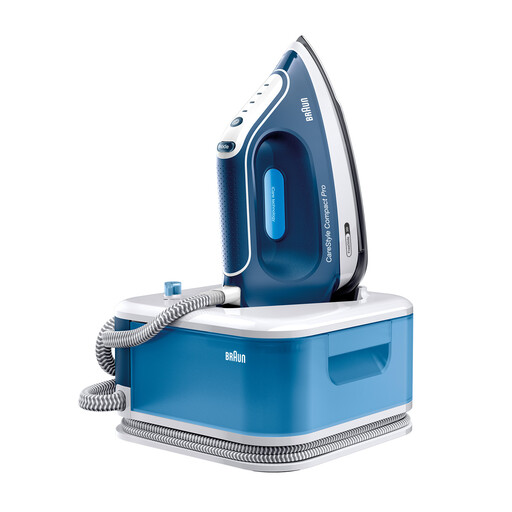 No image available
The stated 1.5 L tank is an option for shared ironing sessions where residents can accommodate the generator base; compare its capacity with the length of those sessions.
The product name specifies 7.5 bar pressure, a FreeGlide 3D soleplate and iCare technology. Check how the model’s fabric settings apply to the trousers, and allow it to cool as instructed before storage.
Compare continuous steam output for sustained ironing, then look at the boost figure for occasional stubborn creases. Tefal specifies these as separate, model-specific figures; neither figure alone establishes the result on a particular trouser fabric.
No: unplug it and let it cool for the period specified by its instructions before storing it. Tefal’s cited Pro Express Protect instructions say to wait until the appliance has cooled, around one hour, and to keep hot parts away from children while it is in use or cooling.
Follow the scale-collector or de-calc procedure for the exact model. Philips describes an Easy De-Calc system on its cited PSG7130/20; Tefal’s cited instructions warn against rinsing the boiler with vinegar or industrial descaling products.
Use one only if its marked current rating accommodates the combined connected load. Electrical Safety First advises against overloading or daisy-chaining extension devices and says cable reels should be fully unwound when used at their full rating.