Turnaround-focused holiday-let operators
If you press several cotton dresses or other textiles between stays, tank capacity, continuous steam and a manageable descaling routine are worth checking together.


For batches of cotton dresses between guest stays, choose a steam generator with a tank capacity that suits the session and a descaling routine you can maintain; compare continuous steam separately from the occasional boost. If several people press different ironable garments, automatic temperature control may simplify the routine, while limited secure storage makes the base dimensions especially important. Whichever model you choose, follow garment care labels and include the appliance in the holiday let's electrical-equipment checks.
If you press several cotton dresses or other textiles between stays, tank capacity, continuous steam and a manageable descaling routine are worth checking together.
When different people use the iron on a range of ironable garments, automatic temperature control can reduce setting changes. Care labels still determine whether each garment or trim can be ironed.
If dress pressing is occasional and secure cupboard space is tight, measure the room available for the base, iron and cable before choosing a generator.
Start with how many dresses you press in one session, then account for who uses the iron and where it can be stored and maintained.
| Concern | What to check | Who this matters to |
|---|---|---|
| Batch pressing and refills | Compare continuous steam with boost output, then check tank capacity and whether refilling suits your routine. | When dresses pile up between stays, I want to finish a pressing session without frequent refill pauses. Around 42% of consumers put batch pressing and refill avoidance first. |
| Handling different garments | Check each care label and whether the exact model offers automatic temperature control for ironable fabrics. | If several people press dresses with different fabrics or trims, I want a straightforward routine that still respects their care instructions. For around 33% of consumers, low-risk garment handling is the primary concern. |
| Storage and upkeep | Measure secure storage space and check the model's descaling instructions; include plug, cable and casing checks in its use routine. | With little cupboard space, I need an appliance the team can store securely and maintain between uses. Storage, upkeep and equipment condition come first for around 25% of consumers. |
A boost describes occasional steam delivery for stubborn creases, not the steam available throughout a batch of dresses.
Compare continuous steam and tank capacity on the exact model as well as its boost figure. Treat claims about time saved as manufacturer claims unless comparable independent testing supports them.
A collector or cleaning cycle still needs the upkeep specified for that model. Tefal lists a removable scale collector for its GV9230, while Morphy Richards provides an Auto Clean procedure for its SteamElite Plus.
Read the exact manual and assign emptying or cleaning to the holiday-let turnover routine.
Morphy Richards says neglecting the prescribed maintenance on its SteamElite Plus invalidates its guarantee.
Checks on a property's fixed electrical installation do not replace attention to the condition of an iron that is moved, used and stored. The Health and Safety Executive advises checking that electrical equipment is suitable and in good condition.
Store the generator dry and protected, check its plug, cable and casing, and remove damaged equipment from use. Set a maintenance routine appropriate to how the holiday let operates.
A reference point for batch pressing and a removable scale-management feature on the Pro Express Protect GV9230.
A reference point for automatic temperature control across ironable fabrics, with compactness also worth considering in the PerfectCare range.
A reference point for stated continuous steam, tank capacity and a defined cleaning routine on the Power SteamElite Plus.
These steam generator irons offer two starting points for the holiday-let task: assess tank capacity for batch pressing, or check whether a model's footprint suits occasional use and limited storage.
 No image available
Consider the 1.8 L tank if you press dresses in batches and want to assess how often your routine may require a refill.
The product name specifies 2800 W. Check the base dimensions, garment instructions and model-specific descaling steps before putting it into a shared-use routine.
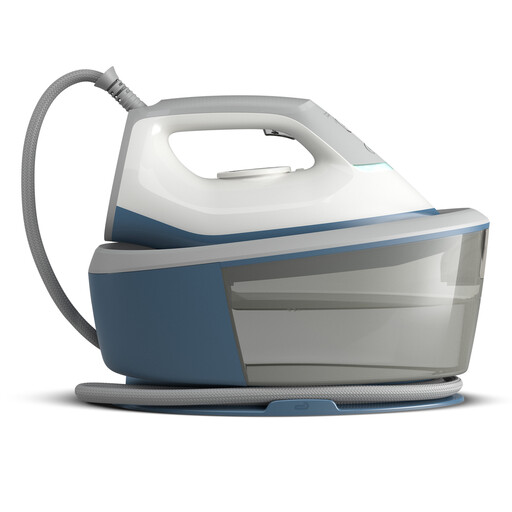 No image available
Consider this model for occasional dress pressing if storage space is a priority, but measure the available cupboard space against the complete unit before choosing it.
The product name specifies 2400 W. If easy refilling or shared use matters, check the tank arrangement and temperature controls for this exact model.
A steam generator is worth considering if you regularly press batches and a separate water tank suits your routine. Which? distinguishes generators from standard irons by that tank and their greater steam output as a category, but this does not establish that every generator will outperform every standard iron.
Yes, when the dress and the parts you intend to press are ironable under their care instructions. Philips says its OptimalTEMP system works across ironable fabrics without setting changes; that brand assurance does not make non-ironable trims safe to press.
Follow the cleaning schedule and permitted-water instructions for the exact generator you buy. Tefal lists a removable scale collector on its GV9230, while Morphy Richards says the Auto Clean indicator on its SteamElite Plus is triggered after approximately 5 litres of water use; their procedures are not interchangeable.
Do not assume that an annual portable appliance test is a universal rule. The Health and Safety Executive says annual PAT testing is not required for every portable appliance in a low-risk environment and describes maintenance according to the circumstances. GOV.UK's guidance for self-catering holiday homes in England directs operators to HSE electrical-safety guidance; check the obligations applicable to the nation where your property operates.