Occasional pressers with limited storage
If you press a tie and a few garments at a time, check the base dimensions, carrying arrangement and space needed for cooling before committing cupboard or board space.


For pressing cotton ties in a small flat, check where a steam generator’s separate base will sit, cool and be stored before choosing by its steam-boost figure. A controllable steam setting and a soleplate that reaches narrow areas are useful selection criteria, but the tie’s care label and construction must guide how you press it. A larger removable tank may be more useful if you also iron batches of clothing, provided the unit fits your board and storage space.
If you press a tie and a few garments at a time, check the base dimensions, carrying arrangement and space needed for cooling before committing cupboard or board space.
If creases near a tie’s narrow end or knot area are your main concern, consider how precisely you can position the soleplate and control steam. Check the tie’s care instructions before applying either.
If ties are only part of a larger ironing session, a removable tank and a clear descaling routine may matter more to you. Allow for the base’s size as well as refill convenience.
Start with physical fit, then assess steam control for the tie and the upkeep you are willing to do. Compare stated product dimensions with both your storage space and the platform that will support the base.
| Concern | What to check | Who this matters to |
|---|---|---|
| Storage and handling | Check base dimensions against your shelf and board; look for a carry lock and a place to leave the unit while it cools. | If cupboard and board space are tight, I need a base I can accommodate and put away safely. Around 42% of consumers would make storage and handling their primary concern. |
| Tie creases and precision | Compare continuous steam separately from boost output, inspect the soleplate tip and check how steam is controlled. Follow the tie’s care label. | When pressing narrow sections, I want to work accurately without assuming a stronger burst suits the tie’s lining or finish. Crease handling would come first for around 33% of consumers. |
| Refills and upkeep | Check tank capacity, whether it is removable, and the model’s descaling and permitted-water instructions. | If I iron shirts and other items alongside ties, I want refilling and cleaning to fit my routine. Around 25% of consumers would prioritise that convenience. |
A boost is a short burst, not the ongoing steam output. A larger manufacturer-rated number does not establish how well an iron will handle every tie.
Compare continuous steam and control alongside soleplate access to narrow areas. Check the tie’s care label before using steam.
More capacity may mean fewer refills during a batch, but a separate base still needs a stable position during use and room for storage afterwards.
Measure your board platform and cupboard first; then decide whether tank capacity or a removable tank will make a difference to your usual ironing sessions.
Philips, Tefal and Morphy Richards describe different cleaning arrangements for the cited models. A self-clean feature does not remove the need to follow the particular model’s instructions.
Read its manual for the cleaning steps and permitted water type before choosing a system you can maintain.
Cleaning also takes time; Morphy Richards states that failing to maintain its SteamElite Plus can affect its guarantee.
Electrical Safety First warns that overloaded extension devices can overheat and that a cable reel can overheat if left wound.
Plan for a suitable socket without daisy-chaining leads. Stop using the iron if it leaks, shows damage, overheats or repeatedly trips the supply.
These examples show different features to assess, not qualities shared by every model from a brand.
The PerfectCare 6000 PSG6064/86 is a useful model to measure against a particular storage shelf.
The Express Easy SV6140G0 gives space-conscious buyers a stated base-footprint reference.
Its cited steam generators offer different approaches to narrow-area pressing and cleaning.
These steam generator irons are options to assess for tie pressing alongside your available storage space. The models here are distinct from the brand examples above, so check each model’s own features rather than transferring specifications between them.
 No image available
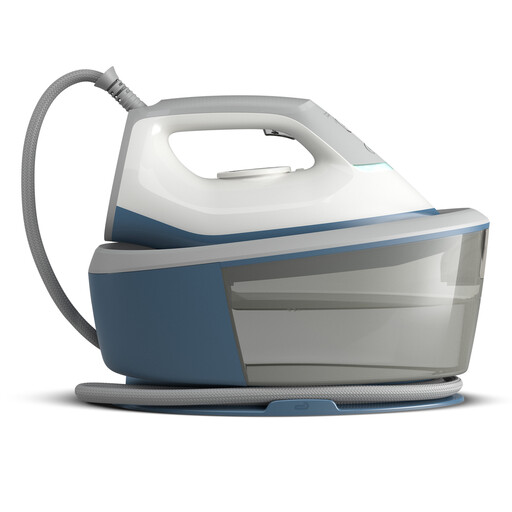
Consider this model if you also iron larger batches and want to assess a stated tank capacity against the space available. Its product name specifies 2800 W and a 1.8 L tank.
Measure the base and board platform before buying, and check the tie’s care label before using steam.
 No image available
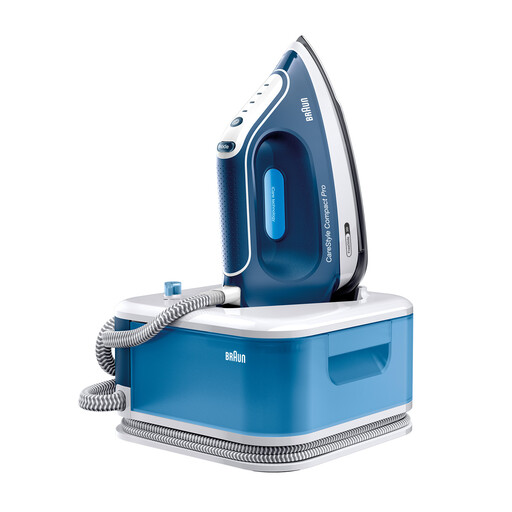
This is another option if your usual session includes ties and a few other garments. Its product name specifies 2400 W.
Confirm the base dimensions against your storage and board, and inspect the soleplate shape if access to narrow tie sections matters to you.
 No image available
Consider this model if a removable-tank arrangement is important to your ironing routine. Its product name specifies 7.5 bar pressure, a 1.5 L tank, FreeGlide 3D and iCare Technology.
Check its footprint, carrying arrangement and cleaning instructions against how you will use and store it; the stated pressure does not establish the right pressing method for every tie.
No: a high boost figure alone is not a reason to choose an iron for cotton ties. Compare ongoing steam control and how accurately the soleplate can reach narrow sections, then follow the tie’s care label and take care with an unfamiliar lining or finish.
Measure the storage shelf, ironing-board platform and place where the generator can cool safely. For a model-specific reference, Philips states dimensions of 16.8 × 26.9 × 36.8 cm for its PerfectCare 6000 PSG6064/86; do not apply those measurements to other Philips models.
No. Cleaning arrangements and permitted water types differ by model, so follow the chosen iron’s instructions for descaling and routine care rather than assuming that one brand’s method applies to another.
Check that the appliance has a suitable plug and an undamaged cable, and plan where it will connect before setting up the board. Electrical Safety First advises against overloading or daisy-chaining extension leads; stop using an appliance that leaks, overheats or repeatedly trips the supply.
Yes. Current Department for Business and Trade guidance lists electrical equipment as eligible for UKCA or CE marking when placed on the Great Britain market. That Great Britain conclusion covers England, Scotland and Wales; check the applicable requirements separately if you are buying for Northern Ireland.