Consider a steam generator iron if you also do regular laundry ironing and its controls let you follow your patch maker’s heat and steam instructions. Azen Gear specifies a standard household iron, a completely dry garment and no steam for its denim repair patches, so a generator designed around automatic or continuous steam needs particular scrutiny for that task.
Who is this for?
Patch-first repairers
If attaching a patch is the main task, start with its application instructions and the garment’s care label rather than the iron’s steam output. Azen Gear, for example, calls for a dry garment and no steam when applying its denim repair patches.
Laundry and project users
If you iron garments between patch projects, a steam generator’s tank and steam controls become relevant to those wider sessions. Keep ordinary ironing separate from any patch application that requires dry heat.
Small utility-room users
If the appliance must share a compact work area, allow space for its base, tank, cable and a safe place to rest the hot iron. Electrical Safety First also advises checking the plug and keeping an iron unplugged when it is not in use.
What matters when choosing?
Choose the pressing method required by the patch first. Then decide whether the same appliance needs to handle regular laundry and fit the utility-room workspace.
Steam generator with selectable heat
Consider it when: You also iron laundry and need to select a fabric-appropriate temperature; Braun lists a thermostat knob on CareStyle 1 Pro, while Polti lists fabric programmes for the La Vaporella XT100C.
Check: A temperature setting does not establish that steam can stay off throughout a patch press.
One-temperature steam generator
Consider it when: Regular garment ironing is the main reason for buying; Tefal describes the Express Vision SV8154G0 as using one steam-and-temperature approach.
Check: That approach must not be taken as permission to use steam on a patch whose instructions prohibit it.
Standard household iron
Consider it when: Patch application is the main job and the patch maker specifies a household iron with no steam, as Azen Gear does for its denim repair patches.
Trade-off: It does not provide a steam generator’s separate water tank for wider steam-ironing sessions.
| Concern |
What to check |
Who this matters to |
| Dry-press control |
Compare the patch and garment instructions with the appliance manual: check temperature selection and whether steam can remain off for the whole press. |
If I mainly attach patches, I need to follow their heat and moisture instructions without relying on a laundry setting. Around 50% of consumers put dry-press control first. |
| Laundry capacity |
Compare removable-tank capacity and the model’s stated steam output for ordinary ironing; neither figure establishes patch-bonding suitability. |
When patch work is part of a larger laundry session, I want to manage refilling and garment ironing without letting those priorities dictate the patch method. Around 30% of consumers primarily value laundry capacity. |
| Utility-room setup |
Measure space for the base and a heat-safe resting place, then check the plug, cable arrangement and model-specific scale care. |
In a limited work area, I need somewhere to position, use and store the appliance safely. Utility-room setup is the main concern for around 20% of consumers. |
What should you avoid?
-
Choosing by steam output alone
Steam figures describe ordinary ironing, not whether moisture is appropriate for an adhesive patch. Azen Gear’s denim repair patches explicitly require no steam.
Read the patch instructions before comparing generator specifications, then check the individual appliance manual for the required operating method.
-
Assuming one temperature suits every patch
An appliance setting intended for ironable garments does not establish the heat tolerance of an adhesive backing, print or trim.
Follow both the garment label and patch instructions; use a pressing cloth or test an area only if the relevant instructions permit it.
-
Overlooking scale care
Scale-management arrangements differ between models. Tefal describes a removable scale collector for the SV8154G0, while Polti describes an anti-scale boiler system for the XT100C.
Check the maintenance steps in the manual for the specific model you intend to buy.
-
Crowding the power setup
A hot iron, water handling and trailing cables need careful placement in a utility room. Electrical Safety First advises checking an iron’s UK plug and fuse and unplugging it when not in use.
Keep the appliance and cable clear of water, inspect them for damage, and avoid overloading or chaining extension equipment.
Brands to consider
Tefal
The Express Vision SV8154G0 is relevant if regular laundry ironing is part of the plan, rather than patch application alone.
- Tefal states that this model has a removable 1.8 L tank, 6.9-bar pressure and 130 g/min continuous steam for garment ironing.
- Its one-temperature steam approach should not be assumed suitable when a patch maker requires steam to be off.
Braun
CareStyle models offer differing control approaches worth checking against fabric-specific instructions.
- Braun lists a mechanical thermostat knob for CareStyle 1 Pro models.
- A selectable temperature alone does not confirm that a particular model permits a complete dry press.
Polti
The La Vaporella XT100C combines fabric programmes with a pull-out tank for wider ironing sessions.
- Polti lists six settings—Silk, Wool, Universal, Cotton, Linen and Turbo—and a 1.5 L pull-out tank for the XT100C.
- A fabric programme does not replace an explicit no-steam instruction from a patch maker.
Joybuy product choices
This steam generator is a choice to consider for ordinary ironing alongside patch projects. Before using it to attach a patch, check that its manual permits the heat and steam method required by the patch and garment instructions.
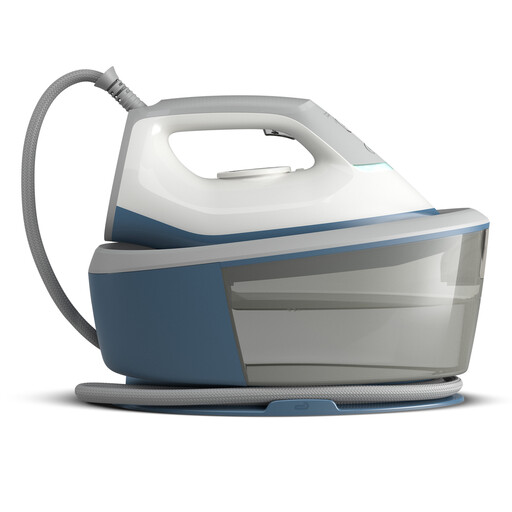 Image unavailable
Philips 2000 Series PSG2000/20 Steam Generator, 2400 W
Consider this steam generator if you also iron laundry between patch projects.
Its stated power rating is 2400 W. Check the model’s manual for temperature controls and whether steam can remain off throughout a patch press; also confirm the plug and cable arrangement suit your utility room.
View on Joybuy
Common questions
Can I attach an iron-on patch with a steam generator?
Only if the patch and garment instructions allow the appliance’s heat and steam method. Azen Gear specifies a standard household iron, a dry garment and no steam for its denim repair patches, so check the instructions for your particular patch before applying heat.
Which temperature should I use for a fabric patch?
Use the patch maker’s specified setting without exceeding the garment care label’s heat tolerance. Patches 'R' Us gives medium heat as general guidance, but the instructions for the particular patch and fabric take priority.
What electrical checks matter in a UK utility room?
Check for a UK 3-pin plug and fuse, follow the appliance manual and inspect the plug and cable for damage. Electrical Safety First also advises unplugging irons when they are not in use; position the hot appliance and its cable clear of water.
Can I use an extension lead with a steam generator iron?
Use one only within its marked rating and the appliance manual’s instructions. Do not overload or daisy-chain extension equipment, and fully unwind a cable reel before use; Electrical Safety First warns that overloaded electrical equipment can overheat.


