Holiday-let hosts handling turnaround laundry
If you press several cotton items in one session, sustained steam, convenient refilling and somewhere to store the separate base may matter more than a large occasional steam boost.


For repeated batches of cotton shorts, compare stated continuous steam and tank capacity before the short-burst steam boost. A tank around 1.5–1.8 L may mean fewer refills, but check whether the base fits your storage space; if other fabrics join the load, temperature controls and a workable descaling routine also matter.
If you press several cotton items in one session, sustained steam, convenient refilling and somewhere to store the separate base may matter more than a large occasional steam boost.
If cotton shorts are pressed alongside other ironable garments, automatic temperature control may reduce setting changes. Check each garment’s care label, particularly for trims, prints or special finishes.
If the appliance will see frequent use or the property has hard water, look for maintenance steps you can fit between turnovers. Philips advises that regular descaling helps prevent brown water, leaks and marks on clothes.
For holiday-let laundry, start with the size and frequency of your pressing batches, then consider whether mixed fabrics or descaling will create more work.
| Concern | What to check | Who this matters to |
|---|---|---|
| Repeated pressing | Compare stated continuous steam in g/min and tank capacity; do not treat the steam boost as sustained output. | When I have several pairs of cotton shorts to press between guests, I want steady steam without repeated refill stops; around 42% of consumers would put batch throughput first. |
| Mixed fabrics | Check what the temperature controls cover and whether steam is automatic; follow garment care labels. | If the load contains different ironable fabrics, I would rather not keep changing settings; around 25% of consumers would prioritise simpler mixed-fabric handling. |
| Scale management | Read the exact model’s descaling steps, including any cooling and drainage requirements. | In a hard-water property, I need upkeep that fits between turnovers without risking marks on laundry; around 33% of consumers would put manageable descaling first. |
A boost is a short burst, whereas pressing several garments depends on sustained steam and having enough water for the session.
Compare the manufacturer’s continuous-steam figure and tank capacity first. Keep boost output as a separate consideration for occasional stubborn creases.
Philips advises that regular descaling helps prevent brown stains, brown water, leaks and reduced steam output.
Read the exact model’s instructions before buying and make sure there is a practical place to cool and drain the appliance when required.
The Health and Safety Executive says the regulations do not prescribe one testing frequency. An automatic annual schedule is not a substitute for maintaining equipment safely.
Plan checks around the appliance, its condition and how it is used; arrange competent inspection or testing where the circumstances call for it.
A steam generator’s tank and base need storage and handling space as well as room for the iron itself.
Check the exact model’s dimensions, carrying weight, tank-removal method and intended storage spot before ordering.
Tefal UK lists Express Airglide and Pro Express Renew models with stated continuous steam of 120 g/min and 140 g/min respectively. Compare the exact model rather than assuming the figures apply across the range.
Philips UK describes the PerfectCare 7000 Series PSG7300/20 with automatic steam, a stated output of up to 170 g/min and a 1.5 L tank. These specifications concern that model, not every Philips steam generator.
Morphy Richards UK lists steam generators with different tank sizes and controls. Its Speed Steam model states 140 g/min continuous steam and a 1.7 L tank, while EasySteam+ lists a removable 1.8 L tank.
These steam generators are relevant to pressing holiday-let laundry. Compare each model’s stated features with the length of your pressing sessions, the fabrics in the load and the space available for storage.
 No image available
Consider this model if its stated 1.8 L tank suits repeated pressing sessions. Check its continuous-steam specification, storage dimensions and scale-collector instructions against the property’s routine.
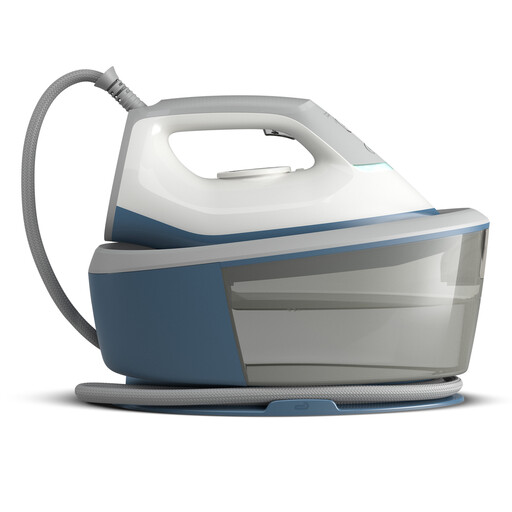 No image available
For regular garment pressing, check whether this model’s continuous steam and tank capacity suit the length of your holiday-let batches. If loads contain different fabrics, also check its temperature-setting steps, descaling procedure and storage dimensions.
For repeated holiday-let batches, continuous steam is the more relevant figure to compare because a boost is only a short burst. Check tank capacity and maintenance requirements alongside it; keep boost output in mind for occasional stubborn creases.
Follow the exact model’s manual and alerts rather than using one timetable for every appliance. Philips says scale develops faster in harder water, and some of its procedures require the unit to be unplugged and cooled before draining.
Not automatically: the Health and Safety Executive says the regulations do not specify an annual testing frequency. Equipment that could cause injury must be maintained in a safe condition, with inspection and testing decisions suited to the equipment and its use environment.
Choose an appliance supplied for the Great Britain market by a traceable seller and keep its documentation. The Office for Product Safety and Standards’ electrical-equipment guidance is specific to Great Britain; do not assume it sets the same requirements for Northern Ireland.