For repeated batches of linen tea towels, compare sustained steam, tank arrangements and model-specific scale care before concentrating on boost or wattage. If several people also iron other textiles, simpler controls may matter more, but everyone still needs to follow fabric care labels and the appliance instructions.
Who needs which features?
High-turnover linen managers
If you press repeated batches between guest changes, sustained steam, a practical refill arrangement and straightforward scale care deserve attention. Tefal UK specifies these features for its GV9580, though its figures do not establish how quickly it will press your linen.
Shared-task holiday-let operators
When different people press tea towels and other ironable textiles, clear controls and instructions can make the task easier to hand over. Philips UK describes automatic steam and OptimalTEMP on its PSG7300/20; fabric care labels still apply.
Small-property hosts with lighter workloads
If pressing sessions are shorter, consider how the station fits your ironing area and storage space, as well as how its tank is filled and cleaned. Check those arrangements on the exact model rather than judging the whole appliance by its steam figures.
What matters when choosing?
For holiday-let tea towels, identify the issue most likely to interrupt your pressing routine, then check the corresponding features on the exact model.
| Concern |
What to check |
Who this matters to |
| Repeated batches |
Compare continuous steam in g/min, tank capacity and whether refilling is permitted during use. Check whether any stated run time applies only in Eco mode. |
If I press a stack of creased tea towels between guest changes, I want fewer pauses to refill. Around 36% of consumers put batch throughput first. |
| Shared use and fabric settings |
Check the exact model's steam and temperature controls, then follow each textile's care label. |
When several people take turns ironing different textiles, I want controls that are easy to use without assuming every fabric is ironable. Roughly 29% of consumers prioritise simpler shared use. |
| Scale maintenance |
Look for the model-specific cleaning method, permitted water type and any cooling instructions before handling a collector or boiler. |
I need a cleaning routine that can be followed consistently when the iron is used regularly. About 21% of consumers make manageable scale care their primary concern. |
| Storage and handling |
Check the station's dimensions, weight, cord storage and where it can be kept securely. |
With limited space for the ironing setup, I need to put the station away without making the next session awkward. Around 14% of consumers put storage and handling first. |
Mistakes to avoid
-
Judging batch pressing by the steam boost alone
A boost describes a short burst, not sustained steam through a stack of tea towels. Tank size and refill arrangements can also affect interruptions.
Compare continuous steam, boost, pressure and clean-water tank capacity on the exact model. Do not treat a manufacturer's ironing-time claim as a guaranteed result for linen.
-
Using a generic descaling method
Water and cleaning instructions differ between appliances. Morphy Richards UK Support advises against vinegar, descaling chemicals and scented water unless the model's manual permits them.
Keep the manual accessible, follow its water and cleaning directions, and let the appliance cool before maintenance where instructed.
-
Confusing total system capacity with the clean-water tank
Morphy Richards UK gives both a 1.35 L water-tank figure and a 2.2 L total capacity including clean- and dirty-water tanks for the Power SteamElite 332014. The larger figure does not describe its clean-water tank alone.
Use the clearly identified clean-water capacity when planning refills, and confirm it for the exact model.
-
Assuming annual PAT is always required—or that no checks are needed
The Health and Safety Executive says there is no general legal requirement for portable-appliance testing every year. Safe maintenance still matters, and the appropriate checks depend on the equipment and its environment.
Arrange inspection and maintenance to suit how and where the iron is used. Check its visible condition before use and seek competent advice about duties that apply to the property.
Relevant brands to consider
Tefal
Its Pro Express range is relevant when sustained steam and refilling arrangements are priorities for frequent pressing.
- Tefal UK specifies 180 g/min continuous steam, a removable 1.9 L tank and a scale collector for the GV9580.
- These GV9580 specifications do not establish linen-pressing speed or describe every Tefal model.
Philips
The PerfectCare 7000 series is relevant when several users handle different ironable textiles.
- Philips UK specifies motion-sensor automatic steam and OptimalTEMP for the PSG7300/20.
- Philips limits its fabric-protection statement to ironable fabrics; check care labels and the exact model's instructions.
Morphy Richards
The Power SteamElite 332014 provides a reference point for buyers comparing generator controls and cleaning arrangements.
- Morphy Richards UK specifies 5-bar pressure and AutoClean for the 332014.
- Its clean-water tank and total water-system capacities are different figures; check which one a listing describes.
Braun
CareStyle models are relevant when soleplate movement and scale-cleaning arrangements are important to the pressing routine.
- Braun Household GB describes FreeGlide 3D and Ultimate FastClean within its CareStyle range.
- Capacities, modes and steam figures vary across the range, so check the exact model rather than applying range details to every station.
Steam generator irons on Joybuy
These steam generator irons are relevant to repeated tea-towel pressing. Compare their stated tank arrangements and operating instructions against your batch size and who will use the appliance.
 Image unavailable
Tefal Express Vision SV8154G0 steam generator iron
Consider this model if refill planning and straightforward operation matter during repeated tea-towel pressing.
The product title specifies a 1.8 L water tank and 2800 W rating. Check the SV8154G0 manual for permitted water and scale-collector cleaning, and follow textile care labels.
View on Joybuy
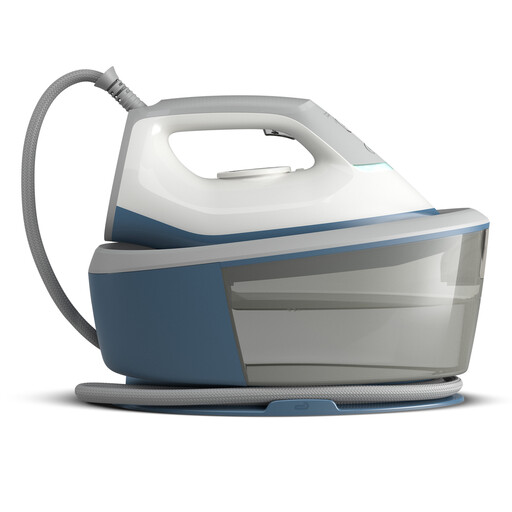 Image unavailable
Philips 2000 Series PSG2000/20 steam generator iron
For repeated pressing, check how this model is refilled and cleaned before deciding whether it suits your routine.
The product title specifies a 2400 W rating. Its operating instructions call for selecting a temperature for the fabric, so follow the textile care label; consult the PSG2000/20 manual for its water and Calc-Clean procedure.
View on Joybuy
Frequently asked questions
What matters more for batches of linen tea towels: pressure, continuous steam or boost?
Compare all three, but pay particular attention to continuous steam for sustained pressing and to tank arrangements for refill interruptions. A boost is a short burst rather than a sustained-output figure. Tefal UK specifies 180 g/min continuous steam and a 600 g/min boost for the GV9580; those manufacturer figures are not a linen-speed test.
Can I put vinegar or scented water in a steam generator iron?
Only if the exact model's instructions expressly permit it. Morphy Richards UK Support advises against vinegar, descaling chemicals and scented water unless the manual says otherwise; follow its cooling directions before opening or cleaning components.
Does a steam generator iron in a holiday let need annual PAT testing?
The Health and Safety Executive says there is no general legal requirement for annual portable-appliance testing. Equipment must still be maintained safely, with inspection and testing suited to its type and environment. Seek competent local advice about the duties that apply to your property and how the appliance is used.
Should I look for UKCA or CE marking when buying for a property in Great Britain?
For covered products placed on the Great Britain market, the Department for Business and Trade says CE marking continues to be recognised alongside or instead of UKCA marking where the relevant requirements meet UK needs. Check the documentation and applicable requirements for the particular iron; this Great Britain guidance does not establish the marking route for Northern Ireland.


