People pressing batches of linen
Students or housemates who press several napkins alongside other laundry may value a larger tank and fewer pauses to refill it.


A steam generator iron makes more sense when you regularly press batches of linen napkins alongside other laundry: its separate, larger tank can mean fewer refill breaks. For just a few occasional napkins, a conventional steam iron is likely to be more proportionate to the task. If you choose a generator, check storage space, board stability, electrical setup and model-specific maintenance as well as steam ratings.
Students or housemates who press several napkins alongside other laundry may value a larger tank and fewer pauses to refill it.
If napkins are only pressed now and then, the separate generator base may be hard to justify in a shared cupboard. A conventional steam iron is worth comparing.
In a shared house, the available socket, cable route, ironing board and place to let the appliance cool all matter alongside its steam output.
Decide whether you press enough items at once to use a generator's larger tank, then check whether the appliance and board can be used and stored safely in your shared space.
| Concern | What to check | Who this matters to |
|---|---|---|
| Batch pressing | Compare the exact model's tank capacity and rated continuous steam output; a boost rating alone does not establish how it will handle your napkins. | If I press several linen napkins with other laundry, I want to avoid stopping repeatedly to refill the tank. Around 37% of consumers put batch pressing first. |
| Storage and frequency | Measure the shelf for both the base and iron, and decide whether your sessions are frequent enough to warrant a separate tank. | When I only press a few napkins occasionally, cupboard space matters more to me than a larger reservoir. Roughly 27% of consumers prioritise storage and proportionality. |
| Shared-house safety | Check the supplied plug and fuse, cable condition and socket setup; use a stable board suitable for steam. | I need somewhere steady to iron without trailing a cable across a shared room or overloading an extension lead. Around 18% of consumers place safe setup first. |
| Water and scale care | Read the exact model's instructions for water, refilling and descaling before choosing it. | If several housemates will use the iron, I need its water and cleaning routine to be manageable. Roughly 18% of consumers make maintenance their primary concern. |
A separate tank and base are easier to justify for repeated loads than for a few napkins now and then.
Consider how often napkins will be pressed with other laundry, and compare a conventional steam iron if sessions are infrequent.
A steam generator needs a steady, robust place to rest, while the board and cover must suit steam ironing.
Check the board's stability and suitability for the appliance before buying.
An unsuitable board or cover may need replacing.
Auto-off does not prevent an overloaded extension lead or damaged cable from creating an electrical risk. Electrical Safety First advises against overloading extension leads.
Check the appliance and socket arrangement, avoid daisy-chained extensions, and unplug the iron after use.
Water and descaling instructions vary by model; a tank or scale-care feature does not replace the manual.
Check the precise model's water and maintenance instructions before purchase, particularly if housemates will share the task.
The Express Easy SV6140G0 illustrates a compact-generator option for repeated ironing where storage space matters.
The PerfectCare 7000 PSG7300/20 illustrates an automatic-steam and automatic-temperature option for households ironing varied fabrics.
Braun's CareStyle range includes compact and larger-tank models, so the exact variant matters in a small shared house.
These steam generator irons are options to compare if you regularly press linen napkins in batches. Check each model's storage fit, supplied UK plug and water instructions before deciding.
 No image available
Consider this separate-tank model if pressing napkins is part of a regular laundry batch.
The listed variant has a 1.8 L water tank and a 2800 W rating. Measure its intended storage space and check the SV8154G0 manual for water and scale care.
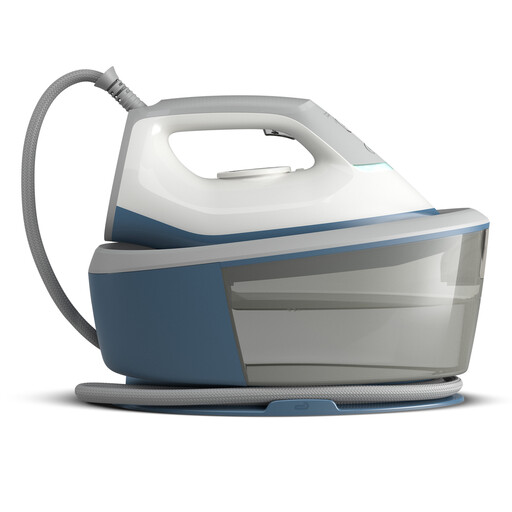 No image available
This generator is another option to assess for regular napkin batches, provided there is room to use and store its base.
The listed variant has a 2400 W rating. Check its dimensions and exact water instructions; do not assume it has the features of the different PerfectCare 7000 model discussed above.
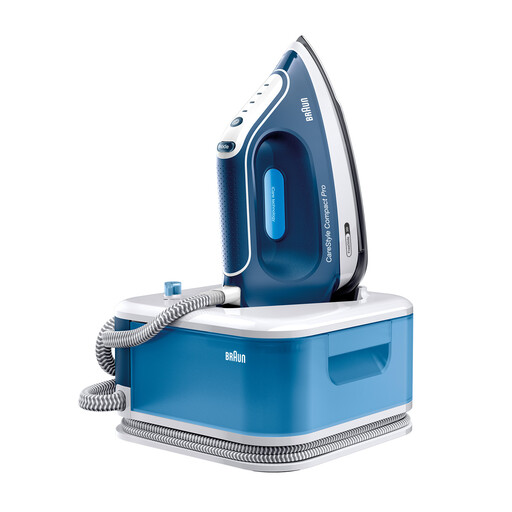 No image available
Consider this model for shared-house batch ironing if its base fits the available board and storage space.
The listed variant has a 1.5 L tank and a 7.5-bar pressure rating. Check the IS2565BL manual's water requirements and confirm the supplied UK plug and fuse.
Usually not for occasional napkins alone. John Lewis & Partners suggests a conventional steam iron for odd items; a generator becomes more relevant when napkins are regularly pressed with larger laundry loads.
Use a steady, robust board suitable for the chosen appliance. Tefal's steam-generator guidance also recommends a perforated board and suitable cover to let steam pass through the fabric.
Check that the supplied iron has a UK three-pin plug and fuse, and inspect its plug and cable before use. Electrical Safety First advises keeping irons unplugged when not in use and not overloading extension leads; never leave an iron unattended.
No single water instruction applies to every model, so follow the exact appliance manual. For the Tefal SV6132G0 specifically, Tefal permits untreated tap water but advises a 50/50 mix of untreated tap and distilled water in very hard-water areas.
Use vertical steam only where the exact model's manual permits it. Tefal advises steaming an item on a hanger and never applying vertical steam to clothing someone is wearing.