Small-flat uniform keepers
You press school trousers on a modest board and need to put the appliance away after each session. Base dimensions, hose clearance and cupboard space may decide whether a generator is practical at all.


A compact steam generator makes more sense for regularly pressing several school-uniform items than for the occasional pair of trousers. In a small flat, check that its separate base fits a sturdy, steam-permeable board and has somewhere to go afterwards; Which? notes that a conventional steam iron is generally easier to store. Tank access, fabric settings and descaling also matter more to this routine than a pressure figure alone.
You press school trousers on a modest board and need to put the appliance away after each session. Base dimensions, hose clearance and cupboard space may decide whether a generator is practical at all.
You regularly press several garments and would value a separate water tank and sustained steam, provided the larger setup fits your board and storage space.
You handle a mix of ironable uniform fabrics and want fewer temperature decisions, while still checking care labels and making time for the appliance’s cleaning routine.
Start with the space available on your board and in your cupboard. If a separate base fits, weigh up how often you press uniforms, how you handle different fabrics and whether the water and cleaning routine works for you.
| Concern | What to check | Who this matters to |
|---|---|---|
| Board and storage fit | Measure the board platform and storage space against the complete appliance, allowing room for its hose and cable. | If I have to clear the board and put everything in a cupboard after pressing, the whole setup must fit, not just the base. Around 37% of consumers would put fit first. |
| Regular trouser loads | Compare continuous steam and tank capacity, then consider independent assessments of crease removal where available. | Pressing several uniform items regularly makes refill interruptions and repeated work around seams more noticeable. For around 27% of consumers, handling that routine would be the primary concern. |
| Mixed fabrics | Check the exact model’s temperature controls or fabric-setting system, and follow each garment’s care label. | If trousers go on the board alongside other ironable fabrics, I want to avoid unnecessary setting changes without ignoring the labels. Around 18% of consumers would prioritise simpler fabric handling. |
| Water and upkeep | Check the manual for permitted water, tank access and the descaling steps, including any cooling or collection requirements. | A cleaning job that is awkward to complete near my sink could disrupt a short ironing session. Manageable upkeep would come first for around 18% of consumers. |
The base still needs stable support during use, while the hose, cable and full appliance need space when stored. Which? notes that conventional steam irons are generally easier to put away.
Measure your board platform and intended storage position, then compare them with the exact model’s dimensions rather than relying on the word “compact”.
A headline steam figure cannot tell you whether the board accommodates the unit or how well it handles trouser creases. Which? assesses ironing ability and usability alongside steam output in its testing.
Compare steam figures between models, but also examine tank access, storage, controls and relevant independent test results.
Cleaning methods differ between models. Philips says that some of its generators stop heating and producing steam while a Calc-Clean alert is active.
Read the exact model’s instructions for water and descaling before buying, including what you need to do when an alert appears.
Electrical Safety First warns that too many appliances on a socket or extension lead can be dangerous, particularly with high-powered appliances such as irons.
Avoid overloading sockets, check plugs and leads for damage or heat, and stop using damaged equipment.
These product lines illustrate different ways to address storage and fabric handling; a brand name alone does not establish that a particular model will fit your board.
Tefal’s Express Essential models provide compact-base examples. Tefal lists a fixed 1.4 L tank for the SV6116 and a removable 1.7 L tank for the SV6140.
Braun’s CareStyle Compact line is relevant if a vertical storage design suits the height and footprint of your cupboard. Braun lists a 1.5 L tank and iCare mode for the IS 2144.
Philips presents the PerfectCare Compact Essential GC6821/36R1 as a compact, settings-free option for ironable fabrics, with a fixed 1.3 L tank.
These steam generators are options to assess for recurring school-trouser pressing. For either one, measure the complete setup against your ironing board and storage space before deciding.
 No image available
Consider this model if you press uniforms regularly and want a generator with a 1.8 L tank. Its product title also specifies 2800 W. Check the full setup’s board and storage clearances, plus the model’s water and scale-collector instructions.
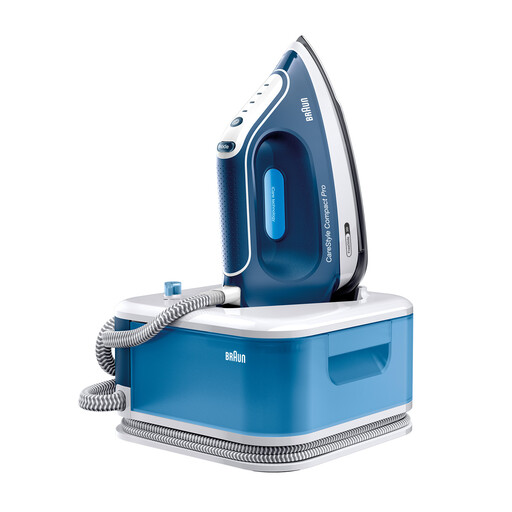 No image available
Consider this model if cupboard space and fabric settings are important to your uniform routine. Its product title specifies a 1.5 L tank, 7.5 bar pressure, FreeGlide 3D and iCare technology; pressure alone does not establish crease-removal results. Confirm its dimensions, hose clearance and exact water and cleaning instructions.
You need a steady, robust board that can support the appliance. Tefal’s guidance also calls for a perforated board so steam can pass through; measure the platform against the base of the model you intend to buy.
No. Tefal’s guidance says never to direct vertical steam at clothing being worn. Use a hanger for a quick refresh, keeping clear of hot steam, and a board when you need to press a trouser crease.
Follow the instructions for your exact model rather than applying one brand’s rule to another. For the cited SV6116, Tefal says untreated tap water is suitable and advises a mix of untreated tap water and distilled water where the water is very hard.
No; follow the model’s cleaning process when required. Philips says some generators stop heating and producing steam while their Calc-Clean alert is active, so check the manual for the steps and any cooling requirements before starting.
No. Electrical Safety First warns against overloading sockets and extension leads, particularly with high-powered appliances such as irons. Use an undamaged electrical setup and follow the appliance instructions.