What matters when choosing?
Start with the fabrics and the control needed at the collar, then consider how the tank, base and maintenance routine will fit a typical family ironing session.
| Concern |
What to check |
Who this matters to |
| Collar control |
Compare continuous steam, an on-demand boost and the soleplate shape; check that steam and heat suit the shirt’s care label. |
I want to work around collar points and seams without treating every shirt as though it needs maximum heat. Around 33% of consumers put collar precision first. |
| Family-load interruptions |
Check tank capacity, whether refilling is convenient and how much room the generator base needs. |
When several shirts are waiting, I want to keep the session moving rather than pause repeatedly to refill. For around 27% of consumers, fewer interruptions are the main concern. |
| Mixed fabrics |
Check whether temperature and steam are adjustable or handled automatically, then follow each garment’s care label. |
If cotton shirts share the load with more delicate pieces, I need settings that suit each fabric. Protecting mixed fabrics comes first for around 20% of consumers. |
| Set-up and upkeep |
Confirm stable board placement, the supplied UK plug and the exact model’s scale-maintenance instructions. |
I need somewhere secure to put the hot base and a maintenance routine I can follow between sessions. Around 20% of consumers prioritise safe set-up and manageable upkeep. |
Brands to consider
These brands provide useful model-level points of comparison; their features vary by product line, so check the precise variant rather than relying on the brand name.
Tefal
Tefal’s Pro Express and Liberty ranges offer different approaches to steam output, refilling and scale care.
- Tefal UK specifies 8 bars, 120 g/min continuous steam, a 500 g/min boost and a 1.9-litre removable tank for the Pro Express Ultimate GV9550G0. Its Liberty SV7040G0 is described with anti-scale cartridges and a removable tank.
- Those are model-specific manufacturer specifications, not measured collar-finishing results. Check the water and maintenance instructions for the variant you choose.
Philips
The PerfectCare Elite Plus GC9682/80 is a model to examine if manual temperature changes across a mixed load are a concern.
- Philips describes the GC9682/80 as using intelligent automatic steam without requiring a temperature setting.
- That model description does not mean every Philips generator has the same controls or that garment care instructions can be ignored.
Russell Hobbs
Russell Hobbs is another brand to include when comparing steam-generator tank sizes and household-use features.
- John Lewis & Partners has listed Russell Hobbs steam generators with tank capacities ranging from 1.3 to 1.8 litres.
- Tank size alone cannot establish how precisely a model will handle collars. Check its steam controls, soleplate and maintenance instructions individually.
Joybuy product choices
These steam generators are options to compare for shirt collars and regular family ironing. For either model, check the collar controls, fabric guidance and space needed for a stable base before choosing.
 No image available
Tefal Express Vision SV8154G0, 1.8 L
Consider this 1.8 L variant if refilling during a family ironing session is a concern. Its listed power is 2800 W; check the exact model’s steam controls for collar work, along with its water instructions, board requirements and supplied UK plug.
View on Joybuy
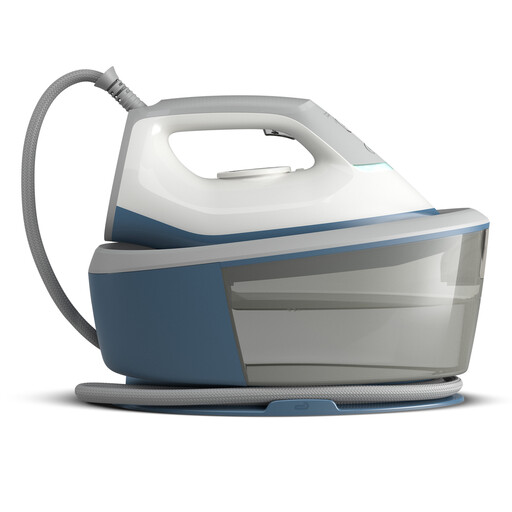 No image available
Philips 2000 Series PSG2000/20
For collar pressing alongside other family garments, check how this model’s temperature and steam controls match their care labels. Its listed power is 2400 W; also confirm the water and scale-care instructions, board placement and supplied UK plug.
View on Joybuy
Common questions
Which specification matters most for pressing shirt collars?
Look at controllable continuous steam, an on-demand boost and whether the soleplate is practical to guide around the collar band and points. A maximum steam figure cannot replace the heat and steam limits on the shirt’s care label.
Is a steam generator worth considering for family shirts?
It is worth considering if you regularly iron several shirts and other garments in one session and want sustained steam. John Lewis & Partners identifies larger family laundry loads as a reason to weigh an iron’s features carefully; for occasional collar touch-ups, consider whether you want to accommodate a separate base.
What board can I use with a steam generator?
Use a steady board and place the generator base only where the chosen model’s instructions permit. Tefal advises a perforated board and cover for its Liberty SV7040 and specifies a flat, stable, heat- and water-resistant surface for the Pro Express Ultimate base; check the instructions for your own model before setting it up.
Can I put distilled or scented water in the tank?
Follow the water instructions for the exact generator rather than assuming either type is suitable. For its Liberty SV7040, Tefal specifies untreated tap water and advises a mixture of untreated tap and distilled water when the water is very hard; that instruction should not be carried over to another model without checking its manual.
What safety checks matter before using one at home?
Check the supplied UK three-pin plug and fuse, and make sure the base has a stable place to sit. Electrical Safety First advises attention to electrical suitability; inspect the plug and cable, and keep the appliance away from children and pets while it is hot or cooling.


