Collar-and-cuff finishers
If collars, cuffs and spaces between buttons are the main task, look closely at the soleplate tip. Morphy Richards specifically describes the tip on its Speed Steam model for reaching collars and button areas.


For regular collar and button-area work, start with a steam generator whose tip is documented for reaching narrow parts of a shirt; continuous steam and tank capacity matter more if collars are part of larger ironing sessions. In a utility room, make sure the separate base fits where you will use and store it, and check its scale-care instructions and the available socket arrangement.
If collars, cuffs and spaces between buttons are the main task, look closely at the soleplate tip. Morphy Richards specifically describes the tip on its Speed Steam model for reaching collars and button areas.
If shirts are part of a larger laundry session, tank capacity, continuous steam and a scale-care routine become more relevant alongside collar access.
If the iron must be lifted out of storage or used near other appliances, allow room for its separate base and check where its cable can safely reach.
Check how the iron reaches collar points first, then weigh its steam and tank features against the space, maintenance and socket arrangements of your utility room.
| Concern | What to check | Who this matters to |
|---|---|---|
| Collars and buttons | Look for a documented precision tip and check the soleplate shape for narrow areas. | I mainly press collar points and around buttons, so reaching those areas matters more to me than a headline steam figure. Around 33% of consumers would put precise access first. |
| Larger ironing loads | Compare continuous steam, tank capacity and how the tank is refilled. | When several shirts and other garments need pressing together, I want fewer interruptions during the session; around 25% of consumers would make larger-load ironing their primary concern. |
| Controls and scale care | Check the exact model’s fabric-setting features and its specified cleaning routine. | Moving between ironable fabrics feels simpler with fewer setting changes, but I also need a scale-care routine I can follow. Around 25% of consumers would prioritise those day-to-day controls and upkeep. |
| Utility-room fit | Measure the base and storage area, check cord reach, and assess the socket or any necessary extension lead. | If I have to lift the generator from a cupboard or work around other appliances, its position and power connection come first; around 17% of consumers would prioritise utility-room fit. |
A steam figure does not tell you whether the tip can reach a collar point or the spaces beside buttons. A generator also needs room for its separate base.
Check the soleplate tip for the shirt work you do, then compare the base dimensions and storage arrangement.
Which? notes that limescale build-up can reduce steam output, so the cleaning routine matters if you expect to use the iron regularly.
Choose a routine you can follow and use only the water and cleaning methods permitted in the exact model’s instructions.
Overloaded leads create a fire risk. London Fire Brigade advises against overloading extensions and recommends a fused inline lead rather than a plug-in cube type.
Use a suitable wall socket where possible. If an extension is necessary, check its rating, avoid daisy-chaining adaptors and fully unwind a drum lead.
A no-temperature-setting feature does not remove the need to check whether the shirt is ironable. Philips describes its OptimalTEMP protection for ironable fabrics on the PSG7300/20.
Follow the garment label and the exact iron’s instructions for fabric care, water and maintenance.
Tefal’s Pro Express Protect GV9230 illustrates a route for people pressing collars as part of longer ironing sessions.
Philips’ PerfectCare PSG7300/20 is relevant if reducing manual adjustments across ironable fabrics matters during a mixed load.
Morphy Richards’ Speed Steam model is relevant to shirt-focused work because the brand identifies its precision tip for collars and spaces between buttons.
These two steam generators address different parts of the shirt-ironing decision: the Tefal listing describes a tip for narrow areas, while the Braun listing highlights movement around buttons and pockets. Check collar access and utility-room fit against the exact model you are considering.
 No image available
For collar points and seams, the listing describes a steam tip intended for narrow shirt areas.
The product name specifies a 2800 W iron with a 1.8 L tank. Check the base dimensions, cord reach and scale-collector cleaning instructions against your utility-room setup.
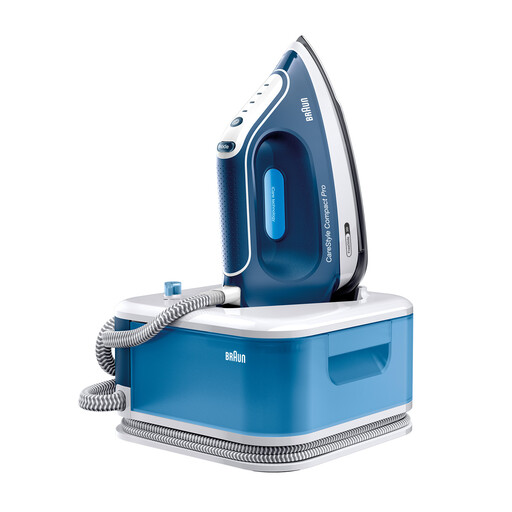 No image available
For work around buttons and pockets, the listing describes a curved FreeGlide 3D soleplate; check its shape before relying on it for collar points.
The product name specifies 7.5-bar pressure and a 1.5 L tank. Check the base dimensions, cord reach and model-specific scale-care instructions before choosing a storage spot.
Look for a soleplate tip documented for reaching narrow areas. Morphy Richards identifies collars and spaces between buttons as uses for the precision tip on its Speed Steam model; also check whether the generator’s base will fit your working area.
It can be if a model’s tip suits your collar work, but the separate base is a practical trade-off for short sessions. Which? describes standard irons as more compact, while steam generators use a separate tank that is particularly relevant when you also press larger loads.
Follow the water and cleaning instructions for your exact model. Which? notes that limescale can reduce steam output, and systems differ: Tefal, for example, lists a removable Scale Collector on the GV9230. Do not add vinegar or fragranced liquids unless the model’s instructions permit them.
If an extension is necessary, check the iron’s instructions and the lead’s rating, and do not overload it. London Fire Brigade recommends a fused inline lead rather than a plug-in cube type and advises fully unwinding drum leads.