Students pressing uniform sleeves regularly
If sleeves need attention before classes, placements or shifts, preparation time and a practical place to set up the iron matter more than capacity for a large household ironing load.


For regular uniform-sleeve pressing in a student house, consider a steam generator with a base that fits your ironing board and storage space, a manageable tank and a scale-care routine you can follow. If you iron only occasionally, weigh the separate base and hose against a conventional steam iron; in halls, check whether personal irons are permitted before choosing either.
If sleeves need attention before classes, placements or shifts, preparation time and a practical place to set up the iron matter more than capacity for a large household ironing load.
A shared ironing board and cupboard make the base footprint, hose and cable storage, cooling space and scale-care routine part of the buying decision.
Check your residence’s appliance rules before ordering. The University of Bath lists irons among items students cannot bring into its halls; the University of Bristol says permitted electrical items may be inspected or tested.
Start with permission and a safe place to iron. Then decide whether frequent sleeve pressing justifies a separate steam-generator base, and compare storage, upkeep and fabric controls for the exact model.
| Concern | What to check | Who this matters to |
|---|---|---|
| Permission and electrical safety | Check your residence rules and the exact appliance’s UK 3-pin plug and fuse. Plan a stable place to use and cool it. | If my residence restricts irons, performance will not settle whether I can use one; roughly 31% of consumers put permission and safe use first. |
| Sleeve preparation | Compare continuous steam, boost and heat-up specifications for the exact model; do not judge sleeve results by pressure alone. | When sleeves need pressing before a shift or placement, I want a routine that fits the time available; around 25% of consumers make preparation their primary concern. |
| Storage and upkeep | Measure the board and cupboard space. Check whether the tank is removable and how the model’s scale-care system works. | Sharing a cupboard leaves little room for a base and hose, while upkeep has to fit around other housemates; roughly 25% of consumers put storage and maintenance first. |
| Fabric controls | Check the model’s temperature and steam controls, their stated fabric scope and each garment’s care label. | If I also iron different eligible garments, I want controls I can use confidently without ignoring care labels; around 19% of consumers prioritise fabric-setting convenience. |
Accommodation rules differ, and a prohibited appliance cannot be used there even if it suits your ironing needs.
Read your current residence rules or ask the accommodation team before ordering. In a shared rental, check the condition of the socket you plan to use and avoid overloaded extensions.
A steam generator needs space for its separate base and hose as well as the iron, both during use and while cooling.
Measure your ironing board and cupboard, then check the exact model’s dimensions and cable or hose storage features.
Auto shut-off or temperature-control features do not replace supervision. Electrical Safety First advises against leaving an iron unattended and says to unplug it after use.
Stay with the iron while it is on, inspect its cable, unplug it afterwards and let it cool away from flammable materials.
Electrical Safety First advises that irons used in the UK have a UK 3-pin plug and fuse.
Check those details for the exact appliance before purchase, and register it after purchase so you can receive recall notices.
These named models illustrate features worth checking; a feature on one model does not apply to every iron from that brand.
Tefal presents the Express Essential SV6116G0 as a compact steam generator for routine ironing.
The PerfectCare 7000 Series PSG7300/20 is a reference point for automatic steam and temperature-control features when ironing eligible fabrics.
The TDS3780GB provides a point of comparison for tank handling and storage features.
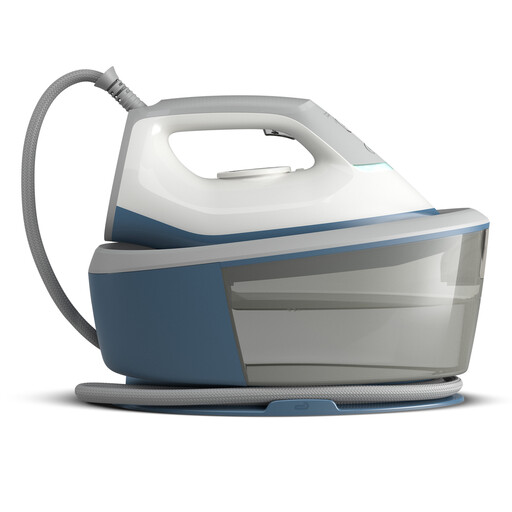
These steam generators are relevant to regular sleeve pressing. Compare their stated configurations with your board space, upkeep preferences and accommodation rules; the Philips 2000 Series shown here is not the PerfectCare 7000 Series model discussed above.
 No image available
Consider this model for regular sleeve pressing if its base fits your ironing board and storage space.
The listed variant is black and purple, rated at 2800W, with a 1.8L water tank. Confirm a UK 3-pin plug and fuse for the exact appliance before buying.
 No image available
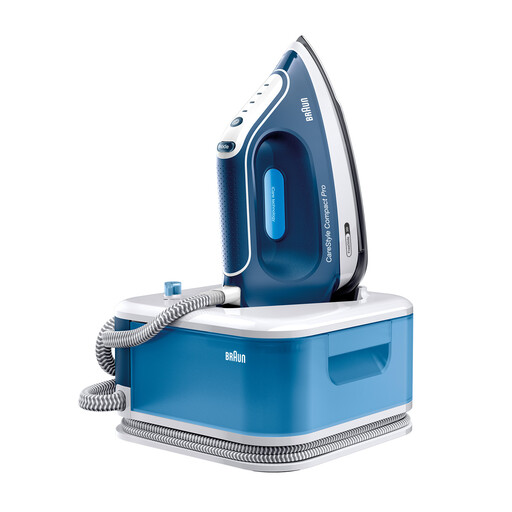
Consider this model for repeated sleeve pressing if its base and temperature controls suit your setup and garments.
The listed rating is 2400W. Check its physical dimensions, UK 3-pin plug and fuse, and the temperature instructions for each fabric before ordering.
 No image available
Consider this model if you press sleeves and other ironable garments, subject to their care labels and the appliance instructions.
The blue IS2565BL variant is listed with 7.5 bar pressure, a 1.5L tank, FreeGlide 3D and iCare technology. Check its dimensions, water and scale-care instructions, and UK 3-pin plug and fuse before buying.
Check your own accommodation rules before buying: permission varies by provider. The University of Bath lists irons among items students cannot bring into its halls, while the University of Bristol says permitted electrical items may be inspected or tested.
Report damaged sockets, scorching or recurring circuit trips rather than using the iron there; Electrical Safety First advises students to report such electrical issues to their landlord. In England, government guidance also requires landlords within the applicable private and social rented-sector rules to arrange inspection and testing of electrical installations by a qualified person at least every five years; student halls are treated separately under that guidance.
Use an iron with a UK 3-pin plug and fuse, remain present while it is on, and unplug it after use, as Electrical Safety First advises. Check the plug and cable for damage, and leave a safe space for the appliance to cool.
Follow the cleaning and water instructions for the exact model rather than assuming all scale-care systems work alike. Tefal describes a built-in anti-scale filter on the SV6116G0, while Bosch lists a Calc’n’Clean collector on its discontinued TDS3780GB.