Frequent uniform pressers with limited storage
If you press sleeves regularly but share a small cupboard or worktop with other things, consider the space needed for the complete iron, base and board—not just the base footprint.


Consider a compact steam generator if you press several uniform items in one session and can store both its base and an ironing board. For a single sleeve or collar, a standard steam iron is easier to store; a handheld steamer is more suited to refreshing a hanging garment than making a crisp, flat press.
If you press sleeves regularly but share a small cupboard or worktop with other things, consider the space needed for the complete iron, base and board—not just the base footprint.
If several garments are pressed together, tank capacity and stated continuous steam may matter more to you than a short steam-boost figure. Check that the setup fits where you iron and store it.
If you usually deal with one sleeve or collar before leaving, a standard iron may avoid storing a separate generator base. For a hanging-garment refresh, consider whether vertical steam gives the finish you need.
Choose when: You press several uniform items together and have room for a separate base and board.
Trade-off: A compact base still leaves an iron, hose and lead to set up and store.
Choose when: You mainly press one sleeve, collar or other small area and storage space is tight.
Trade-off: Which? notes that standard irons are compact to store, while generators use a separate tank to supply more steam.
Choose when: You want to refresh a hanging uniform without setting up a board.
Trade-off: Check whether that finish is sufficient if the sleeve needs a defined, flat press.
| Concern | What to check | Who this matters to |
|---|---|---|
| Sleeve precision | Check the garment care label, how the soleplate moves around cuffs and seams, and continuous steam separately from steam boost. | If I need a neat finish around cuffs and seams, I want to control where heat and steam go. Around 29% of consumers would make controlled sleeve pressing their primary concern. |
| Storage and setup | Measure the storage opening and ironing area; allow for the base, iron, hose, lead and board. | With little cupboard space, I need the whole setup to fit and be manageable to put away. Storage would come first for around 29% of consumers. |
| Routine use | Compare stated heat-up time, tank capacity and whether the tank is removable on the exact model. | When several uniforms need pressing together, I want fewer interruptions to refill. Around 24% of consumers would prioritise that routine convenience. |
| Maintenance and safety | Check the model’s scale-care instructions and UK plug and fuse; plan a safe place for the appliance to cool. | If I will use the iron frequently in a tight space, I want a care routine and electrical setup I can manage safely. That would be the main concern for around 18% of consumers. |
Tefal describes the base footprint of some Express models as smaller than an A4 sheet. That does not account for the iron, hose, lead, cupboard opening or board.
Measure the space where you will iron and store everything, then check the exact model’s full dimensions and storage arrangement.
A boost is a short burst, while repeated sleeve pressing also depends on controllable handling, continuous steam and what the uniform care label permits.
Compare continuous steam and tank format separately from the boost figure, then check the soleplate and heat controls against the garments you press.
Electrical Safety First warns that overloaded or daisy-chained extension devices and wound cable reels can overheat.
Use a suitable wall socket where possible. Do not overload or daisy-chain extension leads, and fully unwind a cable reel before use.
Scale-care procedures vary between steam generators; Philips and Morphy Richards both direct owners to model-specific guidance.
Find the exact model number and follow its manual for water and cleaning instructions.
Its Express Optimal, Express Easy and Express Essential ranges include compact steam-generator models relevant to limited storage.
Its PerfectCare Compact range is relevant if you want to compare compact generators and temperature-setting controls.
Its steam-generator range offers another option to assess against your available ironing and storage space.
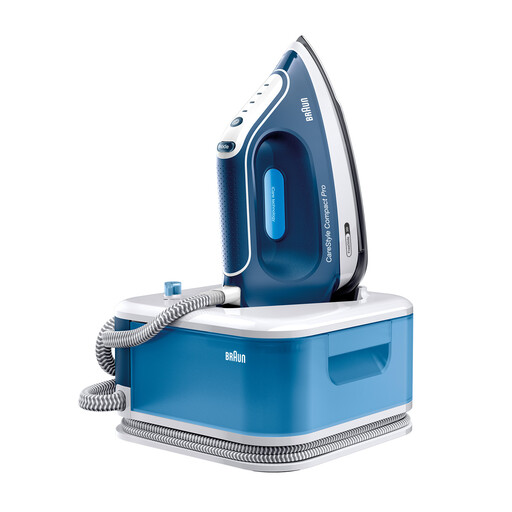
This steam generator is a choice to assess for pressing several uniform items in a session. Check its complete storage arrangement and your garments’ care labels before deciding whether it suits a small flat.
 No image available
Consider this steam generator if you press several uniform items together and have space for its separate base and board.
The product name specifies a 1.5 L tank, 7.5 bar pressure, FreeGlide 3D and iCare Technology. Check the full stored dimensions, model-specific scale-care instructions and UK plug and fuse, and follow each garment’s care label.
Not necessarily: a standard steam iron may be easier to store if you normally press just one sleeve or collar. Which? describes standard irons as compact to store and generators as using a separate tank for more steam; weigh that difference against the space needed for a base and board.
Some generators offer vertical steam: Tefal states that its SV6140G0 and SV6116G0 models have this function for touch-ups. Check the exact model and garment care label, and do not assume a hanging refresh will leave a sleeve as sharply pressed as board-based ironing.
Follow the cleaning and water instructions for your exact model. Philips notes differences between its steam-generator cleaning systems, while Morphy Richards says there is no single descaling method for every appliance.
Check for a standard UK 3-pin plug and fuse, as advised by Electrical Safety First, and inspect the plug and lead before use. Avoid overloaded or daisy-chained extension leads and fully unwind any cable reel.
No: storage fit and a scale-care routine you can follow also matter. Tefal says it aims to provide technical spare parts for almost all its products for 15 years after purchase, subject to its programme terms; check whether the commitment applies to the exact model.