Operators pressing repeat batches
If sleeves are pressed alongside several uniforms or other laundry items, tank refills and routine scale care become part of the choice.


Consider a steam generator when pressing uniform sleeves is part of a recurring laundry batch; for an occasional garment, weigh the base unit and storage it requires against that limited workload. For mixed ironable fabrics, check the scope of a no-setting system, while a cramped utility area makes storage and handling features important alongside steam output.
If sleeves are pressed alongside several uniforms or other laundry items, tank refills and routine scale care become part of the choice.
When ironable garments vary and more than one person uses the appliance, a simpler temperature routine may help. Care labels and heat-sensitive trims still need individual attention.
If the generator must be moved or stored between turnarounds, its base, hose and carry arrangement matter as well as its steam specifications.
For recurring batches, compare continuous steam and refilling first. Then check fabric instructions, scale care and where the cooled appliance will be stored.
| Concern | What to check | Who this matters to |
|---|---|---|
| Repeat batches | Compare continuous steam in g/min, tank capacity and how the exact model is refilled; do not treat a short steam boost as continuous output. | If I press several uniforms in one session, I want fewer refill interruptions while working through the batch. Around 36% of consumers put batch throughput first. |
| Fabric and sleeve finish | Check which ironable fabrics a no-setting claim covers, and whether the soleplate shape or tip lighting suits sleeve seams. | With changing uniform fabrics and awkward sleeve seams, I want a manageable temperature routine without overlooking the care label; around 29% of consumers make fabric handling their primary concern. |
| Scale maintenance | Find the exact model’s cleaning instructions and check whether its scale collector or cleaning process fits the laundry routine. | I need a cleaning routine that someone can carry out consistently when the iron is used repeatedly. For around 21% of consumers, maintenance comes first. |
| Storage and handling | Measure the use and storage space; check the carry arrangement and the property’s applicable electrical-maintenance process. | Between turnarounds, I need somewhere secure for the cooled base, iron and hose. Around 14% of consumers prioritise storage and handling. |
A boost is a brief burst. For repeated sleeves within a laundry batch, continuous steam, refilling and the rest of the workflow deserve separate attention.
Compare continuous g/min and tank capacity on the exact models before using boost figures as a secondary check.
Philips and Tefal describe their cited no-setting systems for ironable fabrics; that scope does not override a care label or settle how to handle a badge or trim.
Sort uniforms by care label and check an unobtrusive area when a finish or construction is uncertain.
A collector or cleaning system is useful only if its model-specific routine can be carried out during regular use.
Read the manual’s cleaning and water instructions before choosing, and decide who will perform the routine.
A carry lock helps with handling; it does not replace equipment inspection and maintenance. The Health and Safety Executive says inspection and testing frequency depends on the equipment and its environment, rather than a universal annual PAT rule.
Store the cooled appliance securely and include it in the property’s applicable electrical-safety arrangements, particularly if it is supplied for others to use.
Its documented UK models span compact steam-station designs and generators with larger removable tanks.
Its cited PerfectCare generators are relevant when temperature handling or a compact format is the deciding feature.
The TDS3780GB illustrates a carry lock, integrated hose and cord storage, and a removable scale collector.
These steam generators offer different starting points for repeat uniform pressing: check the Tefal and Braun models for mixed ironable fabrics, and the Philips model if its stated tank size and temperature controls fit your routine. Confirm storage and care requirements on the exact appliance before buying.
 Image unavailable
Consider this model when repeated sleeves make refilling and visibility around seams important. Tefal UK specifies 130 g/min continuous steam, a removable 1.8 L tank, a tip light and a removable Scale Collector.
Its one-temperature approach is described for ironable fabrics; follow care labels and check badges and trims separately.
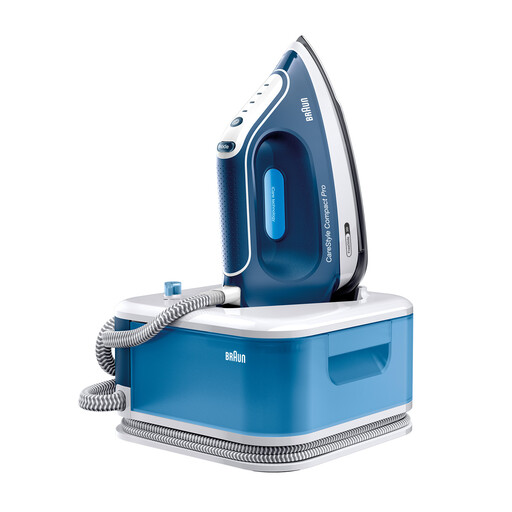 Image unavailable
Consider this model if mixed ironable uniforms and a 1.5 L tank fit your pressing routine. The product name identifies iCare technology, a FreeGlide 3D soleplate and 7.5 bar pressure; check how its different operating modes apply to your garments.
Before choosing it for frequent use or tight storage, check its scale-care instructions and dimensions. Follow care labels rather than assuming one mode suits every fabric or trim.
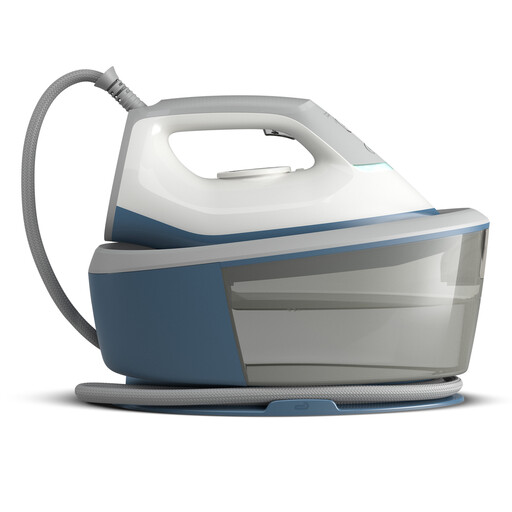 Image unavailable
Consider this model if its temperature-selection routine suits the uniforms being pressed. Its product name states 2400 W; check the tank arrangement and the space needed for the base before planning repeat sessions.
Follow each garment’s care label and the model’s cleaning instructions, particularly if different people will use the iron.
It makes more sense to consider one when those sleeves are part of a recurring laundry batch. For an occasional garment, weigh the base unit’s setup and storage against how little pressing you need to do.
No. Philips and Tefal describe the cited systems for ironable fabrics, so check each care label and treat heat-sensitive badges, trims and uncertain finishes separately.
Choose a model whose cleaning process you can follow as part of the regular laundry routine. Read its manual for the scale-collector or cleaning steps and the water instructions rather than applying another model’s routine.
Do not assume an annual interval applies to every holiday-let iron. The Health and Safety Executive says inspection and testing frequency depends on the equipment and environment, and that visual checks are an essential part of maintenance; apply the arrangements relevant to how the property uses or supplies the appliance.
Include the appliance in the safety arrangements applicable to that accommodation rather than relying on its product features alone. Bath and North East Somerset Council states that electrical equipment supplied with accommodation must be safe; check which property-specific duties and fire-safety guidance apply before making it available to guests.