Shared-house shirt ironers
People who regularly press shirts and need an appliance that can be cooled and put away between residents’ uses. Electrical Safety First advises unplugging irons when they are not in use.


A compact conventional steam iron generally makes more sense for occasional cuff touch-ups in a shared house: Which? describes standard irons as compact and easy to store. Consider a steam generator when several residents iron regularly and there is a safe place for its separate base; its larger tank also means more to store and maintain.
People who regularly press shirts and need an appliance that can be cooled and put away between residents’ uses. Electrical Safety First advises unplugging irons when they are not in use.
People who want a separate-tank iron but need to find room for both the iron and its base in a shared cupboard, bedroom or utility area.
People mainly pressing cuffs or collars rather than a pile of laundry. Which? describes conventional steam irons as compact and easy to store.
Choose it when: Several residents regularly iron shirts or other laundry, and the base has a suitable place to sit and be stored.
Allow for: The separate tank and base take up space and still need cooling, unplugging and maintenance after use.
Choose it when: Cuff pressing is occasional and storage space is more important than handling a larger ironing pile.
Allow for: Its smaller, built-in reservoir may mean more interruptions when several people iron consecutively; Which? identifies the separate tank as a distinction of steam generators.
| Concern | What to check | Who this matters to |
|---|---|---|
| Storage and handling | Measure the complete unit against its intended storage space; check for a carry lock if residents will move it. | I need the iron off shared surfaces after use, but the base must fit somewhere while it cools. Around 42% of consumers might put storage and handling first. |
| Cuff and fabric control | Check access around buttons and seams, and follow the model’s settings and fabric instructions. | If I press buttoned cuffs and shirts made from different fabrics, I need to work around small details without guessing at settings. For around 33% of consumers, cuff and fabric control could be the primary concern. |
| Refilling and upkeep | Check tank access and the exact model’s descaling instructions; agree who maintains a shared appliance. | When several of us iron in succession, I want refilling and upkeep to be manageable rather than interrupting the next person. This could be the leading need for around 25% of consumers. |
Its separate tank and base have to be stored even when the job is only one shirt. Which? describes standard steam irons as the more compact format.
Think about the whole household’s ironing volume before choosing a generator over a conventional iron.
Another resident may not realise that an unattended iron is still hot. Electrical Safety First advises unplugging irons when they are not in use.
Switch off and unplug after use, leave the appliance to cool safely, then follow an agreed storage routine.
GOV.UK guidance on shared or rented accommodation warns against overloaded sockets, while Electrical Safety First advises checking an iron for damage.
Check for a UK 3-pin plug and fuse, avoid overloading the socket, and stop using an appliance with a damaged lead or plug.
Philips describes Smart Calc Clean for PSG6066/26, while Tefal lists a built-in anti-scale filter for SV6140G0. The upkeep depends on the exact model.
Read its maintenance instructions before buying and agree who will carry them out if the iron is shared.
These brands provide models relevant to compact storage or repeated ironing; compare the features of the particular model rather than treating a brand name as a specification.
The PerfectCare 6000 PSG6066/26 is a reference point for a detachable-tank generator intended for repeated ironing.
The Express Easy SV6140G0 offers another compact-generator format to assess for a shared space.
The CareStyle Compact IS 2144 is relevant when vertical storage and work around shirt details matter.
Its steam-generator range provides models to compare if the household’s ironing volume justifies a separate-tank appliance.
These Joybuy steam generators are options to compare if cuff pressing is part of regular household ironing. For occasional touch-ups alone, weigh either one against the smaller storage demands of a conventional iron.
 Image unavailable
Consider this model when several residents iron regularly and a separate base has a suitable storage place.
Listed power: 2800 W; water tank: 1.8 L.
Check the complete unit’s storage fit, UK plug details and model-specific descaling instructions before buying.
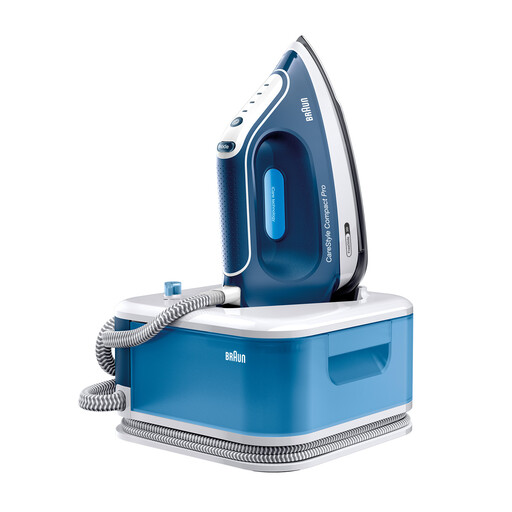 Image unavailable
Consider this model if buttoned cuffs and repeated household ironing make soleplate design and tank access important to your choice.
Listed pressure: 7.5 bar; tank: 1.5 L. The product name identifies FreeGlide 3D and iCare features.
Check stored dimensions, UK plug details, shut-off and carrying features, and the model’s water and descaling instructions.
A conventional compact steam iron is generally the more proportionate choice if cuffs are the main task and storage is tight. Which? describes standard irons as compact and easy to store; a generator becomes more relevant when the household also irons larger amounts of laundry regularly.
Look for a stable place to use and cool the iron, and check for automatic shut-off and a carry lock if the chosen model will be moved. Electrical Safety First advises using an iron with a UK 3-pin plug and fuse; shut-off does not replace switching off and unplugging after use.
Avoid overloading it. GOV.UK fire-safety guidance for shared or rented accommodation advises one plug per socket; check the iron’s plug and lead for damage and use a suitable socket rather than treating an extension lead as a way around an overloaded outlet.
Follow the instructions for the exact model and agree who will carry out its routine upkeep. Philips describes Smart Calc Clean for PSG6066/26, whereas Tefal lists a built-in anti-scale filter for SV6140G0, so one household routine will not fit every generator.