Batch laundry pressers
You press handkerchiefs with shirts, bedding or other cotton laundry, making tank capacity and sustained steam relevant to a longer session.


Choose a steam generator if you regularly press cotton handkerchiefs alongside other laundry and want the larger tank and sustained steam of that format. For just a few handkerchiefs, compare a standard iron first: Polti says traditional irons are smaller and ready in seconds. In a utility room, the space for the base and board, model-specific water care and a safe electrical setup matter as much as listed steam output.
You press handkerchiefs with shirts, bedding or other cotton laundry, making tank capacity and sustained steam relevant to a longer session.
You need room for the generator base, hose and a stable board, as well as somewhere practical to put the appliance after use.
You want clear instructions for the exact model’s water and limescale system, rather than assuming the same routine works across brands.
Decide whether handkerchiefs are usually a small standalone job or part of a laundry batch. If a generator suits the workload, check the utility-room setup before comparing its listed features.
| Concern | What to check | Who this matters to |
|---|---|---|
| Repeated cotton pressing | Compare continuous-steam and boost ratings on the same manufacturer basis; check for a Cotton setting if you prefer fabric presets. | When I press handkerchiefs with a larger laundry load, I want steam and fabric controls suited to the whole session. Around 45% of consumers put sustained cotton pressing first. |
| Space and setup | Measure the space for the base, hose and board, and check whether storage features suit your routine. | If I usually press only one or two handkerchiefs, I do not want the setup to outweigh the job. For around 33% of consumers, a manageable small-load routine comes first. |
| Water care and safe use | Read the exact model’s water and scale instructions; check the board, plug, cable and socket before use. | I need a care routine I can follow and a stable place to use the appliance. Those upkeep and safety needs take priority for around 22% of consumers. |
Tefal lists a removable Scale Collector for the SV7120G0; Philips lists automatic steam for the PSG7300/20; and Polti lists a Cotton setting for the XT100C. These are features of those specific models, not independent evidence that a higher steam rating will give a better result on one handkerchief.
A generator needs a steady place for its base. Tefal advises using a robust, perforated board with a cover that lets steam pass through.
Check the board’s suitability and measure both its working position and the space available for storage before choosing a generator.
An unsuitable board or cover may need replacing before you can use the appliance as intended.
Water and limescale-care directions differ between generators. Tefal’s advice for its models should not be applied automatically to a Philips, Polti or Braun appliance.
Follow the water and descaling instructions in the manual for the exact model you buy.
A separate base and larger tank are easier to justify during regular batch ironing than when the job is only one or two handkerchiefs. Polti says a traditional iron is smaller and ready in seconds.
Compare a standard iron if small loads are your usual task; consider a generator when it will also serve longer laundry sessions.
Electrical Safety First advises checking the plug and cable and unplugging irons when they are not in use. The Health and Safety Executive advises checking that electrical equipment suits its supply and is not damaged.
Check the appliance and socket before use, keep the appliance away from water exposure and stop using it if its plug, cable or casing is damaged. Consult the model instructions if the intended position raises any uncertainty.
Worth considering if a removable scale collector and carrying features matter in your utility-room routine.
Relevant if automatic steam control appeals when handkerchiefs are part of mixed laundry.
Relevant if you prefer an explicit Cotton setting and also iron a broader range of laundry.
These steam generators are options to consider when cotton handkerchiefs are part of a regular ironing batch. Compare their stated variants with your board, storage space and the exact model’s care instructions; this list does not replace the small-load case for a standard iron.
 Image unavailable
Consider this steam generator if handkerchiefs are part of a regular laundry batch and a 1.8 L tank suits your routine.
Listed power: 2800 W. Check that the base and a suitable board fit your utility room, and follow the SV8154G0 water instructions.
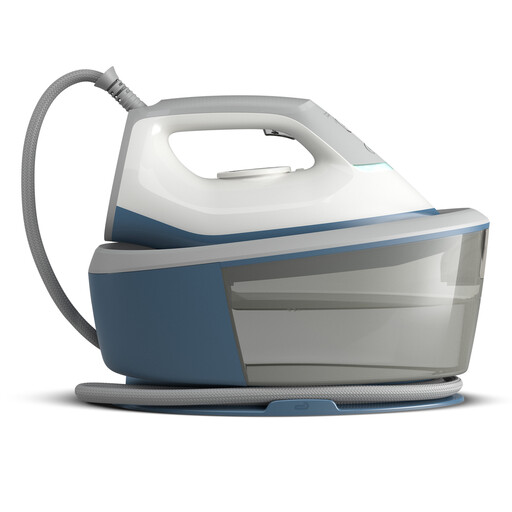 Image unavailable
This steam generator is an option for pressing handkerchiefs alongside other laundry rather than setting up for just one or two items.
Listed power: 2400 W. Check its dimensions against your storage space and follow the PSG2000/20 board and water instructions.
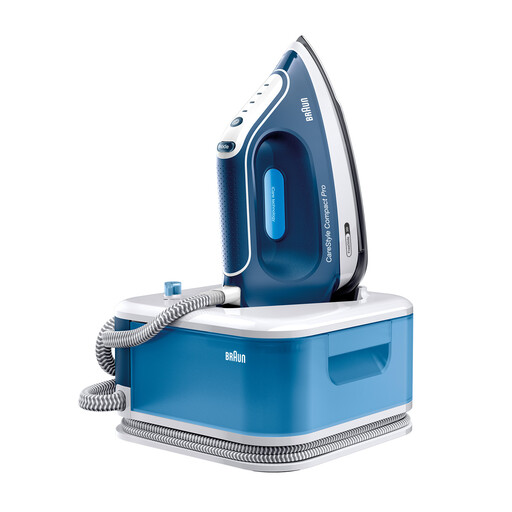 Image unavailable
Consider this generator if you also iron larger laundry batches and want to assess a model with stated iCare temperature technology.
Listed pressure: 7.5 bar; tank: 1.5 L. Check its footprint, suitable board and exact water instructions before choosing it for the utility room.
Not necessarily: a standard iron may be easier to accommodate for a small, occasional load. Polti says traditional irons are smaller and ready in seconds; a generator becomes more relevant when the handkerchiefs are part of regular batch ironing.
Use a stable, robust board suited to supporting the appliance and letting steam pass through. Tefal advises a perforated board and steam-permeable cover; check the instructions for your exact generator and the board you intend to use.
Follow the water instructions for your exact model rather than applying one brand’s rule to another. Tefal says its SV7120G0 and SV8053 guidance allows untreated tap water and advises a 50:50 mixture of untreated tap water and distilled water where water is very hard.
No. Tefal’s instructions say never to use vertical steam on an item someone is wearing. Press the handkerchief on a stable, suitable board instead.
Check that the appliance has a suitable UK plug and that its plug, cable, casing and intended socket are in sound condition. Electrical Safety First advises unplugging irons when not in use; if the utility-room position or electrical installation raises uncertainty, follow the appliance instructions and seek qualified electrical advice.