For repeated shirt or linen loads in a holiday let, a steam generator is worth considering if a collar-friendly tip or visibility aid, a suitable tank and manageable scale care justify its separate base. If you only touch up a collar or two occasionally, a conventional iron may be easier to store. Treat manufacturers’ pressure and steam figures as specifications, not proof of better collar results.
Who needs which features?
Hosts focused on collar detail
If you regularly press collar points, plackets and areas around buttons, tip shape and visibility may matter more to you than maximum tank capacity. Morphy Richards describes a precision tip for collars and between buttons; Tefal describes a tip light on its Express Vision model.
Hosts handling frequent laundry loads
If several shirts or other ironable linens need pressing in one session, consider a removable tank and the space needed for the generator base. Compare tank capacity with your usual workload rather than choosing on a steam-boost figure alone.
Users switching between ironable fabrics
If different people press shirts with different care requirements, an automatic-steam or single-setting system may reduce manual adjustments. Check each garment’s care label and the exact model’s instructions before ironing.
What matters when buying?
Decide whether collar control, repeated loads, simpler fabric settings or routine maintenance is your main priority; then check whether a generator’s separate base fits the ironing and storage space.
| Concern |
What to check |
Who this matters to |
| Collar detail |
Look at the soleplate tip and, if lighting is a problem, any tip-visibility aid. Follow the shirt’s care label. |
If collar points and buttons are the fiddly part of each shirt, I want to position the iron accurately; around 40% of consumers put collar detail first. |
| Repeated loads |
Compare removable-tank capacity and check whether the base fits your board and storage space. |
When several shirts or linens need pressing together, I would rather avoid frequent refill breaks; for around 30% of consumers, that is the primary concern. |
| Fabric settings |
Check the model’s automatic-steam or single-setting instructions and which fabrics it permits you to iron. |
With different ironable shirts in the laundry, I want fewer setting changes without ignoring care labels; around 20% of consumers prioritise that simplicity. |
| Scale care |
Check how the exact model is descaled and what its instructions say about water and cleaning. |
If regular use makes scale care a recurring job, I need a routine I can keep up with; maintenance is the first priority for around 10% of consumers. |
Buying pitfalls
-
Choosing by the largest steam figure alone
Manufacturer-rated pressure and boost figures do not establish how easily an iron reaches collar points or how it performs over time. Which? assesses factors including crease removal, ease of use, durability and limescale resistance in its testing.
Check tip shape or crease visibility for collar work, then assess tank format and independent test results where available.
-
Leaving scale care until steam output drops
Which? notes that limescale can reduce steam output and soleplate residue can make ironing harder.
Follow the exact model’s cleaning and water instructions, and choose a descaling routine you can maintain during regular use.
-
Assuming the same appliance-testing rule applies everywhere
The Health and Safety Executive does not prescribe annual portable appliance testing as a blanket requirement. Scottish Borders Council sets out a short-term-let licence condition for a competent person to produce a testing report on moveable appliances guests can access.
Establish whether guests can access the iron, then check the requirements for the property’s nation and local licensing authority. Inspect and maintain the appliance in line with its use and environment.
-
Forgetting the generator base
A separate tank and base take more room than a conventional iron. Which? describes standard steam irons as more compact and easier to store.
Measure the ironing surface and storage space. If the job is only an occasional collar touch-up, consider whether a conventional iron meets it without the extra footprint.
Brands to consider
Tefal
The Express Vision SV8154G0 is relevant when visibility at the collar edge, a removable tank and scale collection are priorities.
- Tefal UK specifies an LED tip light, a 1.8L removable tank and a removable Scale Collector for this model.
- Its separate base still needs ironing and storage space; the stated steam figures do not establish collar performance against other models.
Philips
The PerfectCare 7000 Series PSG7300/20 is relevant to users who want fewer manual adjustments when moving between ironable fabrics.
- Philips UK specifies motion-sensor automatic steam and OptimalTEMP for the PSG7300/20.
- Check the exact variant and fabric instructions; those features do not establish a collar-specific precision tip.
Morphy Richards
The Speed Steam 333202 is relevant when reaching collar points and between buttons matters alongside repeated ironing loads.
- Morphy Richards UK specifies a precision tip and a 1.7L removable tank for its Speed Steam model.
- The manufacturer lists a 4.82kg appliance weight; consider the separate base and available storage space.
Joybuy steam generator options
These steam generators are relevant to holiday-let shirt pressing when you expect more than occasional collar touch-ups. Compare the Tefal’s stated collar-facing features with the Braun’s tank and named soleplate features, and check each model’s instructions before settling on one.
 No image available
Tefal Express Vision SV8154G0, 1.8L, Black & Purple
Consider this model if seeing the collar edge and managing repeated pressing sessions are priorities.
Tefal UK specifies a 2800W rating, LED tip light, 1.8L removable tank and removable Scale Collector for the SV8154G0.
Allow space for the separate base and follow the model’s water and descaling instructions.
Joybuy
 No image available
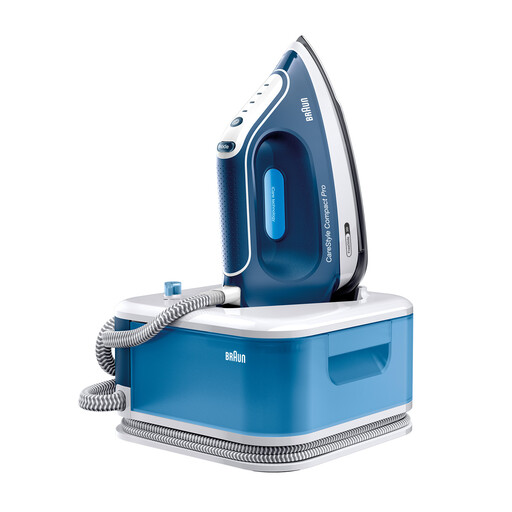
Braun Carestyle Compact Pro IS2565BL, 1.5L, Blue
Consider this model for repeated shirt sessions if its soleplate shape works for the collars you press.
The product name identifies a 1.5L tank, 7.5-bar pressure rating, FreeGlide 3D soleplate and iCare technology; the pressure rating alone does not establish collar control.
Check the tip shape at collar points and confirm the model’s water and descaling instructions before regular use.
Joybuy
Frequently asked questions
Is a steam generator worth it for just a few shirt collars?
A conventional iron may make more sense for occasional touch-ups if storage is tight. Which? describes standard steam irons as more compact and easier to store; a generator’s separate tank becomes more relevant when collars are part of repeated shirt or linen loads.
Does higher steam pressure make collar points easier to press?
Pressure alone does not establish easier control at a collar point. A tip designed to reach narrow areas is more directly relevant: Morphy Richards identifies collars and spaces between buttons as uses for its Speed Steam precision tip. Check the actual soleplate shape as well as the manufacturer’s steam ratings.
How should I manage scale during regular ironing?
Follow the water and descaling instructions for the exact iron you buy. Which? notes that limescale can lower steam output and soleplate residue can make ironing harder, so include both in routine care rather than assuming a scale feature eliminates maintenance.
Does a guest-accessible iron need annual PAT testing?
The Health and Safety Executive does not set a blanket annual testing interval for portable appliances; the appropriate inspection and testing approach depends on use and environment. Scottish Borders Council sets out a short-term-let licence condition requiring a competent person’s testing report for moveable appliances guests can access. Check the rules and licence conditions where the property is located, as well as whether guests can access the iron.


