Occasional placemat pressers
If you press a small set of placemats before meals or guests, a conventional steam iron gives you a starting point without finding storage space for a separate generator base.


For a few linen placemats at a time, start with a conventional steam iron; consider a steam generator if housemates regularly press larger batches and have room for its separate base. For shared use, compare steam controls and maintenance instructions, and check automatic shut-off and the supplied plug rather than choosing on wattage alone.
If you press a small set of placemats before meals or guests, a conventional steam iron gives you a starting point without finding storage space for a separate generator base.
If several people use the iron for clothes as well as table linen, compare steam settings, tank size, automatic shut-off and how easily the appliance can be put away between uses.
If water care is likely to be shared between housemates, compare the exact model’s scale-management arrangement and instructions so everyone can follow the same routine.
For linen placemats in a shared house, start with the size of a typical ironing session, then weigh crease control against the practicalities of sharing and maintaining one appliance.
| Concern | What to check | Who this matters to |
|---|---|---|
| Visible linen creases | Compare the exact model’s continuous-steam and boost ratings, steam controls and soleplate; follow the placemats’ care labels. | If I want flat linen placemats to look neatly pressed, controllable steam and an on-demand burst matter more to me than wattage alone. Around 45% of consumers would put crease removal first. |
| Sharing and storage | Check automatic shut-off, the supplied plug, cord length and whether the iron and any separate base fit the available storage space. | When several housemates use the same iron, I want it to be straightforward to put away and safe to disconnect after use. For around 33% of consumers, shared-use practicality would be the primary concern. |
| Water and limescale care | Identify the model’s filter, collector or self-clean arrangement, and read its instructions before choosing water or cleaning products. | I would rather have a water-care routine everyone in the house can follow than guess how to fill and clean the iron. Manageable maintenance would come first for around 22% of consumers. |
John Lewis & Partners describes steam generators as an option for larger ironing loads, but a separate base takes storage space that may be hard to justify for a few placemats.
Think about the largest batch your household actually presses regularly. Start with a conventional iron for small jobs; consider a generator when repeated larger loads justify storing it.
Wattage does not tell you how the steam controls or soleplate will work for your placemats. Manufacturer steam ratings also do not establish the result you will get on every fabric.
Compare continuous steam, the on-demand burst, soleplate and controls on the exact model, then use the settings permitted by the fabric care label.
Housemates may fill and clean a shared iron differently, while acceptable water and scale-care methods vary by model.
Keep the exact model’s instructions accessible and agree who will empty and clean the iron. Follow its specified water and cleaning methods.
Automatic shut-off is a secondary safeguard; it does not address a damaged plug or cable or make careless storage safe.
Unplug the iron after use, check its plug and cable when it is disconnected, and do not use it if either is damaged.
The Ultimate Pure range is relevant if you want to compare steam output and scale management in a conventional iron.
The Azur 8000 DST8020/26R1 is a conventional-iron reference for comparing automatic temperature control with steam settings.
The Powersteam Ultra Pro 28630 is relevant to households comparing steam, tank capacity and upkeep features in one conventional iron.
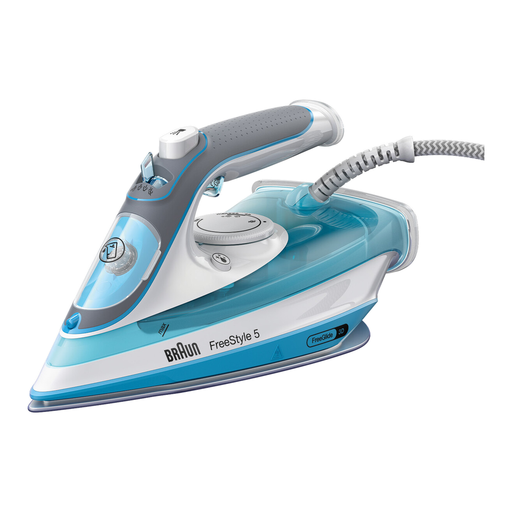
For a few placemats at a time, compare the conventional Braun iron. The Tefal steam generator is an alternative to consider when housemates regularly press larger batches and can store its separate base.
 No image available
Consider this generator if the household regularly presses larger batches and has space for a separate base.
The product title specifies 2800 W and a 1.8 L water tank. Before buying for shared use, check the supplied plug and the exact model’s water and cleaning instructions.
 No image available
This conventional iron is a starting point for pressing a few placemats without storing a separate generator base.
The product title specifies 2600 W, a FreeGlide 3D SuperCeramic soleplate and an anti-drip feature. If automatic shut-off matters to your household, confirm it for this exact model; also check the supplied plug and water instructions.
For a few placemats at a time, a conventional steam iron is the more proportionate starting point. Consider a generator if housemates regularly press larger batches and have room for its separate base.
Compare continuous-steam and steam-boost ratings, then look at the controls and soleplate on the exact model. Tefal, Philips and Russell Hobbs publish model-specific steam figures, but those ratings are not independent results for your placemats; use the fabric care label when setting the iron.
Use the water specified for the exact model rather than assuming distilled, softened or scented water is suitable. John Lewis & Partners notes that some irons can be damaged by those water types, so keep the chosen iron’s instructions available to everyone who fills it.
Check that the supplied connection is suitable for UK mains use, and inspect the plug and cable for damage while the iron is unplugged. Electrical Safety First lists a 13 A fuse for irons, but the appliance’s own instructions should guide any fuse replacement; do not use a damaged iron.
For products placed on the market in Great Britain, GOV.UK guidance recognises CE marking alongside or instead of UKCA marking where the applicable product rules permit it. Check the product’s stated market and marking information rather than treating either mark alone as a product-specific approval; Northern Ireland follows different processes.