Who is this for?

Occasional linen-towel pressers

You press a few tea towels at a time and want an iron that will not take up much shared storage. Ulster Linen advises pressing linen while it is still damp; Which? describes standard steam irons as compact and easy to store.

Housemates planning safe storage and handover

You need a place to let the iron cool and a routine for unplugging it and checking its condition before another person uses it. Automatic shut-off is worth checking on the exact model, but it does not replace those steps.

Frequent laundry-batch users

You regularly press other household laundry as well as tea towels. A generator’s separate tank may be useful for longer sessions, provided the ironing area and cupboard can accommodate its base.

What matters when choosing?

Concern What to check Who this matters to
Linen creases Look for controllable steam and a clean, smooth soleplate. Check the towel’s care label before choosing a heat setting. If I want a pressed finish on tea towels, I need to be able to work on slightly damp linen without guessing the right heat. Around 36% of consumers put crease removal first.
Shared use and storage Check the exact model for automatic shut-off and allow space for it to cool before storage; inspect the plug and cable before use. When several housemates use one iron, I want it to be straightforward to put away safely and check before my turn. Safe, compact sharing comes first for around 29% of consumers.
Scale maintenance Check the model’s calc-clean or scale-collector procedure and whether housemates can follow it regularly. If mineral build-up is a concern, I need a cleaning routine that everyone sharing the iron will actually follow. Keeping steam performance reliable is the main concern for around 21% of consumers.
Larger loads Compare tank capacity and continuous steam figures, then check the space needed for a generator base and ironing board. When tea towels are part of a longer laundry session, I would rather avoid frequent refill interruptions, even if the appliance takes more room. Around 14% of consumers prioritise larger loads.

Mistakes to avoid

  • Relying on high steam for completely dry linen

    Steam output cannot replace preparing the fabric. Ulster Linen advises ironing linen while it is still damp.

    Press tea towels before they dry fully, or lightly dampen them first, and follow their care labels for heat and steam.

  • Assuming anti-scale means no cleaning

    A calc-clean function or removable collector still needs the cleaning steps specified for that model.

    Choose a system housemates will use, and keep its instructions accessible near the ironing area.

  • Continuing to use a damaged shared iron

    A damaged plug, cable or casing is a reason to stop using the appliance, even if it still heats. The Health and Safety Executive advises checking plugs and cables for damage.

    Unplug the iron and stop using it if damage is visible; have a damaged cable dealt with by a competent person rather than attempting a makeshift repair.

  • Choosing a generator without planning where it will go

    A generator’s separate base and larger tank are more relevant to extended ironing sessions than to a few tea towels.

    Check the intended cupboard and ironing-board space before choosing one. For small batches and limited storage, consider a standard steam iron instead.

Relevant brands to consider

Philips

Philips has standard steam irons at different stated steam outputs, including the 5000 Series DST5030/26 and Azur 8000 DST8020/26R1.

  • Philips lists integrated calc-clean and 45 g/min continuous steam for the DST5030/26.
  • The cited DST8020/26R1 offer is identified as refurbished; check the condition of the particular model and offer rather than assuming it is new.

Tefal

Tefal’s named models include the standard FV5872 steam iron and the SV6116 and SV6140 steam generators.

  • Tefal lists a removable scale collector and automatic shut-off for the FV5872.
  • The SV6116 and SV6140 have separate generator bases, so their storage requirements differ from those of a standard iron.

Russell Hobbs

The PowerSteam Ultra 20630 is a standard steam iron for buyers considering a larger tank and variable steam without a generator base.

  • Russell Hobbs lists a 350 ml tank, 70 g continuous steam and a self-cleaning system for this model.
  • Its stated 210 g burst is a model specification, not a guarantee of how a particular linen tea towel will press.

Rowenta

The Steam Force DW9230 is a standard iron with model-specific anti-scale and anti-drip features.

  • Rowenta lists 50 g/min continuous steam and a 220 g steam boost for the DW9230.
  • Rowenta’s repairability programme is a brand service claim; check its terms for the product and location before relying on it.

Joybuy steam generator option

This steam generator suits consideration when tea towels are part of larger shared-house ironing loads. Check that its separate base will fit your ironing area and storage space; a standard iron remains the more compact route for occasional batches.
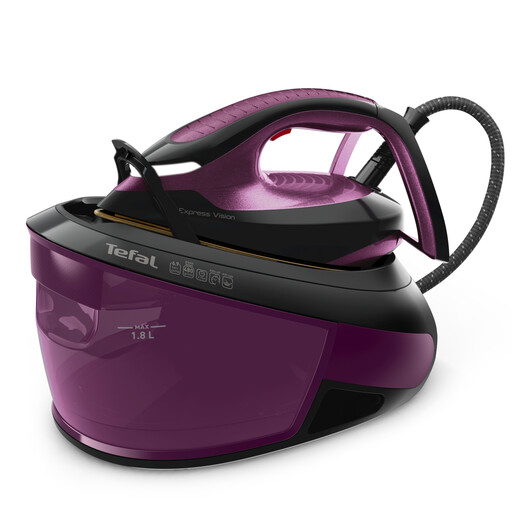
Tefal Express Vision SV8154G0 steam generator iron in black and purple

Tefal Express Vision SV8154G0 Steam Generator, 2800 W, 1.8 L, Black & Purple

Consider this generator if the household regularly irons larger loads and has room for a separate base.

The product title specifies 2800 W and a 1.8 L water tank. Check each tea towel’s care label before pressing, particularly for blends, prints or decorative finishes.

Joybuy

Common questions

What setting should I use for linen tea towels?

Use a setting permitted by the towel’s care label, particularly if it is a blend or has a print or decorative finish. Ulster Linen advises pressing linen while it is slightly damp; test an inconspicuous corner before using a high setting.

Do I need a steam generator just for tea towels?

Usually not for occasional batches: a standard steam iron takes up less storage space. Which? describes generators as using a separate water tank for more steam; consider one when the household also irons larger loads regularly and can accommodate its base.

How should housemates look after a shared iron?

Unplug it after use, let it cool and follow its manual for water and scale cleaning. Before using it again, check the plug, cable and casing; the Health and Safety Executive advises that damaged cables should be dealt with by a competent person, not patched with insulating tape.

Does every shared-house iron need a PAT-testing label?

Do not assume that an inspection requirement for a rented property’s electrical installation sets the testing rule for every portable iron. For England, Ministry of Housing, Communities and Local Government guidance says landlords must have rented-property electrical installations checked at least every five years by a qualified person. Ask the landlord or property manager which equipment-testing requirements apply to your arrangement.

Can a handheld steamer replace an iron for linen tea towels?

Choose an iron if you want a flat, pressed finish. Philips distinguishes garment steamers from irons and says they do not give the same result on linen; a handheld steamer is more suited to a quick refresh than pressing a tea towel flat.