Frequent-changeover host
If tea towels join a larger load between guest stays, a steam generator’s separate tank is worth considering for fewer refill breaks. John Lewis & Partners suggests generator irons for larger amounts of laundry.


Choose a conventional steam iron if you press modest batches of linen tea towels and want an appliance that is simpler to store. A steam-generator iron makes more sense when tea towels are part of larger, repeated changeover loads and fewer refill breaks matter more than space for the separate base. Compare continuous steam and tank capacity for the workload, then check scale maintenance and the linen’s care instructions.
If tea towels join a larger load between guest stays, a steam generator’s separate tank is worth considering for fewer refill breaks. John Lewis & Partners suggests generator irons for larger amounts of laundry.
If creases and scale-related marks are your main concerns, compare sustained steam and the exact model’s scale-management instructions. Tefal lists a MicroScale filter and rated steam figures for its Ultimate Pure FV9845; those features do not guarantee a particular finish on every linen fabric.
If you press only a few tea towels at a time, a conventional steam iron avoids storing a separate generator base. Check that its tank and cable suit the place where you iron.
Choose when: Tea-towel batches are modest and storing a separate base would be inconvenient.
Trade-off: Its built-in tank can mean more refill breaks during larger changeover loads.
Choose when: Tea towels are pressed alongside larger, repeated laundry loads and fewer refills matter.
Trade-off: The separate base needs storage space; check its dimensions before buying.
| Concern | What to check | Who this matters to |
|---|---|---|
| Changeover workload | Compare tank capacity and continuous steam in g/min; allow space for a generator base if choosing one. | If tea towels join a larger load between stays, I want to keep refill breaks manageable. Around 42% of consumers put batch throughput first. |
| Linen finish and scale | Check continuous steam separately from boost steam, plus the model’s scale-cleaning and water instructions. | When presenting linen matters most to me, I want to deal with creases without overlooking scale maintenance. Around 33% of consumers prioritise finish and scale control. |
| Storage and small batches | Check the space needed to store the appliance and whether its tank suits a short pressing session. | If I press only a few tea towels, I would rather put away one iron than find room for a base unit. Around 25% of consumers put compact storage first. |
A conventional iron may suit a small batch, but refilling becomes a more important consideration when tea towels are pressed with other laundry. Tefal specifies a 1.8 L tank for the Pro Express Protect GV9230 generator, compared with smaller tanks on the cited conventional models.
Work out the largest load you normally press between stays, then weigh refill breaks against the space needed for a generator base.
More frequent refilling also interrupts the time set aside for the changeover.
Boost and continuous steam describe different modes. A high boost rating does not mean the iron sustains that output through an entire batch.
Compare continuous g/min for repeated pressing, then consider boost g/min for occasional stubborn creases.
The Health and Safety Executive says there is no universal legal requirement to test portable electrical appliances annually. Equipment still needs to be maintained in a safe condition, with checks appropriate to its use and environment.
Arrange proportionate visual checks and maintenance, remove a damaged iron from use, and confirm the requirements that apply to the property’s location and type.
Its cited range includes a conventional steam iron and a separate-base generator for different laundry volumes.
The Powersteam Ultra 20630 is a conventional-iron option for buyers who do not want a separate generator base.
Its steam-generator range is relevant when larger loads make a separate tank appealing.
These choices include steam generators to consider for larger changeover loads and a conventional iron for smaller pressing sessions. Match the appliance format to your workload before comparing individual features.
 No image available
Consider this generator when tea towels are part of a larger changeover load and you have room to store its base.
The product name specifies 2800 W and a 1.8 L water tank. Check the SV8154G0 instructions for water use and scale-collector cleaning.
 No image available
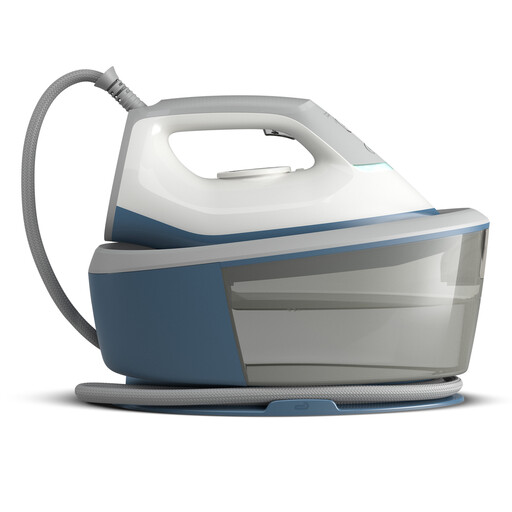
This separate-base format is worth considering for repeated pressing if it fits your storage space.
The product name specifies 2400 W. Check the PSG2000/20 base dimensions and its water and descaling instructions before choosing it.
 No image available
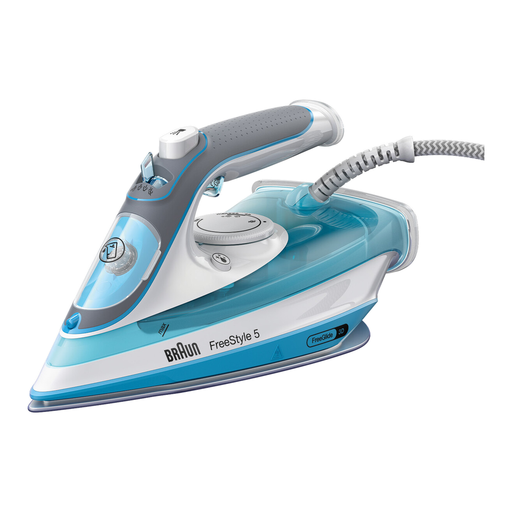
For smaller tea-towel batches, this conventional format avoids storing a separate generator base.
The product name specifies 2600 W, an anti-drip feature and a FreeGlide 3D SuperCeramic soleplate. Check the SI5008BL continuous-steam rating and water instructions if you expect to press linen repeatedly.
A generator is worth considering when tea towels join larger, repeated changeover loads and fewer refills matter; a conventional steam iron can suit modest batches and tighter storage. John Lewis & Partners associates generator irons with larger amounts of laundry, but the choice still depends on your actual batch size.
Compare continuous steam in g/min for sustained pressing, then look at boost steam for occasional difficult creases. The two ratings describe different modes, so a boost figure is not a substitute for continuous output.
There is no universal legal annual PAT-testing requirement, according to the Health and Safety Executive. Electrical equipment must still be kept safe, with visual checks, maintenance and any inspection or testing suited to the appliance and its working environment.
The Home Office guidance for small paying-guest accommodation in England is relevant to self-catering premises within its stated scope. Check whether the property’s layout, guest accommodation and fire risks fit that guide; premises outside its scope need the appropriate wider guidance, and requirements elsewhere in the UK should be checked separately.
No: follow the water instructions for the exact iron or generator. John Lewis & Partners warns that some irons can be damaged by, or spit when used with, pure distilled, scented or softened water, even though many are designed for tap water.