
24/7 Customer Support

Free returns

Same-day & Next-day Delivery

Quality Guaranteed

Unlock Your Welcome Offers: FREE Delivery | Up to 80% OFF | Free 30-day JoyPlus trial
Download the APP
Choosing among the best steam irons is less about finding the highest wattage and more about matching steam performance, tank size and handling to your household routine. A compact steam iron may suit a small flat, while a steam generator iron can save time when several loads of laundry need attention.
Before comparing Tefal, Philips and Braun steam irons, it is worth looking beyond promotional claims. The right product should offer useful steam output, practical maintenance features and safety controls that fit the way you actually iron.
Wattage mainly indicates how quickly the iron heats and how consistently it maintains temperature. It does not, on its own, show how effectively the iron removes creases. For that, check the continuous steam output, steam boost and, for a steam generator, pump pressure.
A 2,000W steam iron with 25g/min continuous steam may be perfectly suitable for shirts and light cotton, but a high-pressure steam iron with 6–7.5 bar pressure is more appropriate for denim, linen, bedding and large laundry loads.
A large steam boost can help with stubborn creases, but it is only delivered in short bursts. Continuous steam output is often more relevant for everyday ironing because it determines how much steam is available as you move across a garment.
Also check whether the iron has a comfortable trigger, a precision tip and a soleplate that glides around buttons and seams. Power without convenient control can make ironing more tiring rather than faster.
UK tap water varies considerably in hardness. Limescale can reduce steam performance and may eventually cause particles or water marks on garments. Look for a self-cleaning steam iron, anti-scale system or removable scale collector, and follow the manufacturer’s instructions about tap, filtered or demineralised water.
An anti-drip steam iron is also useful, particularly when working at lower temperatures. It helps reduce the chance of water droplets marking clothes, although the tank should still be emptied and the appliance stored correctly after use.
For everyday shirts, school uniforms and light cotton, around 20–30g/min continuous steam is a practical starting point. A steam boost of approximately 90–140g can help with thicker areas and isolated creases.
For frequent family ironing, consider a steam generator iron. Models with around 6–7.5 bar pressure and continuous output above 100g/min can deliver more steam into dense fabrics. This can reduce the number of passes needed, but the base unit takes up more storage space than a standard iron.
Standard steam irons commonly hold around 240–300ml. This keeps the iron relatively compact, but frequent users may need to refill during a full laundry session.
Steam generators use a separate tank, often between 1.4 and 1.8 litres. This is more convenient for several loads, curtains or bedding. Consider the unit’s dimensions and weight as well as capacity: a large tank is useful only if you have a stable place to store it.
A ceramic soleplate iron generally offers smooth movement and is easy to wipe clean. Curved or rounded designs can help the iron glide backwards over pockets, seams and fastenings.
Temperature control is equally important. Traditional variable settings give you direct control according to garment labels. One-temperature systems can simplify mixed loads, but always check that the model is suitable for the fabrics you plan to iron.
Look for auto shut-off, a stable heel rest, anti-drip protection and a clear ready indicator. These features do not replace careful use, but they are practical safeguards in busy UK homes.
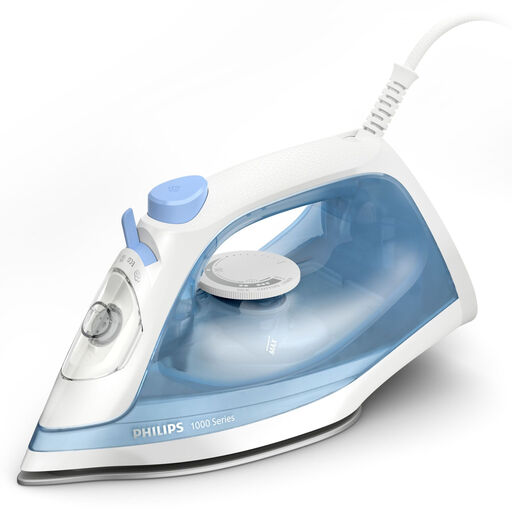
Why This Fits Their Persona: A lightweight 0.88kg option for students, first homes and smaller weekly ironing loads.
It provides clear, realistic figures: up to 20g/min continuous steam, a 90g boost and a calc-clean function rather than relying on wattage alone.
250ml tank, eco mode, non-stick soleplate and variable steam settings.
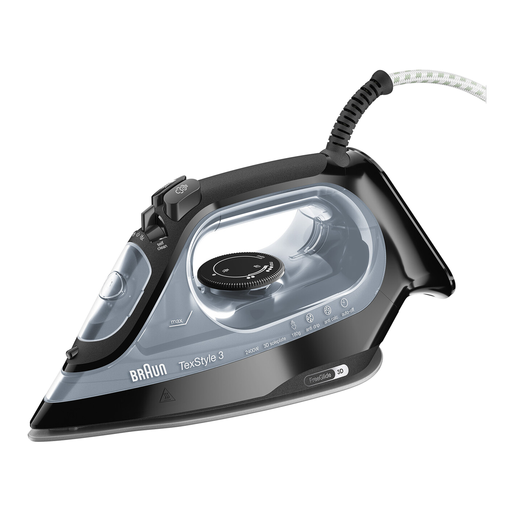
Why This Fits Their Persona: Suits regular users who want strong steam, detailed control and a soleplate designed for awkward garment features.
Its specification lists both outputs separately: up to 50g/min in Turbo mode and a 225g/min steam boost, making comparison clearer.
300ml tank, FreeGlide 3D EloxalPlus soleplate, anti-drip and automatic shut-off.
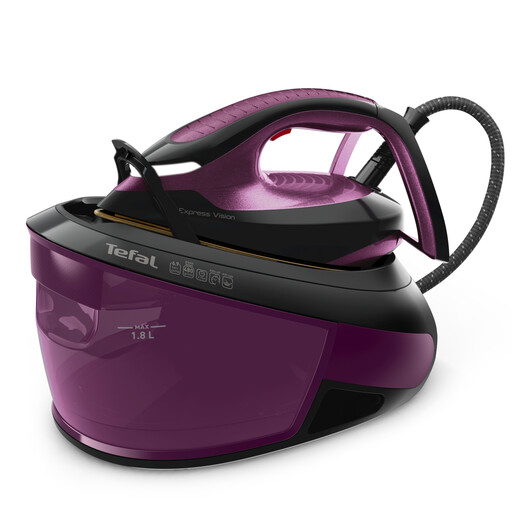
Why This Fits Their Persona: A practical match for families and households ironing large quantities, thick fabrics or hanging garments.
The 6.9-bar pressure, 130g/min continuous steam and 480g boost show how it is configured for demanding loads, not just quick touch-ups.
1.8L removable tank, vertical steaming, anti-drip system, auto shut-off and removable scale collector.
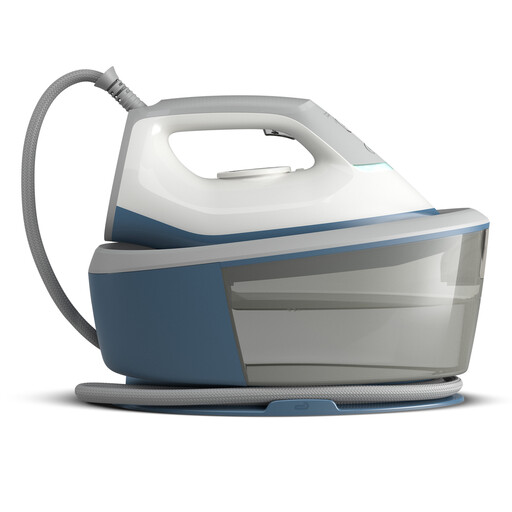
Why This Fits Their Persona: Suitable for professionals and families seeking a compact station with a larger tank than a conventional steam iron.
Its 6-bar pressure and 110g/min continuous steam are stated alongside the 300g boost, so everyday output is not confused with peak performance.
1.4L transparent tank, two-minute heat-up, ceramic soleplate and Smart Calc-Clean alerts.
We have compiled a complete, real-time list of products that fully satisfy these strict selection criteria and UK safety regulations.
They can be worthwhile for households ironing several loads each week, or for people regularly dealing with denim, linen, bedding and curtains. Their larger tanks and higher steam output reduce interruptions, but they need more storage space. For occasional ironing, a standard steam iron may provide sufficient performance at a lower purchase cost.
Around 20–30g/min continuous steam is generally suitable for shirts, trousers, uniforms and light cotton. A higher output can make repeated ironing more efficient, while a steam boost is useful for isolated stubborn creases. Compare both figures rather than relying on the boost number alone.
Use the recommended water type, empty the tank after use and run the calc-clean or self-cleaning function at the intervals stated in the manual. Eco modes may reduce energy consumption during operation, but the actual cost also depends on session length, electricity tariffs and how often the appliance is used. Always unplug the iron after use and allow it to cool before storage.