Routine school-uniform pressers
Parents or carers pressing a few pairs of trousers who want to reach seams and creases without finding storage space for a separate generator unit.


For one or a few pairs of school trousers at a time, a conventional steam iron is the more compact choice for routine pressing. Consider a steam generator when you regularly iron several uniforms alongside a larger family load: its separate tank suits longer sessions, but the appliance needs more storage and setup space.
Parents or carers pressing a few pairs of trousers who want to reach seams and creases without finding storage space for a separate generator unit.
Households pressing several uniforms alongside other laundry in one session, where a separate water tank may be worth the extra space it occupies.
Consumers who want a scale-cleaning method they can use regularly. Which? notes that limescale build-up can reduce an iron’s steam output.
Choose it when: You usually press one or a few pairs of trousers and want an iron that is easier to put away.
Trade-off: Its integrated tank may mean more refilling during a long family ironing session.
Choose it when: Several uniforms and other garments regularly make up one substantial ironing load.
Trade-off: The separate tank and base take more room to set up and store, particularly for a quick trouser touch-up.
| Concern | What to check | Who this matters to |
|---|---|---|
| Defined trouser creases | Compare stated continuous steam, steam boost and the shape of the tip for working around seams. | If a presentable trouser crease is my main aim, I want control around seams as well as steam for stubborn folds; around 40% of consumers put crease pressing first. |
| Fabric settings | Check the garment care label and the iron’s stated fabric controls or automatic-temperature scope. | When I press trousers alongside shirts or knitwear, I want to avoid choosing the wrong setting; roughly 30% of consumers prioritise fabric control. |
| Scale maintenance | Look for a collector, calc-release or self-clean system, then check the model’s water and cleaning instructions. | If regular descaling feels difficult to keep up with, I want a clear maintenance routine; around 20% of consumers place upkeep first. |
| Larger laundry loads | Compare tank capacity and storage dimensions, distinguishing continuous steam from a short steam boost. | With several uniforms and a wider laundry pile to press together, I want fewer refill interruptions; roughly 10% of consumers make longer sessions their primary concern. |
Wattage does not by itself tell you how an iron handles a trouser crease or how easy it is to maintain. Which? assesses ironing ability, ease of use and limescale resistance separately.
Compare steam figures, tip design and the scale-cleaning method alongside wattage; consult independent results for the exact model when available.
A separate base and tank need more space than a conventional iron, which can make setup less convenient for a single pair of trousers.
Consider how often you press a full load, and check the generator’s dimensions against the space where you would use and store it.
Which? notes that limescale can reduce steam output and that unsuitable cleaning or fragranced products can damage an iron.
Follow the exact model’s water and descaling instructions. Use only water unless its manual expressly permits something else.
Electrical Safety First warns that overloading an extension device, daisy-chaining leads or using a cable reel while wound can cause overheating.
Check the marked rating against the combined load of connected appliances, do not daisy-chain extension leads and fully unwind a cable reel before use.
A reference point for conventional steam irons with crease-access and scale-cleaning features.
Relevant when comparing conventional irons for a mixed load of ironable garments.
Offers examples of both a conventional iron for routine work and a steam generator for larger loads.
These steam generators are options to consider when school trousers are part of a larger family ironing session. For occasional single-pair pressing, compare their setup and storage needs with a conventional steam iron before choosing.
 Image unavailable
Consider this generator if you regularly press several garments together and have room for its separate base.
The SV8154G0 listing identifies a 2800 W model with a 1.8 L water tank.
Check the trousers’ care label and the model’s water and scale-maintenance instructions before use.
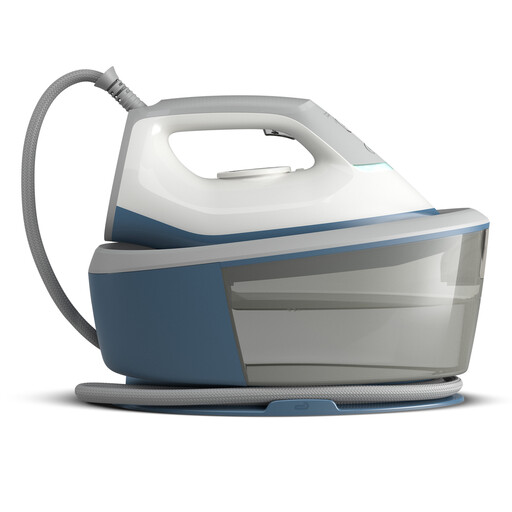 Image unavailable
This is another generator to assess for sessions involving several uniforms and other laundry, rather than a quick single-pair touch-up.
The PSG2000/20 listing identifies a 2400 W model.
Check its dimensions for storage, and use the garment care label and model instructions when selecting a temperature.
Not usually for one or a few pairs at a time: a conventional steam iron is the more compact option. A generator becomes more relevant if you regularly press several uniforms with a larger laundry load and can accommodate its separate base and tank.
Use water unless the exact model’s manual permits something else. Which? warns that unsuitable cleaning and fragranced products can contribute to leaks or internal damage, so follow the model’s filling and descaling instructions.
Check the lead’s marked maximum rating and the combined load before doing so. Electrical Safety First advises against overloading or daisy-chaining extension leads and says cable reels should be fully unwound.
Confirm the exact model, seller information and product documentation for your delivery location. GOV.UK’s product-marking guidance distinguishes requirements by product sector and between Great Britain and Northern Ireland; a marking alone does not tell you whether an iron suits your trousers or ironing routine.