
24/7 Customer Support

Free returns

Same-day & Next-day Delivery

Quality Guaranteed

Unlock Your Welcome Offers: FREE Delivery | Up to 80% OFF | Free 30-day JoyPlus trial
Download the APP
Choosing STEM educational toys can be harder than it appears. Product listings often use phrases such as “advanced”, “realistic” and “professional” without explaining what a child will actually build, operate or learn. For parents, relatives and educators, the important question is not how impressive the packaging looks, but whether the toy offers suitable hands-on activity, clear guidance and safe, manageable components.
This guide highlights common buying pitfalls, key specifications to check and suitable options for different types of young learner, including science kits for children, engineering toys for kids and mechanical building kits.
A detailed model may look attractive on a shelf but provide little practical interaction once assembled. Before buying, check whether the child will connect parts, troubleshoot a mechanism or observe a scientific principle. A motorised model, working circuit or moving engine generally creates more opportunities for active learning than a static display piece.
A toy marked for children aged 8 and up may still contain many small parts, multi-stage instructions or components that require patience and close supervision. The stated age is a starting point, not a guarantee that every child can complete the project independently. Check the number of parts, instruction format and whether tools, batteries or additional materials are needed.
Some STEM toys require batteries that are not included, while others contain dozens or hundreds of pieces that need organised storage. A kit can become frustrating if the child cannot find a connector or if replacement batteries are inconvenient. Consider the available workspace, storage pouch or box and the cost of commonly required batteries before ordering.
For first-time builders, look for step-by-step instructions, labelled components and visual support. A 3D guidance app can help a child understand how parts fit together, but check whether a compatible smartphone or tablet is required. Mechanical kits with numerous precision parts may suit older children or shared parent-child projects more than a short afternoon activity.
If the child is interested in cars, a build your own engine kit can introduce pistons, crankshafts and mechanical linkage. For a learner drawn to electronics, an electrical circuit experiment kit should include clearly identified wires, switches, a power source and a safe, low-voltage design.
Check the listed material and how securely parts are held together. Smooth-edged ABS magnetic building blocks can support repeated construction, while engine kits need parts that fit accurately enough for movement without excessive force. “More pieces” is not automatically more useful if the child cannot identify or organise them.
For UK households, read the product warnings carefully. Small components can present a choking hazard, and children should use relevant kits under adult supervision where instructed. Look for clear manufacturer details, age guidance and applicable conformity information supplied with the product.
Battery requirements affect both setup and running costs. Confirm the battery type, quantity and whether batteries are included. Also check the assembled size: a working model may need a stable table, clear surrounding space and a safe place to store it between sessions.
The practical learning value should match the child’s interests. A circuit kit demonstrates electrical connections, a mechanical model shows motion and transmission, while magnetic tiles introduce geometry, balance and structural design.
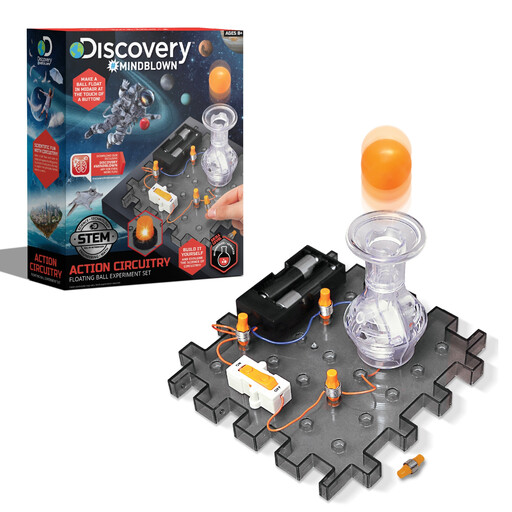
Why This Fits Their Persona: A focused introduction to circuits for children aged 8 and above, with components for a visible floating-ball experiment and guided assembly.
It provides an operable project rather than a display-only model, while the detailed guide helps reduce uncertainty during setup. Two AA batteries are required and are not included.
Includes a breadboard, switches, wires and battery compartment; demonstrates how electrical connections operate a mechanical component.
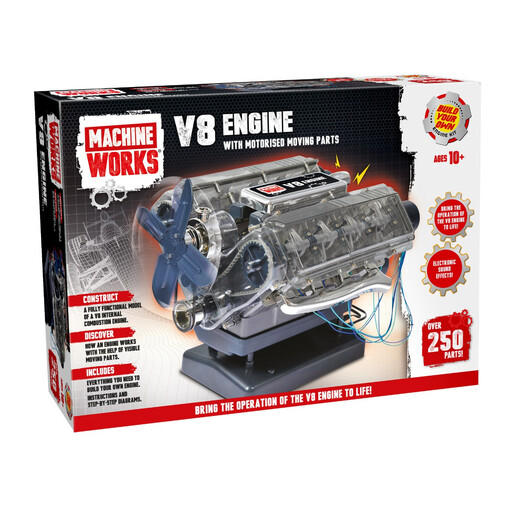
Why This Fits Their Persona: Suitable for older children aged 10 and above and families wanting a substantial engineering project with a displayable result.
The learning activity is built into the assembly: more than 250 parts, a transparent case and visible piston, crankshaft and valve movement provide specific features to assess.
Motorised 1:4 scale model with transparent housing, sound module and LED spark-plug illumination; three AA batteries are required and not included.

Why This Fits Their Persona: A suitable match for children aged 8 and above who are motivated by automotive design, steering mechanisms and motorised movement.
It combines model construction with a motor, steerable wheels and guided 3D instructions, so the finished build has an intended use beyond appearance.
Motor-powered replica with steerable wheels and a 3D app; no batteries are required according to the product details.
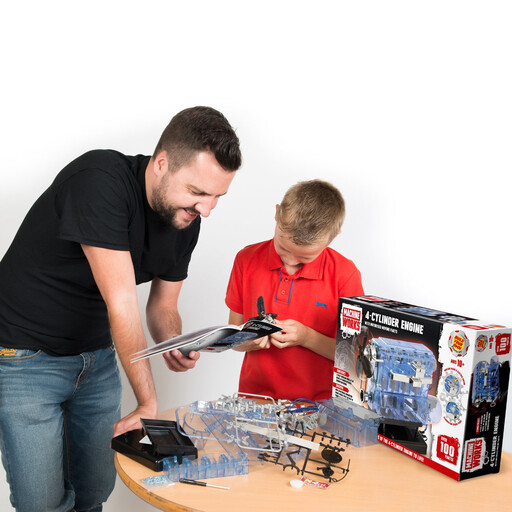
Why This Fits Their Persona: Designed for children from age 10 who enjoy mechanical systems, detailed construction and observing how engine parts transfer motion.
The working movement is central to the project, helping the builder connect assembly steps with pistons and mechanical linkage rather than simply decorating a model.
Includes precision-made components and a guide; no batteries are required according to the listing.
We have compiled a complete, real-time list of products that fully satisfy these strict selection criteria and UK safety regulations.
Many are, but suitability depends on the specific design. Check the manufacturer’s age guidance, small-parts warning and required level of adult supervision. A circuit kit may involve fewer mechanical parts but still requires careful battery handling, while an engine kit may be suitable for an older child because of its assembly complexity.
Some do and some do not. The Discovery circuit set requires two AA 1.5V alkaline batteries, and the Machine Works V8 engine requires three AA batteries; both are listed as not included. The Lamborghini model and 4-cylinder engine listing state that batteries are not required. Always confirm the product page before purchase.
Create a dedicated, level workspace and keep small components in a labelled container or supplied storage pouch. Avoid forcing parts together, follow the instructions in sequence and remove batteries from products that will not be used for an extended period. Adult supervision can also help prevent lost pieces, incorrect connections and damage during assembly.