
24/7 Customer Support

Free returns

Same-day & Next-day Delivery

Quality Guaranteed

Unlock Your Welcome Offers: FREE Delivery | Up to 80% OFF | Free 30-day JoyPlus trial
Download the APP
Choosing STEM science kits for kids can be more difficult than it first appears. Product images often show impressive crystals, bubbling mixtures or elaborate builds, but the finished result does not always reflect the actual play experience. Some kits contain limited consumables, while others require household items, batteries or extensive adult help before children can begin.
For parents, grandparents, gift-givers and educators, the useful question is not simply “Does it look exciting?” It is whether the kit is suitable for the child’s age, practical to use at home and capable of supporting repeated learning.
A sizeable package may contain a small number of experiments or a high proportion of moulds, packaging and reusable tools. Check the product description for the number of activities, included materials and whether consumables need replacing. A crystal growing kit, for example, may provide the materials for several formations but still require patience between stages.
Many children’s experiment kits include small components, powders, liquids, glass-style equipment or tools. The recommended age is not a suggestion to ignore. Always read the supplied instructions and warnings, and check whether the kit requires direct adult supervision.
For UK households, look for clear manufacturer details, age guidance and applicable toy safety information. A CE or UKCA marking may be relevant depending on the product and its supply arrangements, but it should not replace reading the specific warnings. Keep kits away from younger siblings, protect work surfaces and wash hands after activities where the instructions advise it.
A child who enjoys building may lose interest in a children’s experiment kit that mainly involves waiting. Conversely, a child who likes observing nature may find a construction set less engaging. Consider whether they prefer mixing and making, digging and discovering, building mechanisms or observing living and non-living materials.
Age bands help match the activity to a child’s motor skills, reading ability and attention span. STEM toys for ages 3 to 14 cover very different types of play:
An age rating does not mean a child must work independently. Younger children may need help measuring, opening packets and following steps, while older children still require supervision for chemistry-based activities.
Check whether the set contains the practical essentials, such as beakers, pipettes, goggles, tools, slides, plaster or growing materials. Also check what you must provide, such as water, food colouring, batteries, paper towels or a working table.
For a kids chemistry set, examine the supplied substances and storage instructions. A kit with multiple tools and clearly explained activities may offer more useful play than one relying mainly on visual effects.
Some activities work well on a kitchen table, while excavation and slime projects can create dust or residue. A waterproof mat, apron and easy-to-clean surface can make the experience more manageable. Consider whether the set is a one-session gift or supports repeat play.
Battery requirements are another practical detail. Some science kits are battery-free, while microscopes and electronic greenhouses may need AA or AAA batteries that are not included. Check this before wrapping a gift or preparing a classroom activity.
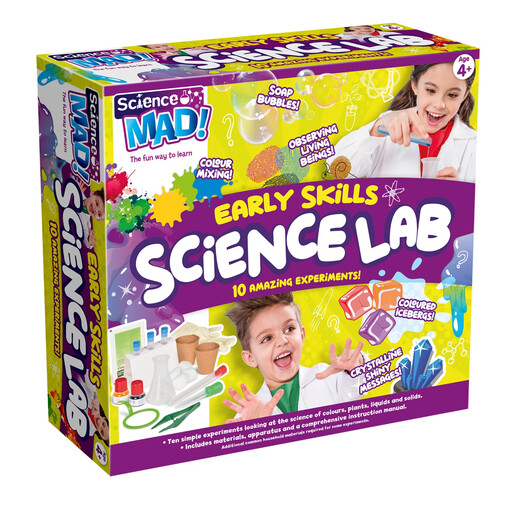
Why This Fits Their Persona: A practical starting point for children aged 4 and over who are new to hands-on experiments, including activities suitable for a kitchen table with adult guidance.
The set states that it includes 10 activities and a 28-page illustrated manual, making the scope clearer than a kit focused on a single visual result.
Includes test tubes, a flask, a pipette, seeds and food colouring; no batteries are required.
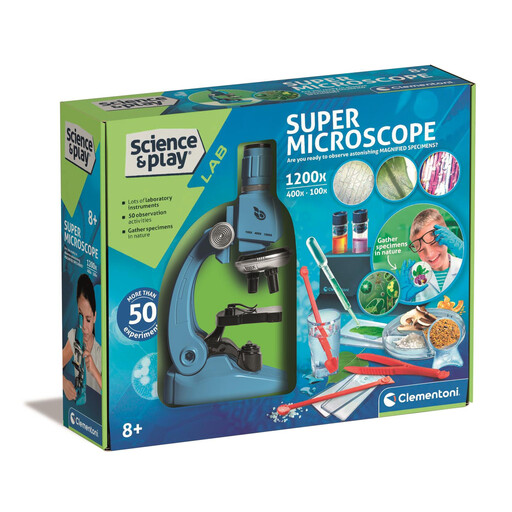
Why This Fits Their Persona: Suits an older child who wants a more detailed observation activity and may return to biology-based projects over time.
It provides a stated programme of 50 experiments and exercises, rather than presenting magnification alone as the whole activity.
Offers magnification up to 1200x and requires two AA batteries, which are not included.
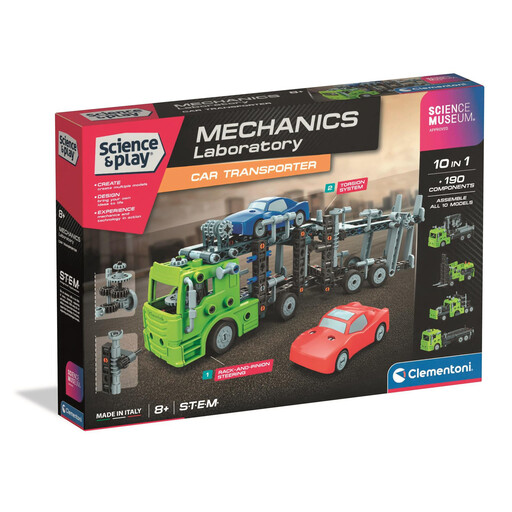
Why This Fits Their Persona: A good match for children aged 8 to 12 who prefer construction, moving parts and repeatable design challenges over consumable experiments.
The activity is not dependent on a single finished effect: the truck and cars can be assembled and examined through their mechanical systems.
Contains over 200 interchangeable components, with steering, sprockets, rods and fold-down ramps.
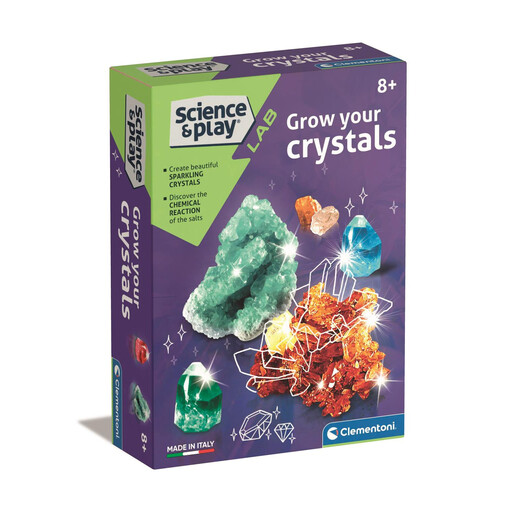
Why This Fits Their Persona: Suitable for children aged 8 to 14 who enjoy geology, chemistry and watching a process develop over time.
The illustrated manual explains crystal formation, while plaster moulds and blotting paper provide more than one shape to create.
Includes beakers and materials for translucent, coloured crystal formations; no batteries are required.
We have compiled a complete, real-time list of products that fully satisfy these strict selection criteria and UK safety regulations.
A traditional experiment kit is not the only route into scientific play. An archaeology excavation kit can suit children who enjoy discovery and history, while an engineering construction kit supports planning and spatial reasoning. A slime science kit offers tactile experimentation but needs careful supervision and protected surfaces.
Magnetic building sets, marble runs and take-apart dinosaur kits can also introduce balance, structure, movement and cause-and-effect for younger children. For a classroom or shared play area, choose products with enough pieces for turn-taking and confirm that small parts can be stored securely.
Many are designed for home use, but the required space and supervision vary. Set up activities on a stable, washable surface, read the instructions first and keep small parts, powders and batteries away from younger children.
It depends on the format. Crystal, slime and chemistry activities may use consumable materials and provide a limited number of sessions. Microscopes, excavation tools and construction sets can usually be reused, provided they are cleaned, dried and stored correctly.
Some do and some do not. Battery-free options include several crystal, early science and mechanical construction kits. Electronic greenhouses and certain microscopes may require AA or AAA batteries, so check the product details before purchase.