Neighbour-conscious open-plan listener
You want to enjoy albums at a comfortable level while paying attention to where bass travels and how the speakers interact with the room.


If you usually sit down to play an album, start with a stereo pair only if you have space to position both speakers around that seat. A one-box wireless speaker makes more sense when you listen in different parts of the flat; whichever format you choose, check its source connections, placement options and setup requirements before buying.
You want to enjoy albums at a comfortable level while paying attention to where bass travels and how the speakers interact with the room.
You play records regularly and need to match the turntable’s output to a suitable speaker input. Ruark Audio, for example, distinguishes between phono and line-level connections for its MR1 Mk3.
You mainly stream music but may also connect a TV or analogue source, making the available inputs, initial setup and any required adapters important.
Decide first whether you have a regular listening seat and room for two speaker positions. Then match the system to your music, TV and turntable connections rather than choosing by power claims alone.
| Concern | What to check | Who this matters to |
|---|---|---|
| Bass and disturbance | Check where the speaker can sit and whether it offers useful sound adjustments. Plan to listen at moderate levels. | If bass carries through my open-plan flat, I want to enjoy an album without disturbing other rooms; around 36% of consumers put managing bass and disturbance first. |
| Stereo placement | Check that a left and right speaker can both face your main seat without awkward furniture or corner placement. | For a full album, I would rather listen from one settled seat with two speakers positioned around it; roughly 36% of consumers make that stereo arrangement their primary concern. |
| Source compatibility | List the sources you will connect, then check their required inputs and any setup or adapter requirements. | I need streaming, records or TV audio to connect without discovering an input mismatch later; about 28% of consumers prioritise source compatibility and convenience. |
Ruark Audio says a turntable with a built-in phono stage should connect to the MR1 Mk3’s line input instead of its phono input.
Check the deck’s output setting and the speaker’s input before choosing the connection.
A stereo pair needs two workable positions around your listening seat. Genelec recommends aiming both speakers towards that position as a starting point for stereo placement.
Work out where the speakers and seat can go, then assess whether you need placement flexibility or sound adjustment.
Sonos specifies additional hardware for an analogue source connected to an Era 300.
Check the complete connection path before buying; Sonos does not intend this line-in connection for TV audio.
Era 300 line-in requires a Sonos Line-In Adapter and a 3.5 mm auxiliary cable, both sold separately.
In England, GOV.UK explains that councils investigate complaints about noise that may be a statutory nuisance. Playing music indoors does not, by itself, settle whether it disturbs someone else.
Begin at a moderate level and take recurring neighbour concerns seriously; check the applicable local guidance for your area.
The LSX II LT is a compact powered stereo pair for listeners who want a separate left and right speaker alongside digital source connections.
The M20 is a powered stereo system to consider when a fixed album-listening position can accommodate two speakers.
The MR1 Mk3 is a compact stereo option for listeners who regularly use a compatible turntable.
The Era 300 is a one-box Wi-Fi option for listeners who favour flexible room listening over positioning a separated stereo pair.
These choices include a powered pair for a regular listening seat, a passive pair that needs a compatible amplifier, and tabletop speakers for a one-box arrangement. Check the connection and placement requirements of each rather than treating them as interchangeable setups.
 No image available
Consider this pair if you can place two speakers around your usual album-listening seat.
The product name specifies 66 W RMS, Bluetooth 5.3, USB-C and AUX inputs, a 3-inch mid-bass driver and a 1-inch tweeter. Check that those inputs suit your sources and that both speaker positions work in your room.
 No image available
This passive stereo pair is relevant if you want a fixed listening position and already have, or plan to obtain, a compatible amplifier.
The product name specifies a 6.5-inch mid-bass driver, 28 mm tweeter and rear bass-reflex design. Check amplifier compatibility, source connections and the available space behind the speakers before buying.
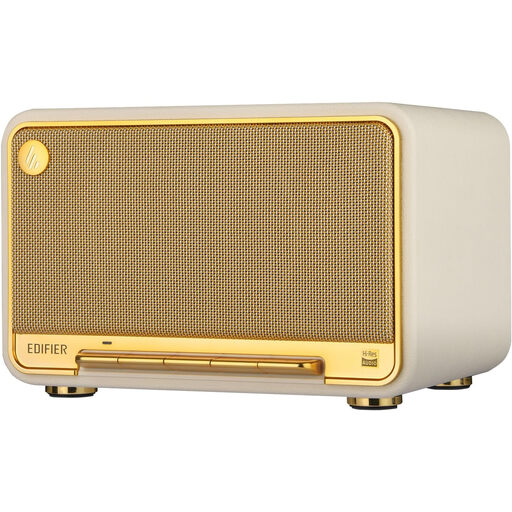 No image available
Consider this one-box format if you listen from different places rather than arranging two separate speakers around one seat.
The product name specifies a 2.1 acoustic layout, 60 W RMS, Bluetooth 5.3, AirPlay 2, USB-C and AUX inputs. Check its connection and sound-adjustment options against your intended sources and room.
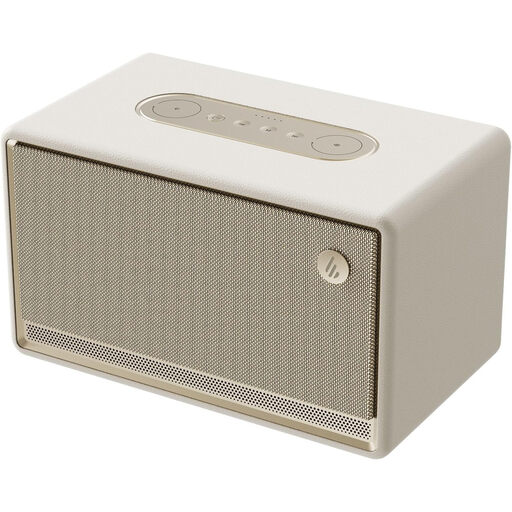 No image available
This tabletop format suits consideration when a single speaker position is more practical than two separate positions.
The product name specifies Bluetooth 5.3 and a stated 12-hour playtime. If a particular wired source, separated stereo layout or room adjustment is important, check those requirements before buying.
Start with both speakers aimed at your main listening seat. Genelec recommends a 60-degree angle between left and right speakers as a stereo-placement starting point; adapt the arrangement to the furniture and positions available in your flat.
Yes, if the turntable’s output matches an available speaker input. Ruark Audio says the MR1 Mk3’s phono input is for a compatible moving-magnet turntable, while a deck with a built-in phono stage should connect to its line input.
Not for the initial setup. Sonos states that Era 300 must first be set up on a Wi-Fi network before it can be used as a Bluetooth speaker.
There is no single fixed-time answer for every flat and UK jurisdiction. For England, GOV.UK explains that councils investigate complaints that could amount to a statutory nuisance, including noise that unreasonably and substantially interferes with the use or enjoyment of a home; check the guidance that applies where you live.
Use an appropriate local electrical-recycling route. GOV.UK identifies the Waste Electrical and Electronic Equipment Regulations 2013, as amended, as the legislation underpinning the UK framework for electrical and electronic equipment waste.